



الصفحة 18
الصفحة 18

Multidetector-Row CT of the Thorax
With the advent of multidetector-row technology, excitement has returned to computed tomography. Not only can we now image faster and with better resolution than ever before; more importantly, the development of sophisticated image acquisition techniques has enabled us to venture into areas previously considered to be beyond the scope of CT imaging. The knowledge, experience, and vision of a host of renowned international experts in cutting-edge thoracic applications of multidetector-row CT are condensed within this book. The result is a critical, comprehensive review of the novel opportunities, but also the new challenges, brought about by the development of ever-faster CT acquisition techniques.

Multidetector-Row Computed Tomography : Scanning and Contrast Protocols
Multidetector-row computed tomography (MDCT) has advanced the approach to diagnostic assessment of many pathologies and now plays an integral role in imaging of both abdominal and cardiovascular diseases. The possibility to acquire diagnostic images with shorter scan duration, longer scan ranges, and/or thinner sections, MDCT has facilitated the opening of new horizons, such as interventional MDCT and functional imaging in stroke and oncology. In addition, advanced postprocessing techniques now permit high quality volumetric imaging in combination with maximum intensity projections, volume rendering, curved planar reformations and multiplanar reconstructions. This volume gathers contributions by internationally renowned specialists in the field who, through presenting their clinical experience, provide a thorough overview not only of MDCT and its practical applications, but also of workflow management in everyday clinical practice. Focussing on scanning and contrast protocols, the current advantages and disadvantages of non-enhanced vs. enhanced MDCT are discussed, along with insights into likely future developments. The volume represents an up-to-date source of technical and practically-oriented clinical information which should prove of great benefit to all who wish to improve or consolidate their knowledge and expertise in MDCT.

Multicomponent reactions towards heterocycles : Concepts and applications
Heterocycles are a central component in natural product chemistry, pharmaceuticals, agrochemicals, and material science. New synthetic methodologies integrating the sequencing of multicomponent reactions (MCRs) are today being used for the rapid synthesis of diversified heterocycles in just one step. Multicomponent Reactions towards Heterocycles presents an up-to-date summary MCR chemistry with a focus on the conjugation between modern synthetic methodologies and MCRs.

Multichain Immune Recognition Receptor Signaling : From Spatiotemporal Organization to Human Disease
The central idea of this book is to show that the structural similarity of the MIRRs determines the general principles underlying MIRR-mediated transmembrane signaling mechanisms and also provides the basis for existing and fixture therapeutic strategies targeting MIRRs. The reviews assembled in this book detail the prog-ress in defining and controlling the spatiotemporal organization of key events in immune cell activation. An improved understanding of MIRR-mediated signaling has numerous potential practical applications, fi-om the rational design of drugs and vaccines to the engineering of cells for biotechnological purposes.

Multi-Carrier Spread Spectrum 2007 ; Proceedings from the 6th International Workshop on Multi-Carrier Spread Spectrum, May 2007,Herrsching, Germany
This combination known as multi-carrier spread spectrum (MC-SS) benefits from the advantages of both systems and offers high flexibility, high spectral efficiency, simple detection strategies, narrow-band interference rejection capabilities, etc. The basic principle of this combination is straightforward: The spreading is performed as direct sequence spread spectrum (DS-SS) but instead of transmitting the chips over a single carrier, several sub-carriers are employed. The MC modulation and demodulation can easily be realized in the digital domain by performing IFFT and FFT operations. The separation of the users’ signals can be performed in the code domain. MC-SS systems can perform the spreading in frequency direction, which allows for simple signal detection strategies. Since 1993, MC-SS has been deeply studied and new alternative solutions have been proposed.

Multibody Dynamics : Computational Methods and Applications
This book contains the revised and extended versions of selected conference communications, representing the state-of-the-art in the advances on computational multibody models, from the most abstract mathematical developments to practical engineering applications. This book will be highly valuable for experienced researchers that want to keep updated on the details of the latest driving ideas in this field. It will also be of interest to researchers approaching the field for the first time, since it provides a useful overview of the most active areas and the efforts devoted by many prominent research groups worldwide.

Multi-body Dynamic Modeling of Multi-legged Robots
This book describes the development of an integrated approach for generating the path and gait of realistic hexapod robotic systems. It discusses in detail locomation with straight-ahead, crab and turning motion capabilities in varying terrains, like sloping surfaces, staircases, and various user-defined rough terrains. It also presents computer simulations and validation using Virtual Prototyping (VP) tools and real-world experiments.

Multi-Agent Systems and Applications IV ; 4th International Central and Eastern European Conference on Multi-Agent Systems, CEEMAS 2005, Budapest, Hungary, September 15-17, 2005, Proceedings
In the very competitive field of agent oriented conferences and workshops nowadays (such as AAMAS, WI/IAT, EUMAS, CIA, MATES) the special profile of CEEMAS is that it is trying to bridge the gap between applied research achievements and theoretical research activities. Our ambition is to provide a forum for presenting theoretical research with an evident application potential, implemented application prototypes and their properties, as well as industrial case studies of successful (but also unsuccessful) agent technology deployments. This is why the CEEMAS proceedings volume provides a collection of research and application papers. The technical research paper section of the proceedings (see pages 11–499) contains pure research papers as well as research results in application settings while the application papers section (see pages 500–530) contains papers focused on application aspects. The goal is to demonstrate the real life value and commercial reality of multi-agent systems as well as to foster communication between academia and industry in this field.
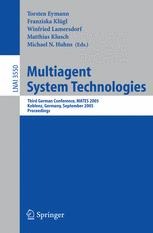
Multiagent System Technologies ; Vol. 3550 : 3rd German Conference, MATES 2005, Koblenz, Germany, September 11-13, 2005, Proceedings
After two successful MATES conferences in Erfurt 2003 and 2004, the 3rd G- man conference on Multi-agent System Technologies (MATES 2005) took place in Koblenz, Germany, in September 2005, and was co-located with the 28th German Conference on Arti?cial Intelligence (KI 2005). Building onotheragent-related events in Germany in the past, and organized by the GI German Special Interest Group on Distributed Arti?cial Intelligence, the MATES conference series aims at promoting the theory and applications of agents and multiagent systems. In corporating the 9th International Workshopon Cooperative Information Agents (CIA 2005), the topics of interest for MATES 2005 also covered the ?elds of intelligent information agents and systems for the Internet and the (Semantic) Web. As in recent years, MATES 2005 provided a distinguished, lively and int- disciplinary forum for researchers, users, and developers of agent technology, to present and discuss the latest advances of research and development in the area of autonomous agents and multiagent systems. Accordingly, the topics of MATES 2005 covered the whole range from the theory to applications of age- and multiagent technology. The technical program included a total of 24 sci- ti?c talks, and demonstrations of selected running agent systems, and both the MATES 2005 Best Paper and the CIA 2005 System Innovation awards.

Multi-Agent Programming : Languages, Platforms and Applications
Part I describes four approaches that are based on computational logic or process algebra--Jason, 3APL, IMPACT, and CLAIM/SyMPA. These programming languages have formal semantics and use heavy machinery based on formal methods, but also provide working platforms for the development of multi-agent systems. Part II presents agent languages and platforms that extend or are based on Java--JADE, Jadex, and JACKTM. Although these have no formal semantics, the languages are well documented and the platforms provide a variety of tools that have been extensively used in practice. Part III provides two significant industry specific applications--The DEFACTO System for coordinating human-agent teams for the future of disaster response, and the ARTIMIS rational dialogue agent technology. The book also features seven appendices, summarising each of the agent programming languages, hence facilitating comparison of the approaches. In particular, Appendix A describes the criteria used for comparing the agent languages and platforms.

Multi-access Edge Computing : Software Development at the Network Edge
The book aims not only at providing a comprehensive technology and standard reference overview for students, but also useful research insights and practical exercises for edge software developers and investigators in the area (and for students looking to apply their skills). A particular emphasis is given Multi-access Edge Computing (MEC) as defined in European Telecommunications Standards Institute (ETSI), in relationship with other standard organizations like 3GPP, thus in alignment with the recent industry efforts to produce harmonized standards for edge computing leveraging both ETSI ISG MEC and 3GPP specifications.

Mud and Mudstones : Introduction and Overview
Our book provides the first elementary overview of mud and mudstone written for a broad spectrum of professionals, teachers and students in geology, petroleum geology and engineering, urban planning and development, paleontology and paleoecology, and architecture and archaeology. Mud and mudstone provide the foundations to master all their aspects and prepares you to dig deeply into the many fascinating questions of their origin, relationships to earth history and practical uses. Key topics include the production of mud, its transport, the important role of bottom oxygen, sites of deposition, burial, provenance, mudstones in basins and an overview of practical uses followed by an appendix and extended glossary.

Mucins : Methods and protocols
Explores the latest advancements in mucin research. The chapters in this book are organized into 8 parts and cover a wide range of topics such as mucin extraction, isolation, physicochemical property analysis, and experimental methods. The chapters also discuss the origins of mucins in jellyfish, feces, saliva and salivary glands, bronchi, stomach, and cervical tract; organic synthesis of peptides glycosylated at specific sites; analysis of mucin gene expression and methylation-specific electrophoresis of genes; imaging of mucin networks by AFM; and experimental methods using supported molecular matrix electrophoresis. Written in the highly successful Methods in Molecular Biology series format, chapters include introductions to their respective topics, lists of the necessary materials and reagents, step-by-step, readily reproducible laboratory protocols, and tips on troubleshooting and avoiding known pitfalls.

M-Solid Varieties of Algebras
It provides a complete and systematic introduction to the fundamentals of the hyperequational theory of universal algebra, offering the newest results on M-solid varieties of semirings and semigroups. The book aims to develop the theory of M-solid varieties as a system of mathematical discourse that is applicable in several concrete situations. It applies the general theory to two classes of algebraic structures, semigroups and semirings. Both these varieties and their subvarieties play an important role in computer science.

MSCs and Innovative Biomaterials in Dentistry
Presents the modern concepts of mesenchymal stem cells (MSCs) and biomaterials as they pertain to the dental field. The book is organized around three main topics: MSCs biology, advanced biomaterials, and clinical applications. The chapters present basic information on stem cell biology and physiology, modern biomaterials that improve bone tissue regeneration, the biomatrices like platelet-rich fibrin (PRF) used to functionalize the biomaterials surface, the strategic and safe intraoral seats of harvesting, the new sources for MSCs, as well as the future perspectives and new challenges in these exciting fields.

MRI in Clinical Practice
The book covers the basic Physics behind MRI, quality assurance, up-to-date safety guidelines and a useful gallery of image artefacts. Part of the book focuses on the specific areas of the body in which MRI is currently exploited, describing how MRI is performed in practice. In each of these sections, a common theme is followed with illustrations of MR images acquired with clinically relevant settings and typical imaging protocols are also explicitly stated. Additional information is provided which includes a subjective view of the strengths and weaknesses of MRI in comparison to other imaging modalities. As well as covering routine clinical techniques, the latest advanced methods (e.g. spectroscopy, fMRI, diffusion, high field MRI) are discussed and placed into the context of clinical application.

MRI Atlas Orthopedics and Neurosurgery The Spine
This MRI atlas of the spine is the fruit of interdisciplinary cooperation among radiologists, orthopedic surgeons, traumatologists, and neurosurgeons. It is a clinically oriented atlas that covers all important diseases and injuries of the spine. Ample illustrations are supplemented by concise descriptions of anatomy and pathophysiology, the normal and abnormal MRI appearance, diagnostic pitfalls, and the clinical significance of MRI. The clear and didactic style enables readers to revise the fundamentals of spinal anatomy and disease states as a basis for understanding the diagnostic strategies and surgical management.

MRI and CT of the Female Pelvis
MRI and CT exquisitely depict the anatomy of the female pelvis and offer fascinating diagnostic possibilities in women with pelvic disorders. This volume provides a comprehensive account of the use of these cross-sectional imaging techniques to identify and characterize developmental anomalies and acquired diseases of the female genital tract. Both benign and malignant diseases are considered in depth, and detailed attention is also paid to normal anatomical findings and variants. Further individual chapters focus on the patient with pelvic pain and the use of MRI for pelvimetry during pregnancy and the evaluation of fertility. Throughout, emphasis is placed on the most recent diagnostic and technical advances, and the text is complemented by many detailed and informative illustrations.

Moving Wearables into the Mainstream : Taming the Borg
Moving Wearables into the Mainstream also introduces concepts such as Operational Inertia that form a mindset conducive to designing wearables suitable for broad adoption by consumers. This book provides insight into legal and cultural issues potentially unfamiliar to research engineers, as well as a broad discussion of technologies underlying wearable devices.Moving Wearables into the Mainstream is designed for a professional audience of practitioners and researchers in industry. This volume is also suitable as a secondary advanced-level text or reference book for students in computer science and electrical engineering.

Moving Millions : Transport Strategies for Sustainable Development in Megacities
The Alliance for Global Sustainability is an international partnership among four of the leading scienti?c and technological universities worldwide: • The Massachusetts Institute of Technology (MIT-AGS); • The University of Tokyo (UT); • The Swiss Federal Institute of Technology (ETH); and • The Chalmers University of Technology. Created in 1997, the AGS today brings together hundreds of university scientists, engineers, and social scientists to address complex issues that lie at the intersection of environmental, economic, and social policy goals. Since its inception, the AGS has promoted and supported multidisciplinary research teams drawn from its partner institutions. Working on critical issues in sustainability across several ?elds encompassing energy and climate, mobility, urban systems, water and agriculture, cleaner technologies, public policy, and communications, these teams have developed a signi?cant body of new knowledge.
