



الصفحة 161
الصفحة 161

Autonomic networking ; 1st International IFIP TC6 Conference, AN 2006, Paris, France, September 27-29, 2006, Proceedings
The autonomic communication paradigm has been defined mainly through the Autonomic Communications Forum (ACF) and particularly as follows: Autonomic communication is centered on selfware – an innovative approach to perform known and emerging tasks of a network control plane, both end-to-end and middle box communication-based. Selfware assures the capacity to evolve; however, it requires generic network instrumentation. Selfware principles and technologies borrow largely from well-established research on distributed systems, fault tolerance among others, from emerging research on non-conventional networking (multihop ad hoc, sensor, peer-to-peer, group communication, etc.

Autonomic communication ; Vol. 3457 ; 1st International IFIP Workshop, WAC 2004, Berlin, Germany, October 18-19, 2004, Revised Selected Papers
The ?rst IFIP Workshop on Autonomic Communication (WAC 2004) was held 2004 in Berlin, Germany. The purpose of this workshop was to discuss Autonomic Communication—a new communication paradigm to assist the design of the next-generation n- works. WAC 2004 was explicitly focused on the principles that help to achieve purposeful behavior on top of self-organization (self-management, self-healing, self-awareness, etc. ). The workshop intended to derive these common principles from submissions that study network element’s autonomic behavior exposed by innovative (cross-layer optimized, context-aware, and securely programmable) protocol stack (or its middleware emulations) in its interaction with numerous, often dynamic network groups and communities. The goals were to understand how autonomic behaviors are learned, in?uenced or changed, and how, in turn, these a?ect other elements, groups and the network. Panel reports were compiled by panel moderators and conclude this volume.
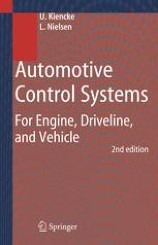
Automotive Control Systems : For Engine, Driveline, and Vehicle
Reflecting the trend to optimization through integrative approaches for engine, driveline and vehicle control, this book enables control engineers to understand engine and vehicle models necessary for controller design and also introduces mechanical engineers to vehicle-specific signal processing and automatic control. The emphasis on measurement, comparisons between performance and modelling, and realistic examples derive from the authors’ industrial experience at Bosch and interactions within IFAC and SAE. The second edition offers new or expanded topics such as diesel-engine modelling, diagnosis and anti-jerking control, and vehicle modelling and parameter estimation. The book addresses professional engineers as well as students.

Automating business modelling : A guide to using logic to represent Informal methods and support reasoning
Enterprise Modelling (EM) methods are frequently used by entrepreneurs as an analysis tool for describing and redesigning their businesses. The resulting product, an enterprise model, is commonly used as a blueprint for reconstructing organizations and such effort is often a part of business process re-engineering and improvement initiatives. Automating Business Modelling describes different techniques of providing automated support for enterprise modelling methods and introduces universally used approaches. A running example of a business modelling method is included; providing a framework and detailed explanation as to how to construct automated support for modelling, allowing readers to follow the method to create similar support. Suitable for senior undergraduates and postgraduates of Business Studies, Computer Science and Artificial Intelligence, practitioners in the fields of Knowledge Management, Enterprise Modelling and Software Engineering, this book offers insight and know-how to both student and professional.
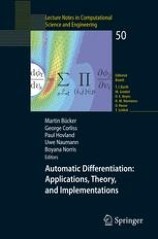
Automatic Differentiation : Applications, Theory, and Implementations
This collection covers the state of the art in automatic differentiation theory and practice. Practitioners and students will learn about advances in automatic differentiation techniques and strategies for the implementation of robust and powerful tools. Computational scientists and engineers will benefit from the discussion of applications, which provide insight into effective strategies for using automatic differentiation for design optimization, sensitivity analysis, and uncertainty quantification.
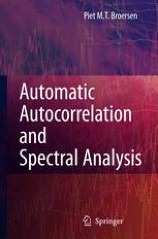
Automatic Autocorrelation and Spectral Analysis
It takes advantage of greater computing power and robust algorithms to produce enough candidate models to be sure of providing a suitable candidate for given data. Improved order selection quality guarantees that one of the best (and often the best) will be selected automatically. The data themselves suggest their best representation. Should the analyst wish to intervene, alternatives can be provided. Written for graduate signal processing students and for researchers and engineers using time series analysis for practical applications ranging from breakdown prevention in heavy machinery to measuring lung noise for medical diagnosis.

Automated technology for verification and analysis ; 6th International Symposium, ATVA 2008, Seoul, Korea, October 20-23, 2008. Proceedings
This book constitutes the refereed proceedings of the 6th International Symposium on Automated Technology for Verification and Analysis, ATVA 2008, held in Seoul, Korea, in October 2008.

Automated technology for verification and analysis ; 5th International Symposium, ATVA 2007 Tokyo, Japan, October 22-25, 2007 Proceedings
This book presented theoretical methods to achieve correct software or hardware systems, including both functional and non functional aspects

Automated technology for verification and analysis ; 4th International Symposium, ATVA 2006, Beijing, China, October 23-26, 2006, Proceedings
The Automated Technology for Veri?cation and Analysis (ATVA) international symposium series was initiated in 2003, The main topics of the symposium include th- ries useful for providing designers with automated support for obtaining correct software or hardware systems, as well as the implementation of such theories in tools or their application. In the end, 35 papers were selected for inclusion in the program. ATVA 2006 had three keynote speeches given respectively by Thomas Ball, Jin Yang, and Mihalis Yannakakis. The main symposium was preceded by a tutorial day, consisting of three two-hourlectures given by the keynotespeakers.

Automated technology for verification and analysis ; 3rd International Symposium, ATVA 2005, Taipei, Taiwan, October 4-7, 2005, Proceedings
The Automated Technology for Veri?cation and Analysis (ATVA) international symposium series was initiated in 2003, responding to a growing interest in formal veri?cation spurred by the booming IT industry, particularly hardware design and manufacturing in East Asia. Its purpose is to promote research on automated veri?cation and analysis in the region by providing a forum for int- action between the regional and the international research/industrial commu- ties of the ?eld. ATVA 2005, the third of the ATVA series, was held in Taipei, Taiwan, 2005. The main theme of the symposium encompasses - sign, complexities, tools, and applications of automated methods for veri?cation and analysis. This book constitutes the refereed proceedings of the symposium .

Automated technology for verification and analysis ; 18th International Symposium, ATVA 2020, Hanoi, Vietnam, October 19–23, 2020, Proceedings
This book constitutes the refereed proceedings of the 18th International Symposium on Automated Technology for Verification and Analysis, ATVA 2020, held in Hanoi, Vietnam, in October 2020. The 27 regular papers presented together with 5 tool papers and 2 invited papers were carefully reviewed and selected from 75 submissions.

Automated Reasoning with Analytic Tableaux and Related Methods ; 16th International Conference, TABLEAUX 2007, Aix en Provence, France, July 3-6, 2007, Proceedings
It covers the wide range of logics, from intuitionistic and substructural logics to modal logics (including temporal and dynamic logics), from many-valued logics to nonmonotonic logics, and from classical first-order logic to description logics.

Automated deduction in Geometry ; 5th International Workshop, ADG 2004, Gainesville, FL, USA, September 16-18, 2004, Revised Papers
This book constitutes the thoroughly refereed post-proceedings of the 6th International Workshop on Automated Deduction in Geometry, ADG 2006, held at Pontevedra, Spain, in August/September 2006 as a satellite event of the International Congress of Mathematicians, ICM 2006. The 13 revised full papers presented were carefully selected from the submissions made due to a call for papers - within the scope of ADG - shortly after the meeting. The papers show the lively variety of topics and methods and the current applicability of automated deduction in geometry to different branches of mathematics and to other sciences and technologies.

Automated deduction – CADE-21 ; 21st International Conference on automated deduction, Bremen, Germany, July 17-20, 2007, Proceedings
All current aspects of automated deduction are addressed, ranging from theoretical and methodological issues to presentation and evaluation of theorem provers and logical reasoning systems. The papers are organized in topical sections on higher-order logic, description logic, intuitionistic logic, satisfiability modulo theories, induction, rewriting, and polymorphism, first-order logic, model checking and verification, termination, as well as tableaux and first-order systems.

Automated deduction – CADE-20 ; 20th International Conference on automated deduction, Tallinn, Estonia, July 22-27, 2005, Proceedings
This book constitutes the refereed proceedings of the 20th International Conference on Automated Deduction, CADE-20, held in Tallinn, Estonia, in July 2005. The 25 revised full papers and 5 system descriptions presented were carefully reviewed and selected from 78 submissions. All current aspects of automated deduction are addressed, ranging from theoretical and methodological issues to presentation and evaluation of theorem provers and logical reasoning systems.

Automated deduction – CADE 28 ; 28th International Conference on automated deduction, Virtual Event, July 12–15, 2021, Proceedings
This book constitutes the proceeding of the 28th International Conference on Automated Deduction, CADE 28, held virtually in July 2021. The 29 full papers and 7 system descriptions presented together with 2 invited papers were carefully reviewed and selected from 76 submissions. CADE is the major forum for the presentation of research in all aspects of automated deduction, including foundations, applications, implementations, and practical experience. The papers are organized in the following topics: Logical foundations; theory and principles; implementation and application; ATP and AI; and system descriptions.

Automata, languages and programming ; Vol. 3580 ; 32nd International Colloquim, ICALP 2005, Lisbon, Portugal, July 11-15, 2005, Proceedings
This book constitutes the refereed proceedings of 32nd International Colloquium on Automata, Languages and Programming ICALP 2005, Lisbon, Portugal, July 11-15, 2005. including Topics Computer Science, general Mathematical Logic and Foundations Theory of Computation Software Engineering/Programming and Operating Systems Data Structures and Information Theory Data Structures
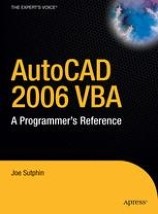
AutoCAD 2006 VBA : A programmer's reference
This book will help you take full advantage of the Visual Basic for Applications programming environment within AutoCAD 2006. Whether you want to automate routine tasks, or create sophisticated applications or design that can be generated programmatically, this book will empower you to make AutoCAD work for you. This book is also suitable if you're a power user who wants to make use of the advanced features of AutoCAD 2006 VBA, and you need a fast reference for the full AutoCAD object model. You'll learn to run Autodesk design tasks in the embedded VBA environment. This book is loaded with source code examples, and gives you no matter your skill level the necessary tools to accomplish your AutoCAD 2006 automation tasks.

Austenitic TRIP/TWIP steels and steel-zirconia composites : Design of tough, transformation-strengthened composites and structures
This book presents a collection of the most up-to-date research results in the field of steel development with a focus on pioneering alloy concepts that result in previously unattainable materials properties.
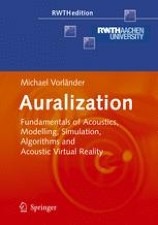
Auralization : Fundamentals of acoustics, modelling, simulation, algorithms and acoustic virtual reality
"Auralization" is the technique of creation and reproduction of sound on the basis of computer data. With this tool is it possible to predict the character of sound signals which are generated at the source and modified by reinforcement, propagation and transmission in systems such as rooms, buildings, vehicles or other technical devices. This book is organized as a comprehensive collection of the basics of sound and vibration, acoustic modelling, simulation, signal processing and audio reproduction. Implementations of the auralization technique are described using examples drawn from various fields in acoustic’s research and engineering, architecture, sound design and virtual reality.
