



الصفحة 15
الصفحة 15

Modelling, Monitoring and Diagnostic Techniques for Fluid Power Systems
Modelling, Monitoring and Diagnostic Techniques for Fluid Power Systems covers the background theory of fluid power and indicates the range of concepts necessary for a modern approach to condition monitoring and fault diagnosis in a readable and understandable fashion. The theory is constantly leavened by 15 years' worth of practical measurements by the author, working in association with major fluid power companies, and real industrial case studies – hot-strip-mill monitoring in conjunction with Corus p.l.c. being just one example. Comprising four parts, it provides: • an introduction to component behaviour. • a guide to the modelling methods employed for circuit analysis. • methods for doing condition monitoring. • common faults and breakdowns.

Modelling, Computation and Optimization in Information Systems and Management Sciences ; 2nd International Conference MCO 2008, Metz, France - Luxembourg, September 8-10, 2008. Proceedings
This book constitutes the refereed proceedings of the Second International Conference MCO 2008, Metz, France, September 2008.The 65 revised full papers presented were carefully reviewed and selected from 160 submissions. The papers are organized in topical sections on optimization and decision making; data mining theory, systems and applications; computer vision and image processing; computer communications and networks; optimization and search techniques for security, reliability, trust.

Modelling, Analysis and Optimization of Biosystems
Mathematical models in biology and medicine cannot be based on natural laws as it is the case with physics and chemistry. This is due to the fact that biological and medical processes are concerned with living organisms. Mathematical models, however, can be used as a language by which certain aspects of biological or medical processes can be expressed. In general, several mathematical models can be designed in order to describe a biological or medical process and there is no unique criterion which model gives the best description. This book presents several of these models and shows applications of them to different biological and medical problems. The book shows that operations research expertise is necessary in respect to modeling, analysis and optimization of biosystems.

Modelling water and nutrient dynamics in soil-crop systems : Applications of different models to common data sets - Proceedings of a workshop held 2004 in Müncheberg, Germany
This book contains articles from a workshop on "Modelling water and nutrient dynamics in crop-soil systems". Data sets from lysimeters and experimental fields of multiyear crop rotations were provided for modellers. A unique data set is provided of a 100 year long term field experiment regarding crop yield and organic carbon development under different management systems. The book includes a detailed description of data sets which can be used by modellers and the papers describe the applications of 18 different modelling approaches describing soil-crop-atmosphere interactions for water, nitrogen and carbon dynamics.

Modelling the dispersion of radionuclides in the marine environment : An introduction
This book is a practical guide to the subject of numerical modelling of radioactivity dispersion in the marine environment. Thus, the techniques and numerical procedures required are explained in detail, with the aim of enabling the reader to build a real mathematical model. The book covers basic concepts and techniques, such as solving the advection-diffusion equation in a simple 1D form, as well as the most recent developments (full 3D models for non-conservative radionuclides including chemical reactions and speciation). A chapter is dedicated to the basic hydrodynamic modelling that is always required to simulate the dispersion of tracers in the sea; Eulerian and Lagrangian modelling techniques are also described. A chapter describes sensitivity and uncertainty analysis, the final stage in modelling works. A review on some published radionuclide dispersion models is also included.

Modelling Regional Scenarios for the Enlarged Europe : European Competitiveness and Global Strategies
The aim of this book is to tackle the question of what the European territory will look like over the next fifteen years by providing quali-quantitative territorial scenarios for the enlarged Europe, under different assumptions on future globalisation strategies of BRIC (Brazil, Russia, India and China) and East and West European countries. The approach is as neutral as possible vis-à-vis the results, leaving to a new forecasting model, the MASST model, built by the authors, to produce the tendencies and behavioural paths of regional GDP and population growth in each individual European region under alternative assumptions on the competitiveness strategies of different blocks of countries. The results are accompanied by strong policy messages intended to encourage long-term strategic thinking among a wide range of actors, scientists and policy makers in response to the risks and opportunities that the European territory will face.

Modelling our Changing World
This book focuses on the concepts, tools and techniques needed to successfully model ever-changing time-series data. It emphasizes the need for general models to account for the complexities of the modern world and how these can be applied to a range of issues facing Earth, from modelling volcanic eruptions, carbon dioxide emissions and global temperatures, to modelling unemployment rates, wage inflation and population growth.

Modelling of Powder Die Compaction
In particular, the book presents a number of case studies that have been developed to test compaction models. Full details of the data required for input to compaction models of these case studies is given, together with a survey of the techniques used to generate the data. Details are also given of methods to produce and assess components for validation of die compaction models. The inclusion of information on case studies then provides a reference for the testing and validation of compaction models.

Modelling Land-Use Change : Progress and Applications
land-use change simulation modelling is a relatively new and dynamic field of study and this book provides a full overview of the topic, a wide range of applications (both geographically and thematically), a mix of theory and practice, a synthesis of recent research progress, and educational material for students and teachers.

Modelling in Mechanical Engineering and Mechatronics : Towards Autonomous Intelligent Software Models
Modelling in Mechanical Engineering and Mechatronics presents a model-centred approach focusing on distributed development and use of autonomous intelligent software models, particularly the efficiency of the models, and their interaction and integration into distributed autonomous intelligent systems. In order to systematise the available knowledge, a domain ontology is presented; a subset of which is used to create a modelling theory based on knowledge and experience in the areas of software engineering, mechanical engineering and mechatronics. This holistic view of modelling explains the purpose and the essence of modelling, as well as the benefits that are to be expected. It discusses the relations to other branches of engineering and science and as a result, it demonstrates strategies, methods and tools for unleashing the full power of modelling.

Modelling in Mathematical Programming : Methodology and Techniques
This book provides basic tools for learning how to model in mathematical programming, from models without much complexity to complex system models. It presents a unique methodology for the building of an integral mathematical model, as well as new techniques that help build under own criteria. It allows readers to structure models from the elements and variables to the constraints, a basic modelling guide for any system with a new scheme of variables, a classification of constraints and also a set of rules to model specifications stated as logical propositions, helping to better understand models already existing in the literature. It also presents the modelling of all possible objectives that may arise in optimization problems regarding the variables values. The book is structured to guide the reader in an orderly manner, learning of the components that the methodology establishes in an optimization problem. The system includes the elements, which are all the actors that participate in the system, decision activities that occur in the system, calculations based on the decision activities, specifications such as regulations, impositions or actions of defined value and objective criterion, which guides the resolution of the system.

Modelling Environmental Dynamics : Advances in Geomatic Solutions
Modelling environmental dynamics is critical to understanding and predicting the evolution of the environment in response to the large number of influences including urbanisation, climate change and deforestation. Simulation and modelling provide support for decision making in environmental management.

Modelling Distributed Systems
Process algebras are languages for the description of elementary parallel systems and are used to study the behavioural properties of distributed systems, but they often lack the ability to handle data. This textbook guides students through algebraic specification and verification of distributed systems, and some of the most prominent formal verification techniques.

Modelling Critical and Catastrophic Phenomena in Geoscience : A Statistical Physics Approach
This book presents a broad survey of models for critical and catastrophic phenomena in the geosciences, with strong emphasis on earthquakes. It assumes the perspective of statistical physics, which provides the theoretical frame for dealing with complex systems in general. This volume addresses graduate students wishing to specialize in the field and researchers working or interested in the field having a background in the physics, geosciences or applied mathematics.

Modelling community structure in freshwater ecosystems
"The book presents approaches and methodologies for predicting the structure and diversity of key aquatic communities (namely diatoms, benthic macroinvertebrates and fish), under natural conditions and under man-made disturbance. Such an approach will make it possible to: 1) set up procedures for robust and sensitive ecosystem evaluation, based on the prediction of the excepted community structure; 2) model community structure in disturbed ecosystems, taking into account all the relevant ecological variables; 3) test ecosystem sensitivity to natural and anthropic disturbance; and 4) explore specific actions to be taken for the restoration of ecosystem integrity."--Jacket.

Modelling Autonomic Communications Environments ; 3rd IEEE International Workshop, MACE 2008, Samos Island, Greece, September 22-26, 2008. Proceedings
Research and development of autonomics have come a long way, and we are delighted to present the proceedings of the 3rd IEEE International Workshop on Modelling Autonomic Communications Environments (MACE 2008).Asin the last two years, this workshopwasheld aspart of Manweek, the International Week on Management of Networks and Services, which took place on the lovely Island of Samos in Greece .MACE started as anexperimentin2006,andcreatedasmallcommunitythat nowfnds it self attracted backeachyearby afeeling ofexcitement-thatthere is something new going on. Certainly, MACE is not as shiny or practiced as other well-known conferences and workshops, but we consider this a feature of the workshopitself.

Modelling and simulation of discrete-event systems
Allows engineers to study and analyze complex systems. Discrete-event system (DES)-M&S is used in modern management, industrial engineering, computer science, and the military. As computer speeds and memory capacity increase, so DES-M&S tools become more powerful and more widely used in solving real-life problems.

Modelling and Simulation : Exploring Dynamic System Behaviour
Modelling and Simulation: Exploring Dynamic System Behaviour provides the reader with a balanced and integrated presentation of the modelling and simulation activity for both Discrete Event Dynamic Systems (DEDS) and Continuous Time Dynamic Systems (CTDS). This book presents the fundamentals necessary to understand the many important facets of the modeling and simulation methodology.
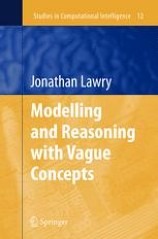
Modelling and Reasoning with Vague Concepts
This volume outlines a formal representation framework for modelling and reasoning with vague concepts in Artificial Intelligence. The new calculus has many applications, especially in automated reasoning, learning, data analysis and information fusion. This book gives a rigorous introduction to label semantics theory, illustrated with many examples, and suggests clear operational interpretations of the proposed measures. It also provides a detailed description of how the theory can be applied in data analysis and information fusion based on a range of benchmark problems.

Modelling and Optimization of Biotechnological Processes : Artificial Intelligence Approaches
The book begins with a historical introduction to the field of bioprocess control based on artificial intelligence approaches, followed by two chapters covering the optimization of fed-batch culture using genetic algorithms. Online biomass soft-sensors are constructed in Chapter 4 using recurrent neural networks. The bioprocess is then modelled in Chapter 5 by cascading two soft-sensor neural networks. Optimization and validation of the final product are detailed in Chapters 6 and 7. The general conclusions are drawn in Chapter 8.
