



الصفحة 15
الصفحة 15

Intelligent information processing and web mining ; Proceedings of the International IIS : IIPWM´06 Conference held in Ustron, Poland, June 19-22, 2006
This volume contains selected papers, presented at the international conference on Intelligent Information Processing and Web Mining Conference IIS:IIPWM'06, organized in Ustro« (Poland) on June 19-22nd, 2006. The submitted papers cover new computing paradigms, among others in biologically motivated methods, advanced data analysis, new machine learning paradigms, natural language processing, new optimization technologies, applied data mining using statistical and non-standard approaches.

Intelligent engineering systems and computational cybernetics
A further important component of machine intelligence is a kind of “structural uniformity” giving room and possibility to model arbitrary particular details a priori not specified and unknown.This idea is similar to the ready-to-wear industry, which introduced products, which can be slightly modified later on in contrast to tailor-made creations aiming at maximum accuracy from the beginning. These subsequent corrections can be carried out by machines automatically. This “learning ability” is a key element of machine intelligence.The past decade confirmed that the view of typical components of the present soft computing as fuzzy logic, neural computing.

Intelligent Document Retrieval : Exploiting Markup Structure
Collections of digital documents can nowadays be found everywhere in institutions, universities or companies. Examples are Web sites or intranets. But searching them for information can still be painful. Searches often return either large numbers of matches or no suitable matches at all. Such document collections can vary a lot in size and how much structure they carry. What they have in common is that they typically do have some structure and that they cover a limited range of topics. The second point is significantly different from the Web in general. The type of search system that we propose in this book can suggest ways of refining or relaxing the query to assist a user in the search process. In order to suggest sensible query modifications we would need to know what the documents are about. Explicit knowledge about the document collection encoded in some electronic form is what we need. However, typically such knowledge is not available. So we construct it automatically.

Intelligent data engineering and automated Learning - IDEAL 2008 ; 9th International Conference Daejeon, South Korea, November 2-5, 2008 Proceedings
This book constitutes the refereed proceedings of the 9th International Conference on Intelligent Data Engineering and Automated Learning, IDEAL 2008, held in Daejeon, Korea, in November 2008.The 56 revised full papers presented together with 10 invited papers were carefully reviewed and selected from numerous submissions for inclusion in the book. The papers are organized in topical sections on learning and information processing, data mining and information management, bioinformatics and neuroinformatics, agents and distributed systems, as well as financial engineering and modeling.

Intelligent data engineering and automated Learning - IDEAL 2007 ; 8th International Conference, Birmingham, UK, December 16-19, 2007, Proceedings
This book constitutes the refereed proceedings of the 8th International Conference on Intelligent Data Engineering and Automated Learning, IDEAL 2007. The papers are organized in topical sections on learning and information processing, data mining and information management, bioinformatics and neuroinformatics, agents and distributed systems, financial engineering and modeling, agent-based approach to service sciences, as well as neural-evolutionary fusion algorithms and their applications.
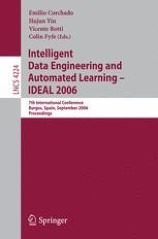
Intelligent data engineering and automated Learning - IDEAL 2006 ; 7th International Conference, Burgos, Spain, September 20-23, 2006, Proceedings
This volume of Lecture Notes in Computer Science contains accepted - pers presented at IDEAL 2006 held at the University of Burgos, Spain, during, September 20–23, 2006. The conference received 557 submissions from over 40 countriesaroundtheworld,whichweresubsequentlyrefereedbytheProgramme Committeeandmanyadditionalreviewers.Afterrigorousreview,170top-quality papers were accepted and included in the proceedings. The acceptance rate was only 30%, which ensured an extremely high-quality standard of the conference. The buoyant number of submitted papers is a clear proof of the vitality and increased importance of the ?elds related to IDEAL, and is also an indication of the rising popularity of the IDEAL conferences.

Intelligent data engineering and automated Learning - IDEAL 2005 ; 6th International Conference, Brisbane, Australia, July 6-8, 2005, Proceedings
Constitutes the refereed proceedings of the 6th International Conference on Intelligent Data Engineering and Automated Learning, IDEAL 2005, held in Brisbane, Australia, in July 2005. These papers are organized in topical sections on data mining and knowledge engineering, learning algorithms and systems, bioinformatics, and more.

Intelligent Control and Automation ; International Conference on Intelligent Computing, ICIC 2006, Kunming, China, August, 2006
"Intelligent Control and Automation" constitutes the results of the International Conference on Intelligent Computing, ICIC 2006, held in Kunming, China, in August 2006. Lecture Notes in Computer Science (LNCS), Lecture Notes in Artificial Intelligence (LNAI), Lecture Notes in Bioinformatics (LNBI), Lecture Notes in Control and Information Sciences (LNCIS). Includes a Special Session on Smart and Intelligent Home Technology.

Intelligent Computer Mathematics ; 13th International Conference, CICM 2020, Bertinoro, Italy, July 26–31, 2020, Proceedings
This book constitutes the refereed proceedings of the 13th International Conference on Intelligent Computer Mathematics, CICM 2020, held in Bertinoro, Italy, in July 2020*. The 15 full papers, 1 invited paper and 2 abstracts of invited papers presented were carefully reviewed and selected from a total of 35 submissions. The papers focus on advances in automated theorem provers and formalization, computer algebra systems and their libraries, and applications of machine learning, among other topics.

Intelleger = انتليجر
The project management system is a web application designed to assist software managers in efficiently managing their projects, including websites, mobile apps, and other software initiatives. Utilizing artificial intelligence, the application streamlines project creation and management processes, offering significant benefits in terms of organization and accuracy. Managers can create projects by inputting essential details such as the name, scope, deadline, and tasks. The system generates AI-based functional and non-functional requirements tailored to the project scope using gpt2 model on Pure dataset. Managers can then review and edit these requirements as needed before finalizing the project. The application facilitates comprehensive task management by allowing managers to assign tasks to developers, edit task details, and ensure task deadlines align with project deadlines. Developers can log their start and end times automatically when they begin and complete tasks, providing accurate time tracking and performance analysis.also they can use code generation model to generate their task’s code using codebert model on concode and codesearchnet dataset Real-time notifications keep both managers and developers informed of task assignments, completions, and other critical updates.

Integrated formal methods ; 6th International Conference, IFM 2007, Oxford, UK, July 2-5, 2007, Proceedings
It addresses all aspects of formal methods integration, including of a process of analysis or design application of formal methods to analysis or design, extension of one method based upon the inclusion of ideas or concepts from others, and semantic integration or practical application.

Integrated formal methods ; 5th International conference, IFM 2005, Eindhoven, The Netherlands, November 29 - December 2, 2005. Proceedings
This book constitutes the refereed proceedings of the 5th International Conference on Integrated Formal Methods, IFM 2005, held in Eindhoven, The Netherlands, in November/December 2005. The 19 revised full papers presented together with 3 invited papers were carefully reviewed and selected from 40 submissions. The papers are organized in topical sections on components, state/event-based verification, system development, applications of B, tool support, non-software domains, semantics, as well as UML and statecharts.

Integrated Circuit Packaging, Assembly and Interconnections
Integrated Circuit Packaging, Assembly and Interconnections is intended as a multi-purpose text, serving individuals looking for an introduction, or a review, or an update of the various IC packaging, assembly, and interconnection technologies. To this end, it provides an overview of the materials and the processes, as well as the trends and available options that encompass electronic manufacturing. It covers both the technical issues and touches on some of the reliability concerns with the various technologies applicable to packaging and assembly of the IC. The focus is on the electronic manufacturing process which, in its simplest form, involves assembly of the IC into a package or interconnect substrate or board. The book discusses the various packaging approaches available, namely, single chip, multichip, and Chip On Board; the assembly options, chip & wire, tape automated bonding, and flip chip; and the essential high density package/substrate manufacturing technologies, thin film, thick film, cofired ceramic, and laminate printed wiring board (PWB) processes. Included also is a discussion of high density PWBs using build up/sequential processes.

Integrated Circuit and System Design. Power and Timing Modeling, Optimization and Simulation ; Vol. 3728 ; 15th International Workshop, PATMOS 2005, Leuven, Belgium, September 21-23, 2005, Proceedings
Welcome to the proceedings of PATMOS 2005, the 15th in a series of international workshops.PATMOS2005wasorganizedbyIMECwithtechnicalco-sponsorshipfrom the IEEE Circuits and Systems Society. Over the years, PATMOS has evolved into an important European event, where - searchers from both industry and academia discuss and investigate the emerging ch- lenges in future and contemporary applications, design methodologies, and tools - quired for the developmentof upcominggenerationsof integrated circuits and systems. The technical program of PATMOS 2005 contained state-of-the-art technical contri- tions, three invited talks, a special session on hearing-aid design, and an embedded - torial. The technical program focused on timing, performance and power consumption, as well as architectural aspects with particular emphasis on modeling, design, char- terization, analysis and optimization in the nanometer era. The Technical Program Committee, with the assistance of additional expert revi- ers, selected the 74 papers to be presented at PATMOS. The papers were divided into 11 technical sessions and 3 poster sessions. As is always the case with the PATMOS workshops, the review process was anonymous, full papers were required, and several reviews were carried out per paper. Beyond the presentations of the papers, the PATMOS technical program was - riched by a series of speeches offered by world class experts, on important emerging research issues of industrial relevance. Prof. Jan Rabaey, Berkeley, USA, gave a talk on “Traveling the Wild Frontier of Ulta Low-Power Design”, Dr. Sung Bae Park, S- sung, gave a presentation on “DVL (Deep Low Voltage): Circuits and Devices”, Prof.

Innovative Algorithms and Techniques in Automation, Industrial Electronics and Telecommunications.
Innovative Algorithms and Techniques in Automation, Industrial Electronics and Telecommunications is a collection of world class paper articles addressing the following topics: Computer Networks: Access Technologies, Medium Access Control, Network architectures and Equipment, Optical Networks and Switching, Telecommunication Technology, and Ultra Wideband Communications. Coding and Modulation: Modeling and Simulation, OFDM technology , Space-time Coding, Spread Spectrum and CDMA Systems. Wireless technologies: Bluetooth , Cellular Wireless Networks, Cordless Systems and Wireless Local Loop, HIPERLAN, IEEE 802.11, Mobile Network Layer, Mobile Transport Layer, and Spread Spectrum.

Innovations in robot mobility and control
The most important aspects of this book is that the principles and models introduced in the text are all field-tested, and thus can readily be used in solving real world problems, such as factory automation, disposal of nuclear wastes, landmine clearing and computerized surgery.

Innovations in E-learning, Instruction Technology, Assessment and Engineering Education
Innovations in E-learning, Instruction Technology, Assessment and Engineering Education is a collection of world class paper articles addressing the following topics: E-Learning including development of courses and systems for technical and liberal studies programs; online laboratories; intelligent testing using fuzzy logic; evaluation of on line courses in comparison to traditional courses; mediation in virtual environments; and methods for speaker verification. Instruction Technology including internet textbooks; pedagogy-oriented markup languages; graphic design possibilities; open source classroom management software; automatic email response systems; tablet-pcs; personalization using web mining technology; intelligent digital chalkboards; virtual room concepts for cooperative scientific work; and network technologies, management, and architecture.

Innovations in Design & Decision Support Systems in Architecture and Urban Planning
Traditionally, the DDSS conferences aim to be a platform for both starting and experienced researchers who focus on the development and application of computer support in urban planning and architectural design. This volume contains 31 peer reviewed papers from this year’s conference. This book will bring researchers together and is a valuable resource for their continuous joint effort to improve the design and planning of our environment.

Innovation in manufacturing networks ; 8th IFIP International Conference on information technology for balanced automation systems, Porto, Portugal, June 23–25, 2008
The IFIP series publishes state-of-the-art results in the sciences and technologies of information and communication. The scope of the series includes: foundations of computer science; software theory and practice; education; computer applications in technology; communication systems; systems modeling and optimization; information systems; computers and society; computer systems technology; security and protection in information processing systems; artificial intelligence; and human-computer interaction. Proceedings and post-proceedings of refereed international conferences in computer science and interdisciplinary fields are featured.

Ingredients for Successful System Level Design Methodology
Ingredients for Successful System Level Design Methodology discusses these wish lists, and provides detailed discussions on how our prototype implementations provide us with these much desired features.
