



الصفحة 138
الصفحة 138
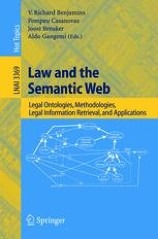
Law and the Semantic Web : Legal Ontologies, Methodologies, Legal Information Retrieval, and Applications
As part of this objective, ICT (information and communication technologies) services should become available for every citizen, and for all schools, homes and businesses. The book you have in front of you is about Semantic Web technology and law. Law is something omnipresent; all citizens — at some points in their lives — have to deal with it. In addition, law involves a large group of professionals, and is a mul- billion business world wide. Information technology is important because it that can improve citizens’ interaction with law, as well as improve legal professionals’ work environment. Legal professionals dedicate a significant amount of their time to finding, reading, analyzing and synthesizing information in order to take decisions, and prepare advice and trials, among other tasks. As part of the “Semantic-Based Knowledge and Content Systems” Strategic Objective, the European Commission is funding projects to construct technology to make the Semantic Web vision come true. 1 The articles in this book are related to two current foci of the Strategic Objective : • Knowledge acquisition and modelling, capturing knowledge from raw information and multimedia content in webs and other distributed repositories to turn poorly structured information into machi- processable knowledge.

Law and Politics : A Dilemma for Contemporary Legal Theory
Politics and the political discourse occupy a central position in the modern legal theoretical discussion. The goal of this book is to reconstruct and to classify, according to ideal-typical models, the different positions taken by the major contemporary legal theories as to whether and how law relates to politics. In particular, attention is focused on Kelsen, Hart, Finnis, Critical Legal Studies, Law and Economics and legal realisms.
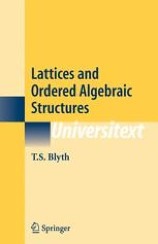
Lattices and Ordered Algebraic Structures
Lattices and Ordered Algebraic Structures provides a lucid and concise introduction to the basic results concerning the notion of an order. Although as a whole it is mainly intended for beginning postgraduates, the prerequisities are minimal and selected parts can profitably be used to broaden the horizon of the advanced undergraduate. The treatment is modern, with a slant towards recent developments in the theory of residuated lattices and ordered regular semigroups.
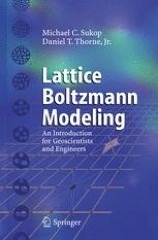
Lattice Boltzmann Modeling : An Introduction for Geoscientists and Engineers
Lattice Boltzmann models have a remarkable ability to simulate single- and multi-phase fluids and transport processes within them. A rich variety of behaviors, including higher Reynolds numbers flows, phase separation, evaporation, condensation, cavitation, buoyancy, and interactions with surfaces can readily be simulated. This book provides a basic introduction that emphasizes intuition and simplistic conceptualization of processes. It avoids the more difficult mathematics that underlies LB models. The model is viewed from a particle perspective where collisions, streaming, and particle-particle/particle-surface interactions constitute the entire conceptual framework. Beginners and those with more interest in model application than detailed mathematical foundations will find this a powerful "quick start" guide. Example simulations, exercises, and computer codes are included. Working code is provided on the Internet

Lateral Alignment of Epitaxial Quantum Dots
Accurate positioning of self-organized nanostructures on a substrate surface can be regarded as the Achilles’ heel of nanotechnology. This perception also applies to self-assembled semiconductor quantum dots. This book describes the full range of possible strategies to laterally align self-assembled quantum dots on a substrate surface, starting from pure self-ordering mechanisms and culminating with forced alignment by lithographic positioning. The text addresses both short- and long-range ordering phenomena and paves the way for the future high integration of single quantum dot devices on a single chip. Contributions by the best-known experts in this field ensure that all relevant quantum-dot heterostructures are elucidated from diverse relevant perspectives.

L'astrofilo moderno = The modern amateur astronomer
In less than two decades, amateur astronomy has changed its face. The reason, of course, is technological progress. Cheap but high-quality telescopes, computer-controlled "go-to" mounts, autoguiders, CCD cameras, video cameras and (as always) computers and the Internet are just some of the elements that revolutionized 21st century astronomy. Not only have they made amateur astronomy more "friendly" and fun, but they have also greatly expanded the potential of the amateur astronomer. Martin Mobberley first tackles the basic issues and then analyzes in depth what tools are available on the market. From here he starts to review the revolutionary possibilities that open up for amateur astronomers, from imaging, to spectroscopy, to photometry, to the surveillance of Near-Earth objects - comets and asteroids that can come dangerously close to the Earth.

Laser in restorative dentistry
The application of lasers in restorative dentistry has revolutionized dental treatments, offering enhanced precision, reduced discomfort, and improved clinical outcomes. Lasers have become a valuable tool in procedures such as cavity preparation, caries removal, tooth whitening, and composite resin curing. Their ability to selectively target diseased tissue while preserving healthy structures minimizes trauma and promotes faster healing. Moreover, lasers offer a less invasive alternative to traditional mechanical methods, often eliminating the need for anesthesia. This technology's versatility allows for its use in both hard and soft tissue treatments, including gingival recontouring and managing peri-implant diseases. As laser technology continues to advance, its integration into restorative dental practices offers significant potential for improved patient care, greater procedural efficiency, and long-term durability of restorations. Future developments in laser applications are expected to expand their role, making them an indispensable asset in modern dentistry.
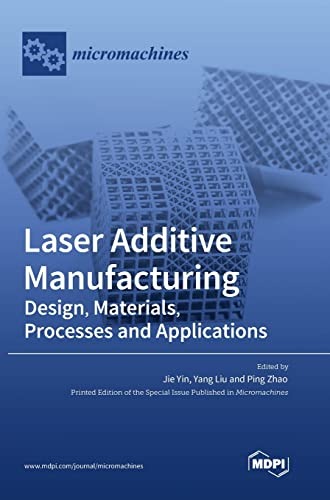
Laser additive manufacturing: design, materials, processes and applications
Laser-based additive manufacturing (LAM) is a revolutionary advanced digital manufacturing technology developed in recent decades, which is also a key strategic technology for technological innovation and industrial sustainability. This technology unlocks the design and constraints of traditional manufacturing and meets the needs of complex geometry fabrication and high-performance part fabrication. A deeper understanding of the design, materials, processes, structures, properties and applications is desired to produce novel functional devices, as well as defect-free structurally sound and reliable LAM parts.The topics in this Special Issue reprint include macro- and micro-scale additive manufacturing with lasers, such as structure/material design, fabrication, modeling and simulation, in situ characterization of additive manufacturing processes and ex situ materials characterization and performance, with an overview that covers various applications in aerospace, biomedicine, optics and energy.

Large-Scale Scientific Computing ; 6th International Conference, LSSC 2007, Sozopol, Bulgaria, June 5-9, 2007. Revised Papers
The 6th International Conference on Large-Scale Scienti?c Computations (LSSC 2007) was held in Sozopol, Bulgaria, June 5–9, 2007. The conference was organized by the Institute for Parallel Processing at the Bulgarian Academy of Sciences in cooperation with SIAM (Society for Industrial and Applied Ma- ematics). Partial support was also provided from project BIS-21++ funded by the European Commission in FP6 INCO via grant 016639/2005. The conference was devoted to the 60th anniversary of Richard E. Professor Ewing is internati- ally well known with his contributions in applied mathematics, mathematical modeling, and large-scale scientific computations.

Large-Scale Scientific Computing ; 5th International Conference, LSSC 2005, Sozopol, Bulgaria, June 6-10, 2005, Revised Papers
The 5th International Conference on Large-Scale Scientific Computations (LSSC 2005) was held in Sozopol, Bulgaria, June 6–10, 2003. The conference was organized and sponsored by the Institute for Parallel Processing at the Bulgarian Academy of Sciences. Partial support was also provided from project BIS-21++ funded by the European Commission in FP6 INCO via grant 016639/2005. More than 120 participants from all over the world attended the conference representing some of the strongest research groups in the field of advanced largescale scientific computing. This volume contains 80 papers submitted by authors from over 20 countries. The 6th International Conference, LSSC 2007, will be organized in June 2007
Large-scale group decision-making : State-to-the-art clustering and consensus paths
The proposed consensus models focus on the treatment of non-cooperative behaviors in the consensus-reaching process and explores the influence of trust loss on the consensus-reaching process.The logic behind is as follows: firstly, a clustering algorithm is adopted to reduce the dimension of decision-makers, and then, based on the clusters’ opinions obtained, a consensus-reaching process is carried out to obtain a decision result acceptable to the majority of decision-makers.
Large Eddy Simulation for Incompressible Flows : An Introduction
First concise textbook on Large-Eddy Simulation, a very important method in scientific computing and engineeringFrom the foreword to the third edition written by Charles Meneveau: ".
Large Coulomb Systems: Lecture Notes on Mathematical Aspects of QED
A mathematically consistent formulation of relativistic quantum electrodynamics (QED) has still to be found. Nevertheless, there are several simplified effective models that successfully describe many body quantum systems and the interaction of radiation with matter. Large Coulomb Systems explores a selection of mathematical topics inspired by QED. It comprises selected, expanded and edited lectures given by international experts at a topical summer school and is intended as a high-level introduction for graduate students, postdocs and nonspecialists from related fields.

Lantibiotics as alternative therapeutics
Explores alternative therapeutics, lantibiotics and other novel drugs. This book provides concrete information to readers regarding lantibiotics and various types of antimicrobial peptides with their mode of actions in treating various multidrug resistant organisms. It explains various techniques that are involved in analyzing antimicrobial peptides and their mode of actions. The development of antibiotic resistance has now reached a point of crisis where innovative methods and application of novel compounds and methods are required to prevent the spread of drug resistant infections.

Languages, Methodologies and Development Tools for Multi-Agent Systems ; 1st International Workshop, LADS 2007, Durham, UK, September 4-6, 2007. Revised Selected Papers
Constitutes the thoroughly refereed post-workshop proceedings of the First International Workshop on Languages, Methodologies and Development Tools for Multi-Agent Systems, LADS 2007, held in Durham, UK, in September 2007. The workshop was part of MALLOW 2007, a federation of workshops on Multi-Agent Logics, Languages, and Organizations.

Languages and Compilers for Parallel Computing ; Vol. 2481 : 15th Workshop, LCPC 2002, College Park, MD, USA, July 25-27, 2002, Revised Papers
LCPC 2002 brought together over 60 researchers from academia and research institutions from many countries. The program of 26 papers was selected from 32 submissions. Each paper was reviewed by at least three Program Committee members and sometimes by additional reviewers. Prior to the workshop, revised versions of accepted papers were informally published on the workshop’s website and in a paper proceedings that was distributed at the meeting. This year, the workshopwas organizedinto sessions of papers on related topics, and each session consisted of two to three 30-minute presentations.Based on feedback from the workshop,the papers were revised and submitted for inclusion in the formal proceedings published in this volume. Two papers were presented at the workshop but later withdrawn from the ?nal proceedings by their authors. We were very lucky to have Bill Carlson from the Department of Defense give the LCPC 2002 keynote speech on “UPC: A C Language for Shared M- ory Parallel Programming.” Bill gave an excellent overview of the features and programming model of the UPC parallel programming language.

Languages and Compilers for Parallel Computing ; 21th International Workshop, LCPC 2008, Edmonton, Canada, July 31 - August 2, 2008, Revised Selected Papers
This book constitutes the thoroughly refereed post-conference proceedings of the 21th International Workshop on Languages and Compilers for Parallel Computing, LCPC 2008, held in Edmonton, Canada, in July/August 2008.The 18 revised full papers and 6 revised short papers presented were carefully reviewed and selected from 35 submissions. The papers address all aspects of languages, compiler techniques, run-time environments, and compiler-related performance evaluation for parallel and high-performance computing and comprise

Languages and Compilers for Parallel Computing ; 20th International Workshop, LCPC 2007, Urbana, IL, USA, October 11-13, 2007, Revised Selected Papers
This book constitutes the thoroughly refereed post-conference proceedings of the 20th International Workshop on Languages and Compilers for Parallel Computing, LCPC 2007, held in Urbana, IL, USA, in October 2007.The 23 revised full papers presented were carefully reviewed and selected from 49 submissions. The papers are organized in topical sections on reliability, languages, parallel compiler technology, libraries, run-time systems and performance analysis, and general compiler techniques.

Languages and Compilers for Parallel Computing ; 19th International Workshop, LCPC 2006, New Orleans, LA, USA, November 2-4, 2006, Revised Papers
The 19th Workshop on Languages and Compilers for Parallel Computing was heldinNovember2006inNewOrleans,LouisianaUSA.Morethan40researchers from around the world gathered together to present their latest results and to exchange ideas on topics ranging from parallel programming models, code generation,compilationtechniques,paralleldatastructureandparallelexecution models,toregisterallocationandmemorymanagementinparallelenvironments.

Language Policy and Modernity in Southeast Asia : Malaysia, the Philippines, Singapore, and Thailand
This volume considers the ways in which modernity challenges and informs the language policies of various Southeast Asians nations. Using case studies from Malaysia, the Philippines, Singapore and Thailand, the authors examine language policies that are explicitly articulated either in the form of State constitutions or in the public proclamations of political leaders. Particular attention is paid to the ways in which English, often seen as the language of globalization, impacts the status of indigenous Southeast Asian language.
