



الصفحة 13
الصفحة 13

Mild Stress and Healthy Aging : Applying hormesis in aging research and interventions
Stress is a double edged sword. Whereas chronic stress has well known harmful effects, recent research shows that intermittent exposure of cells and organisms to mild stress can improve various biological parameters, including severe stress tolerance, health span and longevity. Mild stress-induced hormesis is potentially a powerful tool in gerontological research and interventions. This book brings together some of the world leaders in this area of research who present a critical analysis of the ongoing research with respect to the effects and mechanisms of action of various types of mild stress, such as irradiation, heat, physical exercise, hypergravity, pro-oxidants and nutritional components, on a variety of biological systems ranging from fruitflies to human cells and bodies. Their separate chapters and a final collective chapter open up a whole new world of possibilities for future research in aging, successful aging, and health span extension.

Migration of organisms : Climate. geography. ecology
The editor presents a suitable collection of topics, to achieve the goal of this book, which is explaining the migration of organisms through many examples of different groups of marine and non-marine organisms, ranging from micro-invertebrates to large vertebrates (mammals), and focusing on several aspects that are not collected together.

Migration and Discrimination : IMISCOE Short Reader
This book provides a state of the art overview of the discrimination research field, with particular focus on discrimination against immigrants and their descendants. It covers the ways in which discrimination is defined and conceptualized, how it is measured, how it may be theorized and explained, and how it might be combated by legal and policy means.
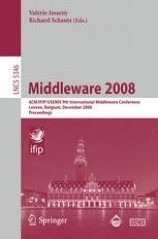
Middleware 2008 ; ACM/IFIP/USENIX 9th International Middleware Conference Leuven, Belgium, December 1-5, 2008 Proceedings
This book constitutes the refereed proceedings of the ACM/IFIP/USENIX 9th International Middleware Conference 2008, held in Leuven, Belgium, in December 2008.The 21 revised full papers presented were carefully reviewed and selected from 117 submissions for inclusion in the book. The papers are organized in topical sections on platforms extended to new capabilities, advanced software engineering focusing on specific system properties, system management techniques, as well as components and system algorithms and properties.

Middleware 2006 ; ACM/IFIP/USENIX 7th International Middleware Conference, Melbourne, Australia, November 27 - December 1, 2006, Proceedings
This book constitutes the refereed proceedings of the ACM/IFIP/USENIX 7th International Middleware Conference 2006, held in Melbourne, Australia, in November/December 2006. The 21 revised full papers presented were carefully reviewed and selected from 122 submissions. The papers are organized in topical sections on performance, composition, management, publish/subscribe technology, databases, mobile and ubiquitous computing, security, and data mining techniques.

Microwave Methods in Organic Synthesis
We are delighted to present this volume with contributions from some of themost renowned and experienced microwave chemists today.The delivery and introduction of energy has been closely connected withthe discovery and investigation of new chemistry. It is with pleasure thatwe have seen an increased use of microwave irradiation over the years andwe hope that this volume will reflect the current interest in expanding thescope of microwave applications in both organic and medicinal chemistry. Oneimportant explanation behind the growth of microwave-enhanced chemistryhas been the introduction of dedicated microwave reactors.As a result of this development we are proud to present a diverse set of re-views.

Microscopy of Semiconducting Materials ; Proceedings of the 14th Conference, April 11-14, 2005, Oxford, UK
This is a long-established international biennial conference series, organised in conjunction with the Royal Microscopical Society, Oxford, the Institute of Physics, London and the Materials Research Society, USA. The 14th conference in the series focused on the most recent advances in the study of the structural and electronic properties of semiconducting materials by the application of transmission and scanning electron microscopy. The latest developments in the use of other important microcharacterisation techniques were also covered and included the latest work using scanning probe microscopy and also X-ray topography and diffraction. Developments in materials science and technology covering the complete range of elemental and compound semiconductors are described in this volume.

Microprocessor 2 : Communication in a digital system
Focuses more particularly on the first generations of microprocessors, that is to say those that handle integers in 4 and 8-bit formats. The first chapter presents the calculation function and reminds the memory function. The following is devoted to notions of calculation model and architecture. The concept of bus is then presented. Chapters 4 and 5 can then address the internal organization and operation of the microprocessor first in hardware and then software. The mechanism of the function call, conventional and interrupted, is more particularly detailed in a separate chapter. The book ends with a presentation of architectures of the first microcomputers for a historical perspective. The knowledge is presented in the most exhaustive way possible with examples drawn from current and old technologies that illustrate and make accessible the theoretical concepts. Each chapter ends if necessary with corrected exercises and a bibliography. The list of acronyms used and an index are at the end of the book.

Microorganisms in the deterioration and preservation of cultural heritage
This book offers a comprehensive overview of the role and potential of microorganisms in the degradation and preservation of cultural materials (e.g. stone, metals, graphic documents, textiles, paintings, glass, etc.).

Microorganisms in soils : Roles in genesis and functions
The following key topics are covered: Microorganisms in bioerosion, humification, mineralization and soil aggregation; Microbial energetics and microbes in biogeochemical processes such as carbon and nitrogen cycles and phosphorus bio-availability; Interactions in the mycorrhizosphere, e.g. between mycorrhizal fungi and bacteria; Impact of microbes on plant nutrient cycling and the possible effects of transgenic rhizospheres on soil fungi; Functions of microbes in specific soil compartments such as soil surface or toxic metal polluted soils; Regulation of microbial activities in functional domains that are influenced by biotic or abiotic factors; Use of marker genes and isotopes as examples for modern techniques in soil microbiology.

Microorganisms in Foods 6 : Microbial Ecology of Food Commodities
The second edition of Microorganisms in Foods 6: Microbial Ecology of Food Commodities is intended for those primarily in applied aspects of food microbiology. For 17 commodity areas it describes the initial microbial flora and the prevalence of pathogens, the microbiological consequences of processing, typical spoilage patterns, episodes implicating those commodities with foodborne illness, and measures to control pathogens and limit spoilage. The control measures are presented in a standardized format in line with international developments in risk management. A comprehensive index has also been added.

Microorganisms and Bioterrorism
The purpose of this book is to bring together, in a single volume, the most up-to-date information concerning microbes with potential as bioterrorist weapons. The primary audience includes microbiologists, including bacteriologists, virologists and mycologists, in academia, government laboratories and research institutes at the forefront of studies concerning microbes which have potential as bioterrorist weapons, public health physicians and researchers and scientists who must be trained to deal with bioterrorist attacks as well as laboratory investigators who must identify and characterize these microorganisms from the environment and from possibly infected patients.

Micrometeorites and the Mysteries of Our Origins
This book relates an attempt to decrypt the still-obscure first billion years of history of the young Earth, during a cataclysmic period during which our planet was heavily bombarded by bodies ranging in size from that of Mars to 0.1 mm sized tiny micrometeorites. It was thus found that micrometeorites played an essential role in the formation of the post-lunar atmosphere. They also provided a surprisingly large diversity of reactions in the organic prebiotic chemistry required for the birth of life on our blue planet. The author presents a wide-ranging review of the type of knowledge required to decrypt this history, which provides extensive background information from astronomy, planetary dynamics, planetology, astrobiology and earth sciences. This book will appeal to both the scientist and the general reader. It will be a source of material for lectures, and possibly new investigations, in these fields.

Micrometastasis
Distant metastases are the main cause of cancer-related death. The onset of the metastatic process can now be assessed in cancer patients by the use of immunocytochemical and molecular methods that allow the identification of disseminated carcinoma cells in regional lymph nodes, peripheral blood or distant organs. There is increasing evidence that the detection and characterization of tumor cells present in bone marrow or peripheral blood can provide clinically important information. In this book, leading experts in the area of micrometastasis research provide an overview that summarizes the current state of research on micrometastatic disease in patients with solid tumors. In each chapter, the technical aspect as well as clinical relevance of micrometastasis detection is discussed. The book addresses basic researchers as well as clinicians involved in the treatment of cancer patients.

Micromanufacturing and Nanotechnology
Micromanufacturing and Nanotechnology is an emerging technological infrastructure and process that involves manufacturing of products and systems at the micro and nano scale levels. Development of micro and nano scale products and systems are underway due to the reason that they are faster, accurate and less expensive. Moreover, the basic functional units of such systems possesses remarkable mechanical, electronic and chemical properties compared to the macro-scale counterparts. Since this infrastructure has already become the prefered choice for the design and development of next generation products and systems it is now necessary to disseminate the conceptual and practical phenomenological know-how in a broader context. This book incorporates a selection of research and development papers. Its scope is the history and background, underlynig design methodology, application domains and recent developments.

Microlithography/Molecular Imprinting
The series presents critical reviews of the present and future trends in polymer and biopolymer science including chemistry, physical chemistry, physics and material science. It is addressed to all scientists at universities and in industry who wish to keep abreast of advances in the topics covered.Molecular recognition is central to how biological systems work. The molecular imprinting technique is a valuable polymerisation method for preparing synthetic materials able to mimic the molecular recognition phenomena present in living systems. A molecule that acts as a template is associated with functional monomers to form a complex by means of covalent linkages or noncovalent interactions. A polymerisation-crosslinking reaction is then performed around this complex. Upon removal of the template species, functionalised cavities, that have memorized the special features and bonding preferences of the template, are left inside the polymer network.

Microeconomics for Managers ; 2nd ed.
Shows future managers how economics can provide practical answers to critical business problems. Focuses on case studies and real companies, such as Amazon, Microsoft, General Motors, United Airlines, and Xerox. Covers essential topics for future managers—including price discrimination, Porter’s five forces, risk sharing and spreading, signaling and screening, credibility and reputation, and economics and organizational behavior / Features an online supplement (available at micro4managers.stanford.edu) for students that provides solutions to the problems in the book, longer caselike exercises, review problems, a calculus review, and more

Microeconometric Evaluation of Labour Market Policies
This study was accepted as a doctoral thesis by the Department of E- nomics of the Johann Wolfgang Goethe-University in Frankfurt/Main. It was undertaken within the research project 'The Efects of Job Creation and Structural Adjustment Schemes on the Participating Individuals', which was conducted by the Institute of Statistics and Econometrics (Empirical E- nomic Research) in cooperation with the Institute for Employment Research in Nuremberg.

Microbiology of Extreme Soils
This volume provides an excellent introduction to the study of extreme soil micro-biology, and a variety of the challenging and fascinating environments that Earth-bound microbes face. Some are natural, and some are the result of human activity, and all of them have lessons to teach us about life’s adaptations within the “extreme” hori-zons of terrestrial soils. What’s more, each of these chapters (including the chapter on the soils of Mars by Ronald L. Crawford and David A. Newcombe) can give us insights into strategies that may make life possible beyond the safe confines of our present-day biosphere, to other worlds in this solar system and beyond

Microbial Sulfur Metabolism
In nature, sulfur occurs in many different oxidation states and is one of the most versatile elements in life. It is an integral part of many important cell constituents, such as the amino acids cysteine and methionine, and many sulfur compounds serve as the basis for energy-related processes in prokaryotes. In recent years, new methods have been applied to study the biochemistry and molecular biology of reactions of the global sulfur cycle, the microorganisms involved and their physiology, metabolism and ecology. These activities have uncovered fascinating new insights for the understanding of aerobic and anaerobic sulfur metabolism.
