



الصفحة 12
الصفحة 12

Modeling of Creep for Structural Analysis
"Creep Modeling for Structural Analysis" develops methods to simulate and analyze the time-dependent changes of stress and strain states in engineering structures up to the critical stage of creep rupture. The principal subjects of creep mechanics are the formulation of constitutive equations for creep in structural materials under multi-axial stress states; the application of structural mechanics models of beams, plates, shells and three-dimensional solids and the utilization of procedures for the solution of non-linear initial-boundary value problems. The objective of this book is to review some of the classical and recently proposed approaches to the modeling of creep for structural analysis applications as well as to extend the collection of available solutions of creep problems by new, more sophisticated examples.

Modeling of Adhesively Bonded Joints
A lot of recent developments have been made about adhesively bonded joints modeling using various methods of analysis. The increasing application of adhesives in industry is partly due to the increased sophistication and reliability of adhesive joints modeling. The book proposed intends to provide the designer with the most advanced stress analyses techniques in adhesive joints to reinforce the use of this promising bonding technique.

Modeling Longitudinal Data
This book teaches the art and statistical science of modern longitudinal data analysis. The author emphasizes specifying, understanding, and interpreting longitudinal data models. He inspects the longitudinal data graphically, analyzes the time trend and covariates, models the covariance matrix, and then draws conclusions. The book has many figures and tables illustrating longitudinal data and numerous homework problems. The associated web site contains many longitudinal data sets, examples of computer code, and labs to re-enforce the material.

Modeling Foundations of Economic Property Rights Theory : An Axiomatic Analysis of Economic Agreements
The idea is to construct a kind of mathematical application in which any fundamental formal entity and/or operation has an empirical economic interpretation. This approach is seen as a way to cope with an extreme c- plexity of economic phenomena under consideration and requests for precise formulationofmodelswheremeaningfulanswersandsolutionsofproblemsare only those which are obtained rigorously. The proposed extensions in ma- ematical economics and property rights theory are to provide rich enough foundations to follow complexity of economic property rights in the exact way, and to identify where there is an appropriate method providing a- quate solution, and also to ?nd problems where in general there is no such methodology.

Modeling Financial Time Series with S-PLUS®
This book represents an integration of theory, methods, and examples using the S-PLUS statistical modeling language and the S+FinMetrics module to facilitate the practice of financial econometrics. This is the first book to show the power of S-PLUS for the analysis of time series data.It covers S+FinMetrics 2.0 and includes new chapters on copulas, nonlinear regime switching models, continuous-time financial models, generalized method of moments, semi-nonparametric conditional density models, and the efficient method of moments.

Modeling Excitable Tissue : The EMI Framework
This volume presents a novel computational framework for understanding how collections of excitable cells work. The key approach in the text is to model excitable tissue by representing the individual cells constituting the tissue. This is in stark contrast to the common approach where homogenization is used to develop models where the cells are not explicitly present. The approach allows for very detailed analysis of small collections of excitable cells, but computational challenges limit the applicability in the presence of large collections of cells.

Modeling Data Irregularities and Structural Complexities in Data Envelopment Analysis
DEA is computational at its core and this book by Zhu and Cook deals with the micro aspects of handling and modeling data issues in modeling DEA problems. DEA's use has grown with its capability of dealing with complex "service industry" and the "public service domain" types of problems that require modeling both qualitative and quantitative data. It is a handbook treatment dealing with specific data problems including the following: (1) imprecise data, (2) inaccurate data, (3) missing data, (4) qualitative data, (5) outliers, (6) undesirable outputs, (7) quality data, (8) statistical analysis, (9) software and other data aspects of modeling complex DEA problems. In addition, the book demonstrates how to visualize DEA results when the data is more than 3-dimensional, and how to identify efficiency units quickly and accurately.

Modeling biological systems : Principles and applications
This extensively revised second edition of Modeling Biological Systems: Principles and Applications describes the essentials of creating and analyzing mathematical and computer simulation models for advanced undergraduates and graduate students. It offers a comprehensive understanding of the underlying principle, as well as details and equations applicable to a wide variety of biological systems and disciplines. Students will acquire from this text the tools necessary to produce their own models. The text contains two major sections: Principles and Applications. The first section discusses the principles of biological systems with a thorough description of the essential modeling activities of formulation, implementation, validation, and analysis. These activities are illustrated by a set of example models taken from recent and classical literature, chosen for their breadth of coverage and current timeliness. The new edition updates extensively many of these topics, especially quantitative model formulation, validation and model discrimination using information theory measures and Bayesian probability, and stability analysis and non-dimensionalization.

Modeling and simulation of complex communication networks
Covers important topics and approaches related to the modeling and simulation of complex communication networks from a complex adaptive systems perspective. The authors present different modeling paradigms and approaches as well as surveys and case studies. Modern network systems such as Internet of Things, Smart Grid, VoIP traffic, Peer-to-Peer protocol, and social networks, are inherently complex. They require powerful and realistic models and tools not only for analysis and simulation but also for prediction. With contributions from an international panel of experts, this book is essential reading for networking, computing, and communications professionals, researchers and engineers in the field of next generation networks and complex information and communication systems, and academics and advanced students working in these fields.

Modeling and Analysis of Transient Processes in Open Resonant Structures : New Methods and Techniques
The principal goal of the book is to describe new accurate and robust algorithms for open resonant structures with substantially increased efficiency. The book presents a systematic approach to the study of electromagnetic waves scattering which can be introduced in undergraduate/postgraduate education in theoretical and applied radiophysics and different advanced engineering courses on antenna and wave-guide technology.

Model-Driven Development of Reliable Automotive Services ; 2nd Automotive Software Workshop, ASWSD 2006, San Diego, CA, USA, March 15-17, 2006, Revised Selected Papers
This book constitutes the thoroughly refereed post-workshop proceedings of the Second Automotive Software Workshop, ASWSD 2006, held in San Diego, CA, USA in March 2006.The 11 revised full papers presented were carefully reviewed and selected from 18 lectures held at the workshop, that brought together experts from industry and academia, working on highly complex, distributed, reactive software systems related to the automotive domain. The papers are organized in topical sections on modeling techniques and infrastructures, model transformations, quality assurance, real-time control, as well as services and components.

Model-Driven Development and Operation of Multi-Cloud Applications : The MODAClouds Approach
In this book readers will find technological discussions on the existing and emerging technologies across the different stages of the big data value chain. They will learn about legal aspects of big data, the social impact, and about education needs and requirements. And they will discover the business perspective and how big data technology can be exploited to deliver value within different sectors of the economy. The book is structured in four parts: Part I "The Big Data Opportunity" explores the value potential of big data with a particular focus on the European context. It also describes the legal, business and social dimensions that need to be addressed, and briefly introduces the European Commission's BIG project.

Model-based Fault Diagnosis Techniques : Design Schemes, Algorithms, and Tools
The objective of this book is to introduce basic model-based FDI schemes, advanced analysis and design algorithms and the needed mathematical and control theory tools at a level for graduate students and researchers as well as for engineers.

Model-Based Demography: Essays on Integrating Data, Technique and Theory
This book shows how demography can build a strong theoretical edifice on its broad and deep empirical foundation by adoption of the model-based approach to science. But the full-fruits of this approach will require demographers to make greater use of computer modeling [both macro- and micro-simulation], in the statement and manipulation of theoretical ideas, as well as for numerical computation.

Model tests and numerical simulations of liquefaction and lateral spreading ; LEAP-UCD-2017
This book presents work collected through the Liquefaction Experiments and Analysis Projects (LEAP) in 2017. It addresses the repeatability, variability, and sensitivity of lateral spreading observed in twenty-four centrifuge model tests on mildly sloping liquefiable sand.

Model driven Engineering Languages and Systems; 10th International Conference, MoDELS 2007, Nashville, USA, September 30 - October 5, 2007, Proceedings
This book constitutes the refereed proceedings of the 10th International Conference on Model Driven Engineering Languages and Systems (formerly the UML series of conferences), MODELS 2007, held in Nashville, USA, September 30 - October 5, 2007. The 45 revised full papers were carefully reviewed and selected from 158 initial submissions.
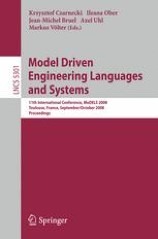
Model Driven Engineering Languages and Systems ; 11th International Conference, MoDELS 2008, Toulouse, France, September 28 - October 3, 2008. Proceedings
The book also contains three keynote speeches and contributions to workshops, symposia, tutorials and panels at the conference. The papers are organized in topical sections on Model Transformation: Foundations; Requirements Modeling; Domain-Specific Modeling; Model Transformation: Techniques, Composition and Analysis of Behavioral Models; Model Comprehension; Model Management; Behavioral Conformance and Refinement; Metamodeling and Modularity; Constraints; Model Analysis; Service-Oriented Architectures; Adaptive and Autonomic Systems; Empirical Studies; Evolution and Reverse Engineering; Modeling Language Semantics; Dependability Analysis and Testing; Aspect-Oriented Modeling; Structural Modeling;and Embedded Systems.

Model Driven Architecture : Foundations and Applications ; 1st European Conference, ECMDA-FA 2005, Nuremberg, Germany, November 7-10, 2005, Proceedings
Constitutes the refereed proceedings of the First European Conference, Workshops on Model Driven Architecture - Foundations and Applications, ECMDA-FA 2005, held in Nuremberg, Germany, in November, 2005. The papers are organized in topical sections on MDA development processes, MDA for embedded and real-time systems, and more.

Model Checking Software ; Vol. 3925 ; 13th International SPIN Workshop, Vienna, Austria, March 30 - April 1, 2006, Proceedings
he name “SPIN” refers both to a workshopon model checking and to a famous model checking tool. The SPIN workshop is an annual forum for practitioners and researchersinterested in state space-based techniques for the validation and analysis of software and hardware systems, including communication protocols. It focuses on techniques based on explicit representations of state spaces, as implemented in the SPIN model checker or other tools, and techniques based on a combination of explicit representations with other representations. The SPIN model checker has proven to be particularly suited for the analysis of concurrent asynchronous systems. The workshop aims to encourage interaction and exchange of ideas with all related areas in software engineering.

Model Checking Software ; Vol. 3639 : 12th International SPIN Workshop, San Francisco, CA, USA, August 22-24, 2005, Proceedings
Constitutes the refereed proceedings of the 12th International SPIN workshop on Model Checking Software, SPIN 2005, held in San Francisco, USA in August 2005. The papers are organized in topical sections on state representation and abstraction, dealing with concurrency, dealing with complex data, checking temporal properties, and more.
