



الصفحة 119
الصفحة 119

Equestrain and Horse Care Club = نادي الفروسية و رعاية الخيول
يهدف المشروع إلى تصميم وإنشاء نادٍ متكامل للفروسية يُعنى برعاية الخيول وتدريبها وفق أعلى المعايير الحديثة. يوفر النادي بيئة مناسبة لمحبَي رياضة الفروسية، حيث يجمع بين الجانب الرياضي والترفيهي والتعليمي. يتضمن المشروع دراسة متكاملة لتخطيط المساحات، تصميم الإسطبلات، الميادين التدريبية، مرافق الرعاية البيطرية، والمناطق الخصصة للزوار. كما يهدف إلى تعزيز ثقافة الفروسية في المجتمع، والمحافظة على الخيل العربي الأصيل، وتوفير تجربة آمنة وممتعة للمشتركين والزوار. يعتمد المشروع على معايير الاستدامة في التصميم والمواد المستخدمة بما يحقق التوازن بين الجمال والوظيفة. تمت دراسة احتياجات الخيول من حيث التغدية، الإيواء، والنظافة بما يضمن سلامتها وصحتها الجسدية والنفسية، مع تخصيص مرافق بيطرية مجهزة بأحدث الأدوات لخدمتها على مدار الساعة. كما تم الآخد بعين الاعتبار تطبيق معايير الأمان للخيول والفرسان على حدٍ سواء. ويعد المشروع نموذجاً متكاملاً يجمع بين الجمال المعماري والوظائف العملية، مسهماً في دعم السياحة الداخلية وتطوير البيئة التحتية الرياضية في المنطقة، إضافةً إلى خلق فرص تدريب وتشغيل ضمن قطاع الفروسية في المجتمع المحلي.

Enzyme Biocatalysis : Principles and Applications
This book was written with the purpose of providing a sound basis for the design of enzymatic reactions based on kinetic principles, but also to give an updated vision of the potentials and limitations of biocatalysis, especially with respect to recent app- cations in processes of organic synthesis. The ?rst ?ve chapters are structured in the form of a textbook, going from the basic principles of enzyme structure and fu- tion to reactor design for homogeneous systems with soluble enzymes and hete- geneous systems with immobilized enzymes. The last chapter of the book is divided into six sections that represent illustrative case studies of biocatalytic processes of industrial relevance or potential, written by experts in the respective ?elds.

Environments for Multi-Agent Systems III ; 3rd International Workshop, E4MAS 2006, Hakodate, Japan, May 8, 2006, Selected Revised and Invited Papers
This book are organized in topical sections on models, architecture, and design, mediated interaction and stigmery, governing environment, and applications.

Environmentally-Friendly Product Development: Methods and Tools
Presents a survey of eco-friendly product design. This work is aimed at researchers and academics in design engineering and practitioners and managers in the industry

Environmental valuation with discrete choice experiments : Guidance on design, implementation and data analysis
This book offers up-to-date advice and practical guidance on how to undertake a discrete choice experiment as a tool for environmental valuation. It discusses crucial issues in designing, implementing and analysing choice experiments. Compiled by leading experts in the field, the book promotes discrete choice analysis in environmental valuation through a more solid scientific basis for research practice. Instead of providing strict guidelines, the book helps readers avoid common mistakes often found in applied work. It is based on the collective reflections of the scientific network of researchers using discrete choice modelling in the field of environmental valuation (www.envecho.com).

Environmental security and environmental management : The role of risk assessment ; Proceedings of the NATO Advanced Research Workhop on The Role of Risk Assessment in Environmental Security and Emergency Preparedness in the Mediterranean Region, held in Eilat, Israel, April 15-18, 2004
The concept of “environmental security” has emerged as one basis for understanding international conflicts. This phrase can mean a variety of things. It can signify security issues stemming from environmental concerns or conflicting needs, or it can mean that the environment is treated as a resource for the long term, and the question is what should be done today to preserve the quality of the environment in the future. In the same way that energy security is about ensuring access to energy for the long run, it can also mean that pressing environmental concerns create a situation where different countries and communities are forced to collaboratively design a unified response, even if cooperation is not generally in the logic of their relations. Over the last several years, the authors of this book and their colleagues have tried to demonstrate the power of risk assessment and decision analysis as valuable tools that decision makers should use for a broad range of environmental problems, including environmental security. Risk analysis is almost more a state of mind or a way of looking at problems than it is a kind of algorithm or a set of recipes. It projects a kind of rationality on problems and forces a certain degree of quantitative rigor, as opposed to the all too common tendency of making environmental recommendations based on anecdotal evidence.

Environmental Modeling : Using MATLAB®
“Environmental Modeling using MATLAB R ” by Ekkehard Holzbecher is an excellent publication and a novel approach covering the intersection of two important, growing worlds – the world of environmental modeling and of mathematical software. Environmental modeling is a science that uses mathematics and comp- ers to simulate physical and chemical phenomena in the environment (e.g., environmental pollution).

Environmental impact assessment of recycled wastes on surface and ground waters ; Vol.3 : Engineering modeling and sustainability
The state of the art of the impact assessment of recycled hazardous waste materials on surface and ground waters is presented. The topics include chemodynamics, toxicology, modeling and information systems. The book serves as a practical conceptual guide for those who have professional responsibility for the monitoring, design, management, or conduct of environmental impact assessment. It is believed that the book will prove useful to the reader who, regardless of disciplinary background, wants to examine in greater detail the kinds of interdisciplinary contributions to contemporary decision-making processes that characterize modern impact assessment project development.

Environmental Impact Assessment of Recycled Wastes on Surface and Ground Waters ; Vol.2 : Risk analysis
The state of the art of the impact assessment of recycled hazardous waste materials on surface and ground waters is presented. The topics include chemodynamics, toxicology, modeling and information systems. The book serves as a practical conceptual guide for those who have professional responsibility for the monitoring, design, management, or conduct of environmental impact assessment. It is believed that the book will prove useful to the reader who, regardless of disciplinary background, wants to examine in greater detail the kinds of interdisciplinary contributions to contemporary decision-making processes that characterize modern impact assessment project development.

Environmental Impact Assessment of Recycled Wastes on Surface and Ground Waters ; Vol.1 : Concepts, methodology and cemical analysis
The state of the art of the impact assessment of recycled hazardous waste materials on surface and ground waters is presented. The topics include chemodynamics, toxicology, modeling and information systems. Due to the wealth of information on this topic, the texts of T. Kassim (ed.): Environmental Impact Assessment are published in three separate volumes: vol. 1: Concepts, Methodology and Chemical Analysis; vol. 2: Risk Analysis and vol. 3: Engineering Modeling and Sustainability. The book serves as a practical conceptual guide for those who have professional responsibility for the monitoring, design, management, or conduct of environmental impact assessment. It is believed that the book will prove useful to the reader who, regardless of disciplinary background, wants to examine in greater detail the kinds of interdisciplinary contributions to contemporary decision-making processes that characterize modern impact assessment project development.

Entrepreneurship in Emerging Domestic Markets : Barriers and Innovation
As one examines worldwide economic growth over the past decade, it is clear that the U.S. economy has surpassed most of the industrialized world, both in its rate of growth and its ability to create wealth. Entrepreneurship is critical to this growth—entrepreneurs recognize the potential of new ideas, design applications, develop new products, and successfully bring products to market. They build companies and create jobs, generating new opportunities for wealth creation.

Entrepreneurship and innovation : Theory, practice and context, 4th
Provides an overview of the theory, Practice and context of entrepreneurship and innovation at both the industry and firm level. It provides a foundation of ideas and understandings designed to shape the reader’s thinking and behaviour to better appreciate the role of innovation and entrepreneurship in modern economies, And to recognise their own abilities in this regard. The book provides the reader with an overview of these elements and how they combine to create new value in the market.
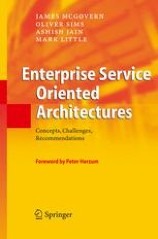
Enterprise service oriented architectures : Concepts, challenges, recommendations
Enterprise Service Oriented Architectures helps readers solve this challenge in making different applications communicate in a loosely coupled manner. This classic handbook leverages the experiences of thought leaders functioning in multiple industry verticals and provides a wealth of knowledge for creating the agile enterprise.

Enterprise ontology : Theory and methodology
Such a theory and a matching methodology, which has passed the test of practical experience, constitute the contents of this book. The enterprise ontology, as developed by Dietz, is the starting point for profoundly understanding the organization of an enterprise and subsequently for analyzing, (re)designing, and (re)engineering it. The approach covers numerous issues in an integrated way: business processes, in- and outsourcing, information systems, management control, staffing etc.

Enterprise Knowledge Infrastructures
Success of an organization is increasingly dependent on its capability to create an environment to improve the productivity of knowledge work. This book focuses on the concepts, models and technologies that are used to design and implement such an environment. It develops the vision of a modular, yet highly integrated enterprise knowledge infrastructure and presents an ideal architecture replete with current technologies and systems. The most important streams of technological development that are covered in the book are computer-supported cooperative work, document and content management, e-learning, enterprise portals, information life cycle management, knowledge management, mobile computing, and the Semantic Web. It includes learning goals, exercises and case examples that help the reader to easily understand and practice the concepts.

Enhancing Teaching and Learning through Assessment : Deriving an Appropriate Model
Provides a practical guide on the effective use of assessment. It includes the use of assessment tools and pedagogical design that help students deepen their learning. Major issues on assessment and some excellent examples are presented as a useful resource to university teachers in enhancing teaching and students' learning. It will also be found useful by teachers when implementing various assessment methods. School administrators and teaching development professionals will find the book useful when making decisions related to learning and teaching issues in their institutions.

Enhancing Cognitive Assistance Systems with Inertial Measurement Units
The primary goal of this book is the specification, design and testing of an inertially stabilized camera platform for assistance systems with the focus on adaptive inertial measurement.

Enhanced Methods in Computer Security, Biometric and Artificial Intelligence Systems
"Methods of Artificial Intelligence and Intelligent Agents" contains 13 contributions analyzing such areas of AI as fuzzy set theory, predicate logic, neural networks, clustering, data mining and others. It also presents applications of AI as possible solutions for problems like firm bankruptcy, soil erosion, flight control and others. "Information Technology Security" covers three important areas of security engineering in information systems: software security, public key infrastructure and the design of new cryptographic protocols and algorithms. "Biometric Systems" comprises 11 contributions dealing with face picture analysis and recognition systems. This chapter focuses on known methods of biometric problem solution as well as the design of new models.

Engineering theories of software intensive systems : Theory, algorithms, software, and applications
Software engineering has over the years been applied in many different fields, ranging from telecommunications to embedded systems in car and aircraft industry as well as in production engineering and computer networks. Foundations in software technology lie in models allowing to capture application domains, detailed requirements, but also to understand the structure and working of software systems like software architectures and programs. These models have to be expressed in techniques based on discrete mathematics, algebra and logics. However, according to the very specific needs in applications of software technology, formal methods have to serve the needs and the quality of advanced software engineering methods, especially taking into account security aspects in Information Technology. This book presents mathematical foundations of software engineering and state-of-the-art engineering methods in their theoretical substance in the step towards practical applications to examine software engineering techniques and foundations used for industrial tasks.
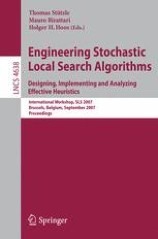
Engineering Stochastic Local Search Algorithms. Designing, Implementing and Analyzing Effective Heuristics ; International Workshop, SLS 2007, Brussels, Belgium, September 6-8, 2007, Proceedings
Stochastic local search (SLS) algorithms enjoy great popularity as powerful and versatile tools for tackling computationally hard decision and optimization pr- lems from many areas of computer science, operations research, and engineering. However, in recent years it has become evident that at the core of this development task there is a highly complex engineering process, which combines various aspects of algorithm design with empirical analysis techniques and problem-specific background, and which relies heavily on knowledge from a number of disciplines and areas, including computer science, operations research, artificial intelligence, and statistics. This development process needs to be - sisted by a sound methodology that addresses the issues arising in the various phases of algorithm design, implementation, tuning, and experimental eval- tion.
