


تحسين النتائح
ترتيب حسب
من
الى

Analyses the implications of the technical, legal, ethical and privacy challenges as well as challenges for human rights and civil liberties regarding Artificial Intelligence (AI) and National Security. It also offers solutions that can be adopted to mitigate or eradicate these challenges wherever possible. As a general-purpose, dual-use technology, AI can be deployed for both good and evil. The use of AI is increasingly becoming of paramount importance to the governments mission to keep their nations safe. However, the design, development and use of AI for national security poses a wide range of legal, ethical, moral and privacy challenges. This book explores national security uses for Artificial Intelligence (AI) in Western Democracies and its malicious use. This book also investigates the legal, political, ethical, moral, privacy and human rights implications of the national security uses of AI in the aforementioned democracies. It illustrates how AI for national security purposes could threaten most individual fundamental rights, and how the use of AI in digital policing could undermine user human rights and privacy.
Provides a detailed review of the latest methods and applications of artificial intelligence (AI) and machine learning (ML) in medicine. With chapters focusing on enabling the reader to develop a thorough understanding of the key concepts in these subject areas along with a range of methods and resulting models that can be utilized to solve healthcare problems, the use of causal and predictive models are comprehensively discussed. Care is taken to systematically describe the concepts to facilitate the reader in developing a thorough conceptual understanding of how different methods and resulting models function and how these relate to their applicability to various issues in health care and medical sciences. Guidance is also given on how to avoid pitfalls that can be encountered on a day-to-day basis and stratify potential clinical risks.
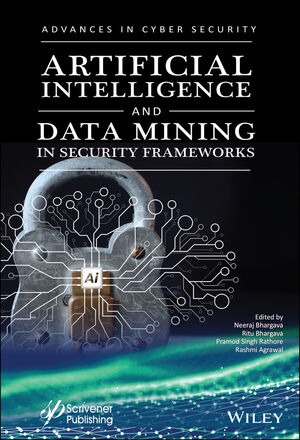
Offers solutions to the problems of security, outlining the concepts behind allowing computers to learn from experience and understand the world in terms of a hierarchy of concepts, with each concept defined through its relation to simpler concepts. provides state of the art approaches of artificial intelligence and data mining in these areas. It includes areas of detection, prediction, as well as future framework identification, development, building service systems and analytical aspects. In all these topics, applications of AI and data mining, such as artificial neural networks, fuzzy logic, genetic algorithm and hybrid mechanisms, are explained and explored. This book is aimed at the modeling and performance prediction of efficient security framework systems, bringing to light a new dimension in the theory and practice. This groundbreaking new volume presents these topics and trends, bridging the research gap on AI and data mining to enable wide-scale implementation. Whether for the veteran engineer or the student, this is a must-have for any library. This groundbreaking new volume: Clarifies the understanding of certain key mechanisms of technology helpful in the use of artificial intelligence and data mining in security frameworks ; Covers practical approaches to the problems engineers face in working in this field, focusing on the applications used every day ; Contains numerous examples, offering critical solutions to engineers and scientists ; Presents these new applications of AI and data mining that are of prime importance to human civilization as a whole
Provides advanced system implementation for Smart Cities using artificial intelligence. It addresses the complete functional framework workflow and explores basic and high-level concepts. The book is based on the latest technologies covering major challenges, issues and advances, and discusses intelligent data management and automated systems.
It's about the science of artificial intelligence (AI). AI is the study of the design of intelligent computational agents. This book provides a valuable resource for researchers, scientists, professionals, academicians and students dealing with the new challenges and advances in the areas of AI and innovations. This book also covers a wide range of applications of machine learning such as fire detection, structural health and pollution monitoring and control. Provides insight into prospective research and application areas related to industry and technology / Discusses industry- based inputs on success stories of technology adoption / Discusses technology applications from a research perspective in the field of AI / Provides a hands- on approach and case studies for readers of the book to practice and assimilate learning
This book focused on engineering general intelligence – autonomous, self-reflective, self-improving, commonsensical intelligence.Each author explains a specific aspect of AGI in detail in each chapter, while also investigating the common themes in the work of diverse groups, and posing the big, open questions in this vital area.
This book constitutes the refereed proceedings of the 21st International Conference on Architecture of Computing Systems, ARCS 2008, held in Dresden, Germany, in February 2008.
Applies the functional OCaml programming language to numerical or computational weighted data science, engineering, and scientific applications. This book is based on the authors' first-hand experience building and maintaining Owl, an OCaml-based numerical computing library. You'll first learn the various components in a modern numerical computation library. Then, you will learn how these components are designed and built up and how to optimize their performance. After reading and using this book, you'll have the knowledge required to design and build real-world complex systems that effectively leverage the advantages of the OCaml functional programming language.
As software systems become increasingly ubiquitous, the issues of dependability become more and more crucial. Given that solutions to these issues must be considered from the very beginning of the design process, it is reasonable that dependability is addressed at the architectural level. This book was born of an effort to bring together the research communities of software architectures and dependability.
As software systems become ubiquitous, the issues of dependability become more and more crucial. Given that solutions to these issues must be considered from the very beginning of the design process, it is reasonable that dependability is addressed at the architectural level. It also contains sections on architectural description languages, architectural components and patterns, architecting distributed systems, and architectural assurances for dependability.
As software systems become ubiquitous, the issues of dependability become more and more crucial. Given that solutions to these issues must be considered from the very beginning of the design process, it is reasonable that dependability is addressed at the architectural level. This book comes as a result of an effort to bring together the research communities of software architectures and dependability. The papers are organised in topical sections on architectures for dependable services, monitoring and reconfiguration in software architectures, dependability support for software architectures, architectural evaluation, and architectural abstractions for dependability

Cheriet provides an overview of the problems of Arabic recognition and how systems can use natural language processing techniques to correct errors in lexicon-based systems.
Introduction The PARA workshops in the past were devoted to parallel computing methods in science and technology. There have been seven PARA meetings to date: PARA’94, PARA’95 and PARA’96 in Lyngby, Denmark, PARA’98 in Umea, ? Sweden, PARA 2000 in Bergen, N- way, PARA 2002 in Espoo, Finland, and PARA 2004 again in Lyngby, Denmark. The ?rst six meetings featured lectures in modern numerical algorithms, computer science, en- neering, and industrial applications, all in the context of scienti?c parallel computing. This meeting in the series, the PARA 2004 Workshop with the title “State of the Art in Scienti?c Computing.
Focuses on the fundamental concepts and at the same time on practical aspects of implementing neural networks and deep learning for your research projects. This book is designed so that you can focus on the parts you are interested in. You will explore topics as regularization, optimizers, optimization, metric analysis, and hyper-parameter tuning. In addition, you will learn the fundamentals ideas behind autoencoders and generative adversarial networks. All the code presented in the book will be available in the form of Jupyter notebooks which would allow you to try out all examples and extend them in interesting ways. A companion online book is available with the complete code for all examples discussed in the book and additional material more related to TensorFlow and Keras. All the code will be available in Jupyter notebook format and can be opened directly in Google Colab (no need to install anything locally) or downloaded on your own machine and tested locally. You will: Understand the fundamental concepts of how neural networks work / Learn the fundamental ideas behind autoencoders and generative adversarial networks / Be able to try all the examples with complete code examples that you can expand for your own projects / Have available a complete online companion book with examples and tutorials.

This book constitutes the refereed proceedings of the 6th International Conference on Applied Cryptography and Network Security, ACNS 2008, held in New York, NY, USA, in June 2008.
Contains the 11 papers that were accepted and published in the Special Issue “Applied and Computational Mathematics for Digital Environments” of the MDPI Mathematics journal. The topics of interest include, among others, scientific research, applied tasks, and problems in the following areas: The construction of mathematical and information models of intelligent computer systems for monitoring and controlling the parameters of digital environments; The development of intelligent optimization algorithms that search for optimal parameter values of mathematical and information models in digital environments; Software and mathematical technologies in the implementation of intelligent monitoring and computer control of the parameters of digital environments; The development and application of mathematical and information models, machine learning methods, and artificial intelligence for the analysis and processing of big data in digital environments.
Membrane computing is a branch of natural computing which investigates computing models abstracted from the structure and functioning of living cells and from their interactions in tissues or higher-order biological structures. The models considered, called membrane systems (P systems), are parallel, distributed computing models, processing multisets of symbols in cell-like compartmental architectures. In many applications membrane systems have considerable advantages – among these are their inherently discrete nature, parallelism, transparency, scalability and nondeterminism.
This book constitutes the thoroughly refereed post-conference proceedings of the Third International Symposium on Applications of Graph Transformations, AGTIVE 2007, held in Kassel, Germany, in October 2007.
This volume presents a careful selection of relevant EC examples combined with a thorough examination of the techniques used in EC. The papers in the volume illustrate the current state of the art in the application of EC and should help and - spire researchers and professionals to develop e?cient EC methods for design and problem solving.
Computational intelligence (CI) is the theory, design, application, and development of biologically and linguistically motivated computational paradigms. Traditionally, the three main pillars of CI have been neural networks, fuzzy systems, and evolutionary computation. However, in time, many nature-inspired computing paradigms have evolved. Thus, CI is an evolving field, and, at present, in addition to the three main constituents, it encompasses computing paradigms such as ambient intelligence, artificial life, cultural learning, artificial endocrine networks, social reasoning, and artificial hormone networks. CI plays a major role in developing successful intelligent systems, including games and cognitive developmental systems.

سوريا - اتستراد درعا - غباغب
+963-15 2050 - 15 860 380 /1/2/3 - 11 662 3900