



الصفحة 10
الصفحة 10
Advanced memory optimization techniques for low-power embedded processors
this book explores a collaborative approach by proposing novel memory hierarchies and software optimization techniques for the optimal utilization of these memory hierarchies. Linking memory architecture design with memory-architecture aware compilation results in fast, energy-efficient and timing predictable memory accesses.The evaluation of the optimization techniques using real-life benchmarks for a single processor system, a multiprocessor system-on-chip (SoC) and for a digital signal processor system, reports significant reductions in the energy consumption and performance improvement of these systems. The book presents a wide range of optimizations, progressively increasing in the complexity of analysis and of memory hierarchies. The final chapter covers optimization techniques for applications consisting of multiple processes found in most modern embedded devices.
Advanced Intelligent Computing Theories and Applications : With Aspects of Artificial Intelligence ; 4th International Conference on Intelligent Computing, ICIC 2008 Shanghai, China, September 15-18, 2008 Proceeding
This book - in conjunction with the two volumes CCIS 0015 and LNCS 5226 - constitutes the refereed proceedings of the 4th International Conference on Intelligent Computing, ICIC 2008, held in Shanghai, China, in September 2008.
Advanced functional programming ; 5th International School, AFP 2004, Tartu, Estonia, August 14-21, 2004, Revised Lectures
Contains the revised lecture notes corresponding to nine of thelecture courses presented at the 5th International School on Advanced Functional Programming, AFP 2004, held in Tartu, Estonia, August 14–21, 2004. The goal of the AFP schools is to inform the wide international communitiesof computer science students and software production professionals about thenew and important developments in the area of functional programming. The schools put a special emphasis on practical applications of advanced techniques.
Adaptive agents and multi-agent systems III : Adaptation and multi-Agent learning ; 5th, 6th, and 7th European Symposium, ALAMAS 2005-2007 on Adaptive and Learning Agents and Multi-Agent Systems, Revised Selected Papers
This book contains selected and revised papers of the European Symposium on Adaptive and Learning Agents and Multi-Agent Systems (ALAMAS).
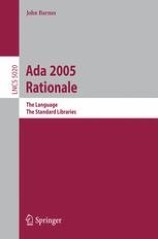
Ada 2005 Rationale : The Language, The Standard Libraries
The primary goals for this book were to enhance its capabilities particularly in those areas where its reliability and predictability are of great value. Accordingly, a number of intriguing and attractive ideas have been included and implemented in a coherent manner as appropriate to the level of perfection necessary for the diligent maintenance of a language standard.

Accelerator Programming Using Directives ; 6th International Workshop, WACCPD 2019, Denver, CO, USA, November 18, 2019, Revised Selected Papers
This book constitutes the refereed post-conference proceedings of the 6th International Workshop on Accelerator Programming Using Directives, WACCPD 2019, held in Denver, CO, USA, in November 2019. The 7 full papers presented have been carefully reviewed and selected from 13 submissions. The papers share knowledge and experiences to program emerging complex parallel computing systems. They are organized in the following three sections: porting scientific applications to heterogeneous architectures using directives; directive-based programming for math libraries; and performance portability for heterogeneous architectures.

Abstract State Machines, B and Z ; 1st International Conference, ABZ 2008, London, UK, September 16-18, 2008. Proceedings
This book constitutes the refereed proceedings of the First International Conference of Abstract State Machines, B and Z, ABZ 2008, held in London, UK, in September 2008.
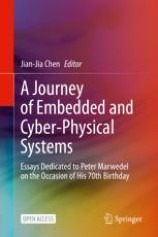
A journey of embedded and cyber-physical systems : Essays dedicated to Peter Marwedel on the occasion of his 70th birthday
This book celebrates Professor Peter Marwedel's outstanding achievements in compilers, embedded systems, and cyber-physical systems. The contributions in the book summarize the content of invited lectures given at the workshop “Embedded Systems” held at the Technical University Dortmund in early July 2019 in honor of Professor Marwedel's seventieth birthday.
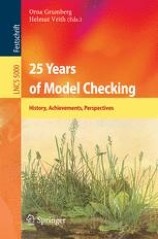
25 Years of Model Checking : History, Achievements, Perspectives
Model checking technology is among the foremost applications of logic to computer science and computer engineering. The model checking community has achieved many breakthroughs, bridging the gap between theoretical computer science and hardware and software engineering, and it is reaching out to new challenging areas such as system biology and hybrid systems. Model checking is extensively used in the hardware industry and has also been applied to the verification of many types of software. Model checking has been introduced into computer science and electrical engineering curricula at universities worldwide and has become a universal tool for the analysis of systems.
