



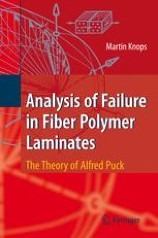
Analysis of failure in fiber polymer laminates : the theory of Alfred Puck
This book presents for the first time comprehensively the Theory of Alfred Puck on failure in Fiber Polymer Laminates. After a brief introduction into the failure analysis of laminates and its history, the text focuses first on Puck’s fracture criteria and gives detailed information on their physical background, mathematical derivation and application. Another core part of Puck’s Theory is his concept for Post Failure Analysis. Here, too, the physical background and the analytical procedure are presented. The theoretical chapters are completed by the presentation of the latest developments, namely the consideration of residual stresses and probabilistic effects. The second main part of the book deals with the extensive experimental verification program which has been accomplished since the mid 1990’s. As a result of this work, the Puck Theory can be regarded as better verified than any other theory. All experimental set ups and the major results are presented and explained.
كتب مشابهة

Comprehensive utilization of magnesium slag by pidgeon process
This book introduces the harmless handling/recycling of magnesium slag , the process of magnesium silicothermic reduction (Pidgeon process)which the slag was produced, and . the magnesium resources, layout of the industry of the world. Examples and experimental data in this book are from the author group’s research programs, as well as the rencent researches in China. The book could provide precious reference to scientists and engineers in the field of recycling and environment friendly use of the industrial solid wastes. It could also be used for researchers and students who are interested in relevant field.

Adhesive Bonding of Aircraft Composite Structures: Non-destructive Testing and Quality Assurance Concepts
This book is under a CC BY 4.0 license. It presents the results of the ComBoNDT European project, which aimed at the development of more secure, time- and cost-saving extended non-destructive inspection tools for carbon fiber reinforced plastics, adhered surfaces and bonded joints. The book reports the optimal use of composite materials to allow weight savings, reduction in fuel consumptions, savings during production and higher cost efficiency for ground operations.
Materials Issues for Generation IV Systems ; Status, Open Questions and Challenges
Global warming, shortage of low-cost oil resources and the increasing demand for energy are currently controlling the world's economic expansion while often opposing desires for sustainable and peaceful development. In this context, atomic energy satisfactorily fulfills the criteria of low carbon gas production and high overall yield. However, in the absence of industrial fast-breeders the use of nuclear fuel is not optimal, and the production of high activity waste materials is at a maximum. These are the principal reasons for the development of a new, fourth generation of nuclear reactors, minimizing the undesirable side-effects of current nuclear energy production technology while increasing yields by increasing operation temperatures and opening the way for the industrial production of hydrogen through the decomposition of water.
Magnetic Nanostructures in Modern Technology ; Spintronics, Magnetic MEMS and Recording
A team of outstanding scientists in the field of modern magnetic nanotechnologies illustrates the state of the art in several areas of advanced magneto-electronic devices, magnetic micro-electromechanical systems and high density information storage technologies.The physics and chemistry of nano-scale systems have made rapid advances and there are real prospects of translating exciting scientific findings into a new generation of processes and high technology products with a potential impact on several industrial sectors. In particular the development of nano-structured magnetic materials plays a leading role in the increasing miniaturization of devices with superior performances.
