



Page 4
Page 4

Dependable computing ; 3rd Latin-American Symposium, LADC 2007, Morelia, Mexico, September 26-28, 2007, Proceedings
This book presented fault-tolerant algorithms, software engineering of dependable systems, networking and mobile computing, experimental dependability evaluation, as well as intrusion tolerance and security.

Data Communications and Networking with TCP
Teaches the principles of networking using TCP/IP protocol suite. It employs a bottom-up approach where each layer in the TCP/IP protocol suite is built on the services provided by the layer below.

Data Communications and networking
Helps students understand the basics of data communications and networking, and the protocols used in the Internet in particular by using the protocol layering of the Internet and TCP/IP protocol suite. Technologies related to data communication and networking may be the fastest growing in today's culture.

Data communications and network technologies
Aims to help readers master the basics of network communications and use Huawei network devices to set up enterprise LANs and WANs, wired networks, and wireless networks, ensure network security for enterprises, and grasp cutting-edge computer network technologies. The content of this book includes: network communication fundamentals, TCP/IP protocol, Huawei VRP operating system, IP addresses and subnetting, static and dynamic routing, Ethernet networking technology, ACL and AAA, network address translation, DHCP server, WLAN, IPv6, WAN PPP and PPPoE protocol, typical networking architecture and design cases of campus networks, SNMP protocol used by network management, operation and maintenance, network time protocol NTP, SND and NFV, programming, and automation.

Data center networking : Network topologies and traffic management in large-scale data centers
Provides a comprehensive reference in large data center networking. It first summarizes the developing trend of DCNs, and reports four novel DCNs, including a switch-centric DCN, a modular DCN, a wireless DCN, and a hybrid DCN. Furthermore another important factor in DCN targets at managing and optimizing the network activity at the level of transfers to aggregate correlated data flows and thus directly to lower down the network traffic resulting from such data transfers. In particular, the book reports the in-network aggregation of incast transfer, shuffle transfer, uncertain incast transfer, and the cooperative scheduling of uncertain multicast transfer.

Data and Computer Communications
It is ideal for one/two-semester courses in Computer Networks, Data Communications, and Communications Networks in CS, CIS, and Electrical Engineering departments. This book is also suitable for Product Development personnel, Programmers, Systems Engineers, Network Designers and others involved in the design of data communications and networking products. With a focus on the most current technology and a convenient modular format, this best-selling text offers a clear and comprehensive survey of the entire data and computer communications field. Emphasizing both the fundamental principles as well as the critical role of performance in driving protocol and network design, it explores in detail all the critical technical areas in data communications, wide-area networking, local area networking, and protocol design.

CyberParks – The Interface Between People, Places and Technology: New Approaches and Perspectives
This book is about public open spaces, about people, and about the relationship between them and the role of technology in this relationship. It is about different approaches, methods, empirical studies, and concerns about a phenomenon that is increasingly being in the centre of sciences and strategies – the penetration of digital technologies in the urban space. As the main outcome of the CyberParks Project, this book aims at fostering the understanding about the current and future interactions of the nexus people, public spaces and technology. It addresses a wide range of challenges and multidisciplinary perspectives on emerging phenomena related to the penetration of technology in people’s lifestyles - affecting therefore the whole society, and with this, the production and use of public spaces. Cyberparks coined the term cyberpark to describe the mediated public space, that emerging type of urban spaces where nature and cybertechnologies blend together to generate hybrid experiences and enhance quality of life.

Creating Flash Widgets with Flash CS4 and ActionScript 3.0
Creating Flash Widgets with Flash CS4 and ActionScript 3.0 is an introduction to developing widgets for the Internet using the features of Flash CS4 and ActionScript 3.0. Many social-networking sites, blogs, and personal home pages have adopted the use of widgets and Flash developers can create and distribute their own widgets for others to use. A step-by-step example demonstrates how to design and develop your own Flash widgets and integrate them with XML. In addition, publishing, promoting, and capitalizing on your Flash widgets is discussed.

Computing science, communication and security ; 2nd International Conference, COMS2 2021, Gujarat, India, February 6–7, 2021, Revised Selected Papers
This book constitutes revised selected papers of the Second International Conference on Computing Science, Communication and Security, COMS2 2021, held in Gandhinagar, India, in February 2021. Due to the COVID-19 pandemic the conference was held virtually. The 19 full papers were thoroughly reveiwed and selected from 105 submissions. Papers are organised according to the topical sections on artificial intelligence and machine learning; networking and communications.

Computer networking : A top-down approach ; 8th ed.
The text works its way from theapplication layer down toward the physical layer, motivating students by exposing them to important concepts early in their study of networking. Focusing on the Internet and the fundamentally important issues of networking, This text provides an excellent foundation for students in computer science and electrical engineering, without requiring extensive knowledge of programming or mathematics. The 8th Edition, Global Edition, has been updated to reflect the most important and exciting recent advances in networking, including the importance of software-defined networking (SDN) and the rapid adoption of 4G/5G networks and the mobile applications they enable.

Computer networking : A top-down approach ; 7th ed.
The text works its way from the application layer down toward the physical layer, motivating students by exposing them to important concepts early in their study of networking. Focusing on the Internet and the fundamentally important issues of networking, this text provides an excellent foundation for students in computer science and electrical engineering, without requiring extensive knowledge of programming or mathematics. The Seventh Edition has been updated to reflect the most important and exciting recent advances in networking.

Computational linguistics and intelligent text processing ; Vol. 3406 ; 6th International Conference, CICLing 2005, Mexico City, Mexico, February 13-19, 2005, Proceedings
This book constitutes the refereed proceedings of the 6th International Conference on Computational Linguistics and Intelligent Text Processing, CICLing 2005, held in Mexico City, Mexico in February 2005. An approach that involves natural language analysis techniques for the treatment of software system functional requirements is described in this book. This approach is used as the basis for a process developed to generate sequence diagrams automatically from the textual specification of use cases. This facility has been integrated in the Requirements Engineering Phase of OO-Method, an automatic production environment of software. For this purpose, a translator that is based on natural language parser is used. The translator provides grammatical information to each use case sentence and it identifies the corresponding interaction. The automatic transformation is conceived and specified following an orientation that is based on models and patterns. The results of the validation of the transformation patterns are presented.
Combinatorial and algorithmic aspects of networking ; Vol.3405 ; 1st Workshop on combinatorial and algorithmic aspects of networking, CAAN 2004, Banff, Alberta, Canada, August 5-7, 2004, Revised Selected Papers
The Internet is a massive global network of over 700 million users and it is addingusers at the rate of 300,000 per day. This large, distributed, and everchangingnetwork poses a challenge to researchers: How does one study, model, or under-stand such a decentralized, constantly evolving entity? The workshop Combi-natorial and Algorithmic Aspects of Networking and the Internet (CAAN 2004)provided a forum for the exchange of ideas on these topics. and among thepapers were some new and surprising results as well as some introductions tothe foundations of the field.The workshop program featured 12 peer-reviewed papers bracketed by Topics covered by the talks ranged from the Web graph to game theoryto string matching, all in the context of large-scale networks. This volume collectstogether the talks delivered at the workshop along with a number of survey articlesto round out the presentation and give a comprehensive introduction to the topic.

Combinatorial and Algorithmic Aspects of Networking ; 4th Workshop, CAAN 2007, Halifax, Canada, August 14, 2007, Revised Papers
It contiants developments on all aspects of networking could be presented. It covered were diverse, with talks on strategies for searching in networks, for cleaning networks of unwanted - truders, on difierent routing strategies, and on scheduling, load balancing, probability, a concept central to network modeling and managing.
Combinatorial and Algorithmic Aspects of Networking (vol. # 4235) ; Third Workshop, CAAN 2006, Chester, UK, July 2, 2006, Revised Papers
This book constitutes the thoroughly refereed post-proceedings of the Third Workshop on Combinatorial and Algorithmic Aspects of Networking, held in Chester, UK in July 2006, co-located with the 13th Colloquium on Structural Information and Communication Complexity, SIROCCO 2006.The 10 revised full papers and one invited lecture cover a range from the Web graph to game theory to string matching, all in the context of large-scale networks.

Co-governed Sovereignty Network : Legal Basis and Its Prototype & Applications with MIN Architecture
This book introduces MIN, a novel networking architecture to implement the sovereign equality of all countries in the cyberspace. Combining legal theory and network technology, it first discusses the historical development of sovereignty and expounds the legal basis of cyberspace sovereignty. Then, based on the high-performance blockchain, it describes a new network architecture designed to implement co-governance at the technical level.

Cloud Computing Enabled Big-Data Analytics in Wireless Ad-hoc Networks
Discusses intelligent computing through the Internet of Things (IoT) and Big-Data in vehicular environments in a single volume. It covers important topics, such as topology-based routing protocols, heterogeneous wireless networks, security risks, software-defined vehicular ad-hoc networks, vehicular delay tolerant networks, and energy harvesting for WSNs using rectenna.

Management of Multimedia Networks and Services ; 8th International Conference on Management of Multimedia Networks and Services, MMNS 2005, Barcelona, Spain, October 24-26, 2005, Proceedings
We are delighted to present the proceedings of the 8th IFIP/IEEE International Conference on Management of Multimedia Networks and Services (MMNS 2005). The MMNS 2005 conference was held in Barcelona, Spain on October 24–26, 2005. As in previous years, the conference brought together an international audience of researchers and scientists from industry and academia who are researching and developing state-of-the-art management systems, while creating a public venue for results dissemination and intellectual collaboration. This year marked a challenging chapter in the advancement of management systems for the wider management research community, with the growing complexities of the “so-called” multimedia over Internet, the proliferation of alternative wireless networks (WLL, WiFi and WiMAX) and 3G mobile services, intelligent and high-speed networks scalable multimedia services and the convergence of computing and communications for data, voice and video delivery. Contributions from the research community met this challenge with 65 paper submissions; 33 high-quality papers were subsequently selected to form the MMNS 2005 technical program. The diverse topics in this year’s program included wireless networking technologies, wireless network applications, quality of services, multimedia, Web applications, overlay network management, and bandwidth management.
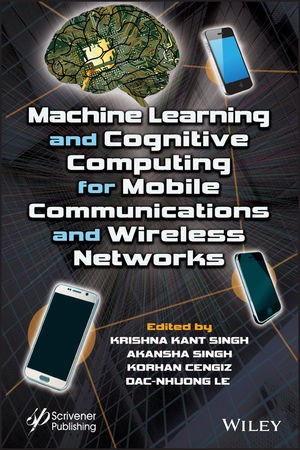
Machine Learning and Cognitive Computing for Mobile Communications and Wireless Networks
Communication and network technology has witnessed recent rapid development and numerous information services and applications have been developed globally. These technologies have high impact on society and the way people are leading their lives. The advancement in technology has undoubtedly improved the quality of service and user experience yet a lot needs to be still done. Some areas that still need improvement include seamless wide-area coverage, high-capacity hot-spots, low-power massive-connections, low-latency and high-reliability and so on. Thus, it is highly desirable to develop smart technologies for communication to improve the overall services and management of wireless communication. Machine learning and cognitive computing have converged to give some groundbreaking solutions for smart machines. With these two technologies coming together, the machines can acquire the ability to reason similar to the human brain. The research area of machine learning and cognitive computing cover many fields like psychology, biology, signal processing, physics, information theory, mathematics, and statistics that can be used effectively for topology management. Therefore, the utilization of machine learning techniques like data analytics and cognitive power will lead to better performance of communication and wireless systems.
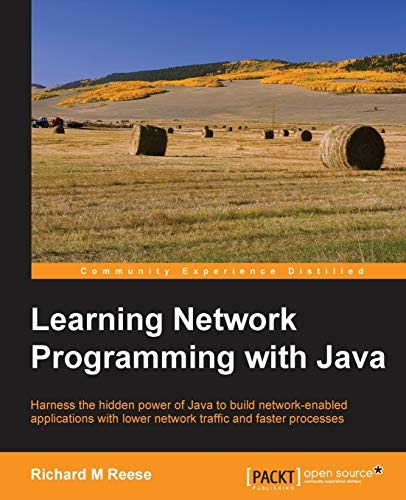
Learning network programming with Java
Learn to deliver superior server-to-server communication through the networking channels / Gain expertise of the networking features of your own applications to support various network architectures such as client/server and peer-to-peer Explore the issues that impact scalability, affect security, and allow applications to work in a heterogeneous environment
