



Page 29
Page 29

Computational Geometry : Algorithms and Applications
This introduction to computational geometry focuses on algorithms. Modern insights in computational geometry are used to provide solutions that are both efficient and easy to understand and implement.

Computational Forensic ; 2nd International Workshop, IWCF 2008, Washington, DC, USA, August 7-8, 2008. Proceedings
This book constitutes the refereed proceedings of the Second International Workshop, IWCF 2008, held in Washington, DC, USA, August 2008. The papers are organized in topical sections on trends and challenges; scanner, printer, and prints; human identification; shoeprints; linguistics;decision making and search; speech analysis; signatures and handwriting.

Computational Electronic Circuits : Simulation and Analysis with MATLAB®
This textbook teaches in one, coherent presentation the three distinct topics of analysis of electronic circuits, mathematical numerical algorithms and coding in a software such as MATLAB®. By combining the capabilities of circuit simulators and mathematical software, the author teaches key concepts of circuit analysis and algorithms, using a modern approach. The DC, Transient, AC, Noise and behavioral analyses are implemented in MATLAB to study the complete characteristics of a variety of electronic circuits, such as amplifiers, rectifiers, hysteresis circuits, harmonic traps and passes, polyphaser filters, directional couplers, electro-static discharge and piezoelectric crystals. This book teaches basic and advanced circuit analysis, by incorporating algorithms and simulations that teach readers how to develop their own simulators and fully characterize and design electronic circuits.

Computational Discovery of Scientific Knowledge : Introduction, Techniques, and Applications in Environmental and Life Sciences
Advances in technology have enabled the collection of data from scientific observations, simulations, and experiments at an ever-increasing pace. For the scientist and engineer to benefit from these enhanced data collecting capabilities, it is becoming clear that semi-automated data analysis techniques must be applied to find the useful information in the data. Computational scientific discovery methods can be used to this end: they focus on applying computational methods to automate scientific activities, such as finding laws from observational data. In contrast to mining scientific data, which focuses on building highly predictive models, computational scientific discovery puts a strong emphasis on discovering knowledge represented in formalisms used by scientists and engineers, such as numeric equations and reaction pathways. This state-of-the-art survey provides an introduction to computational approaches to the discovery of scientific knowledge and gives an overview of recent advances in this area, including techniques and applications in environmental and life sciences.

Combinatorial pattern matching ; Vol.4009) ; 17th Annual Symposium, CPM 2006, Barcelona, Spain, July 5-7, 2006, Proceedings
The book presents 33 revised full papers together with 3 invited talks, organized in topical sections on data structures, indexing data structures, probabilistic and algebraic techniques, applications in molecular biology, string matching, data compression, and dynamic programming

Combinatorial pattern matching ; 19th Annual Symposium, CPM 2008, Pisa, Italy, June 18-20, 2008 Proceedings
This book constitutes the refereed proceedings of the 19th Annual Symposium on Combinatorial Pattern Matching, CPM 2008, held in Pisa, Italy, in June 2008.

Combinatorial pattern matching ; 18th Annual Symposium, CPM 2007, London, Canada, July 9-11, 2007, Proceedings
This book presented original research contri- tions on computational pattern matching and analysis, data compression and compressed text processing, sufix arrays and trees, and computational biology. Combinatorial Pattern Matching addresses issues of searching and matching strings and more complicated patterns such as trees, regular expressions, graphs, point sets, and arrays.The goal is to derive non-trivial combinatorial properties of such structures and to exploit these properties in order to either achieve superior performance for the corresponding computational problems or pinpoint conditions under which searches cannot be performed eficiently.

Combinatorial Optimization in Communication Networks
Combinatorial optimization algorithms are used in many applications including the design, management, and operations of communication networks. The objective of this book is to advance and promote the theory and applications of combinatorial optimization in communication networks. The book collects a distinguished set of papers on subjects such as wireless communication systems, satellite networks, optical networks, and ad hoc networks. The topics covered range from topology control, routing optimization, and resource allocation to QoS provisioning. It is the first book that integrates rich theory from operations research with cutting-edge research in communication networks.

Combinatorial optimization and applications ; 2nd International Conference, COCOA 2008, St. John’s, NL, Canada, August 21-24, 2008. Proceedings
This book constitutes the refereed proceedings of the Second International Conference on Combinatorial Optimization and Applications, COCOA 2008, held in St. John's, Canada, in August 2008.

Combinatorial Image Analysis ; Vol.4040 : 11th International Workshop, IWCIA 2006, Berlin, Germany, June 19-21, 2006, Proceedings
Constitutes the refereed proceedings of the 11th International Workshop on Combinatorial Image Analysis, IWCIA 2006, held in Berlin, June 2006. The book presents 34 revised full papers together with two invited papers, covering topics including combinatorial image analysis; grammars and models for analysis and recognition of scenes and images; combinatorial topology and geometry for images; digital geometry of curves and surfaces; algebraic approaches to image processing, and more.

Combinatorial Image Analysis ; 12th International Workshop, IWCIA 2008, Buffalo, NY, USA, April 7-9, 2008. Proceedings
This volume contains the proceedings of the 12th International Workshop on Combinatorial Image Analysis. Coverage includes digital geometry, curves and surfaces, applications of computational geometry, as well as medical imaging and biometrics.

Combinatorial image analysis ; 10th International Workshop, IWCIA 2004, Auckland, New Zealand, December 1-3, 2004, Proceedings
This volume presents the proceedings of the 10th International Workshop on Combinatorial Image Analysis,held 2004, in Auckland, New Zealand. For this workshop we received 86 submitted papers from 23 countries. We selected 55 papers for the conference. completed the program. Conference papers are presented in this volume under the following topical part titles: discrete tomography (3 papers), combinatorics and computational models (6), combinatorial algorithms (6), combinatorial mathematics (4), d- ital topology (7), digital geometry (7), approximation of digital sets by curves and surfaces (5), algebraic approaches (5), fuzzy image analysis (2), image s- mentation (6), and matching and recognition (7). These subjects are dealt with in the context of digital image analysis or computer vision.
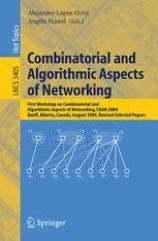
Combinatorial and algorithmic aspects of networking ; Vol.3405 ; 1st Workshop on combinatorial and algorithmic aspects of networking, CAAN 2004, Banff, Alberta, Canada, August 5-7, 2004, Revised Selected Papers
The Internet is a massive global network of over 700 million users and it is addingusers at the rate of 300,000 per day. This large, distributed, and everchangingnetwork poses a challenge to researchers: How does one study, model, or under-stand such a decentralized, constantly evolving entity? The workshop Combi-natorial and Algorithmic Aspects of Networking and the Internet (CAAN 2004)provided a forum for the exchange of ideas on these topics. and among thepapers were some new and surprising results as well as some introductions tothe foundations of the field.The workshop program featured 12 peer-reviewed papers bracketed by Topics covered by the talks ranged from the Web graph to game theoryto string matching, all in the context of large-scale networks. This volume collectstogether the talks delivered at the workshop along with a number of survey articlesto round out the presentation and give a comprehensive introduction to the topic.

Combinatorial and Algorithmic Aspects of Networking ; 4th Workshop, CAAN 2007, Halifax, Canada, August 14, 2007, Revised Papers
It contiants developments on all aspects of networking could be presented. It covered were diverse, with talks on strategies for searching in networks, for cleaning networks of unwanted - truders, on difierent routing strategies, and on scheduling, load balancing, probability, a concept central to network modeling and managing.
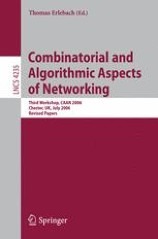
Combinatorial and Algorithmic Aspects of Networking (vol. # 4235) ; Third Workshop, CAAN 2006, Chester, UK, July 2, 2006, Revised Papers
This book constitutes the thoroughly refereed post-proceedings of the Third Workshop on Combinatorial and Algorithmic Aspects of Networking, held in Chester, UK in July 2006, co-located with the 13th Colloquium on Structural Information and Communication Complexity, SIROCCO 2006.The 10 revised full papers and one invited lecture cover a range from the Web graph to game theory to string matching, all in the context of large-scale networks.

Collaborative networks and their breeding environments ; IFIP TC 5 WG 5.5 Sixth IFIP Working Conference on VIRTUAL ENTERPRISES, 26-28 September 2005, Valencia, Spain
This book contains selected articles from PRO-VE'05, the sixth working conference on virtual enterprises, which was sponsored by the International Federation for Information Processing (IFIP) and held in Valencia, Spain. Being recognized as the most focused scientific / technical conference on Collaborative Networks, PRO-VE continues offering the opportunity for the presentation and discussion of both the latest research developments and practical application case studies. Following the IFIP vision. The articles included in this book represent a comprehensive overview of recent advances in various domains and lines of development of collaborative networks. Of particular relevance are the topics of holistic approaches and breeding environments management, creation and management of virtual organizations and professional virtual communications, performance measurement and management, benefit analysis, trust management, process modeling and meta-modeling, ICT infrastructures and support services, legal issues, and case studies.

Cognitive engineering : A distributed approach to machine intelligence
Cognitive Engineering: A Distributed Approach to Machine Intelligence explores the design issues of intelligent engineering systems. Beginning with the foundations of psychological modeling of the human mind, the main emphasis is given to parallel and distributed realization of intelligent models for application in reasoning, learning, planning and multi-agent co-ordination problems. The last two chapters provide case studies on human-mood detection and control, and behavioral co-operation of mobile robots. This is the first comprehensive text of its kind, bridging the gap between Cognitive Science and Cognitive Systems Engineering. Each chapter includes plenty of numerical examples and exercises with sufficient hints, so that the reader can solve the exercises on their own. Computer simulations are also included in most chapters to give a clear idea about the application of the algorithms undertaken in the book. In addition, mathematical analysis on convergence and stability of the neuro-fuzzy models will enable the reader to pursue their research career in cognitive engineering.

Cognition, Communication and Interaction : Transdisciplinary Perspectives on Interactive Technology
This book aims to provide a trans-disciplinary research framework and methodology for interaction design. The analysis directs attention to three human capacities that our engagement with interactive technology has made salient and open to constant redefinition.

Coding and Cryptography ; International Workshop, WCC 2005, Bergen, Norway, March 14-18, 2005, Revised Selected Papers
This volume contains refereed papers devotedtocodingandcrypto graphy.These papers arethe full versionsof a selectionof the best extended abstractsaccepted for presentation at the International Workshop on Coding and Cryptography (WCC 2005) held in Bergen, Norway, March 14–18, 2005. Each of the 118 - tended abstracts originallysubmitted to the workshop were reviewed by at least two members of the Program Committee. As a result of this screening process, 58 papers were selected for presentation, of which 52 were eventually presented at the workshop together with four invited talks.

Codici cifrati: Arne Beurling e la crittografia nella II guerra mondiale = Cipher codes : Arne Beurling and cryptography in world war II
The story of the German codebreaking is told in detail for the first time and has all the makings of a thriller, but with elements that make it an excellent introduction to the field of cryptography, as well as a vibrant and human portrait of the society of the time: a desperate wartime situation, political and espionage intrigue, the sometimes incomprehensible yet always fascinating genius of the main architect of its success — mathematician Arne Beurling—the difficulties and tricks of the trade, but also the systematic and obscure work of a crowd of codebreakers who treat their situation as if it were a normal job. The author, Bengt Beckman, was for years, after the war, head of the cryptanalysis department of the Swedish intelligence agency.
