



Page 1
Page 1

The Physics of the Early Universe
The Physics of the Early Universe is an edited and expanded version of the lectures given at a recent summer school of the same name. Its aim is to present an advanced multi-authored textbook that meets the needs of both postgraduate students and young researchers interested in, or already working on, problems in cosmology and general relativity, with emphasis on the early universe. A particular strong feature of the present work is the constructive-critical approach to the present mainstream theories, the careful assessment of some alternative approaches, and the overall balance between theoretical and observational considerations. As such, this book will also benefit experienced scientists and nonspecialists from related areas of research.

The Music of the Big Bang : The Cosmic Microwave Background and the New Cosmology
Most cosmological information is encoded in the cosmic background radiation by acoustic oscillations in the dense plasma that filled the primordial Universe: a "music" of the big bang, which cosmologists have long been trying to reconstruct and analyze, in order to distinguish different cosmological models, much like one can distinguish different musical instruments by their timbre and overtones. Only lately, this amazing cosmic sound has been unveiled by such experiments as BOOMERANG and MAXIMA and, more recently, by the WMAP satellite. This led to a giant leap in our understanding of the Universe, but the investigation is not ended yet.

The Many Scales in the Universe : JENAM 2004 Astrophysics Reviews
The book gathers the invited talks to the XIII JENAM conference, organized this time by the European Astronomical Society (EAS) and the Spanish Astronomical Society (SEA), and hosted by the Instituto de Astrofísica de Andalucía (CSIC). All branches of astrophysics are encompassed from the largest scales and cosmology to the solar system and the Sun, through the galaxies and the stars, including a section on astronomical instrumentation. Very relevant experts from all over the world speak in a single book about the most recent, exciting results from their fields in a way which is useful for both researchers in these fields and colleagues working in other disciplines. The book is accompanied by a CD-ROM including the remaining contributions of the meeting in PDF format, hence opening a wide panorama of what is going on in astrophysics nowadays.

Statistical Physics for Cosmic Structures
The physics of scale-invariant and complex systems is a novel interdisciplinary field. Its ideas allow us to look at natural phenomena in a radically new and original way, eventually leading to unifying concepts independent of the detailed structure of the systems. The objective is the study of complex, scale-invariant, and more general stochastic structures that appear both in space and time in a vast variety of natural phenomena, which exhibit new types of collective behaviors, and the fostering of their understanding. This book has been conceived as a methodological monograph in which the main methods of modern statistical physics for cosmological structures and density fields (galaxies, Cosmic Microwave Background Radiation, etc.) are presented in detail. The main purpose is to present clearly, to a workable level, these methods, with a certain mathematical accuracy, providing also some paradigmatic examples of applications.

First Light in the Universe : Saas-Fee Advanced Course 36. Swiss Society for Astrophysics and Astronomy
The exploration of the first billion years of the history of the Universe, from the so-called Dark Ages to cosmic reionisation, represents one of the great challenges of contemporary astrophysics and one of the main drivers for future observational facilities. The book contains the elaborated notes of lectures given at the 36th Saas-Fee Advanced Course "First Light in the Universe" by three eminent scientists in the field: Abraham Loeb, Andrea Ferrara, and Richard Ellis. The formation of the first stars and black holes, the initial mass function, feedback effects, early dust formation, the history of cosmic star formation, distant galaxies, cosmic reionisation and the cosmic infrared background are the main topics treated. This book provides an accessible and up-to-date review of the field and will be useful to graduate students of astronomy, cosmologists, physicists and researchers.
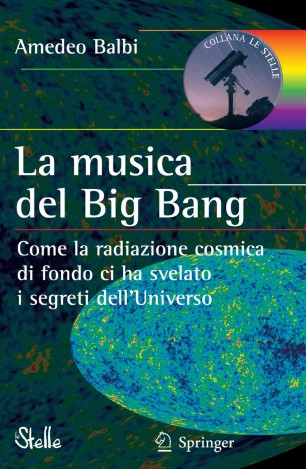
La musica del Big Bang : Come la radiazione cosmica di fondo ci ha svelato i segreti dell’Universo = The music of the Big Bang : How the cosmic background radiation revealed the secrets of the Universe to us
Cosmic microwave background radiation is the residue of the great heat following the Big Bang. A tenuous sign, over 13 billion years old, in which the answers to many of the questions about the nature of our Universe are hidden. Discovered by chance in 1964, in the last forty years this fossil trace of the origins of the Cosmos has been explored with every available means. Two Nobel Prizes in physics have already been awarded for research involving it, the last in 2006 for the results of the COBE satellite. Much of the information encoded in the cosmic background radiation was impressed by the superimposition of acoustic waves present in the early Universe: a "music" of the Big Bang, which cosmologists have tried for years to reconstruct, using techniques similar to those that allow to distinguish the sound of different musical instruments. Only recently have the first notes of this extraordinary cosmic symphony finally been revealed, but the investigation is not over yet. This book illustrates, with a language suitable even for non-specialists, the theories, observations and discoveries that have brought cosmology into a new era.
La correspondance entre Henri Poincaré et les physiciens, chimistes et ingénieurs = The correspondence between Henri Poincaré and physicists, chemists and engineers
Cosmic microwave background radiation is the residue of the great heat following the Big Bang. A tenuous sign, over 13 billion years old, in which the answers to many of the questions about the nature of our Universe are hidden. Discovered by chance in 1964, in the last forty years this fossil trace of the origins of the Cosmos has been explored with every available means. Two Nobel Prizes in physics have already been awarded for research involving it, the last in 2006 for the results of the COBE satellite. Much of the information encoded in the cosmic background radiation was impressed by the superimposition of acoustic waves present in the early Universe: a "music" of the Big Bang, which cosmologists have tried for years to reconstruct, using techniques similar to those that allow to distinguish the sound of different musical instruments. Only recently have the first notes of this extraordinary cosmic symphony finally been revealed, but the investigation is not over yet. This book illustrates, with a language suitable even for non-specialists, the theories, observations and discoveries that have brought cosmology into a new era.
