



Page 50
Page 50

Information Retrieval Technology ; Vol. 4182 ; 3rd Asia Information Retrieval Symposium, AIRS 2006, Singapore, October 16-18, 2006, Proceedings
Asia Information Retrieval Symposium (AIRS) 2006 was the third AIRS conf- ence in the series established in 2004.The ?rst AIRS washeld in Beijing, China, and the 2nd AIRS was held in Cheju, Korea. The AIRS conference series traces its roots to the successful Information Retrieval with Asian Languages (IRAL) workshop series which started in 1996. The AIRS series aims to bring together international researchers and dev- opers to exchange new ideas and the latest results in information retrieval. The scope of the conference encompassed the theory and practice of all aspects of information retrieval in text, audio, image, video, and multimedia data. Wearehappyto reportthatAIRS2006received148submissions,thehighest number since the conference series started in 2004. Submissions came from Asia and Australasia, Europe, and North America. We accepted 34 submissions as regular papers (23%) and 24 as poster papers (16%). We would like to thank all the authors who submitted papers to the conf- ence, the seven area chairs, who worked tirelessly to recruit the program c- mittee members and oversaw the review process, and the program committee members and their secondary reviewers who reviewed all the submissions.

Information Retrieval Technology ; Vol. 3689 ; 2nd Asia information retrieval symposium, AIRS 2005, Jeju Island, Korea, October 13-15, 2005, Proceedings
Asia Information Retrieval Symposium (AIRS) was established in 2004 by the Asian information retrieval community after the successful series of Information Retrieval with Asian Languages (IRAL) workshops held in six different locations in Asia, starting from 1996. The AIRS symposium aims to bring together international researchers and developers to exchange new ideas and the latest results in the field of information retrieval (IR). The scope of the symposium covers applications, systems, technologies and theoretical aspects of information retrieval in text, audio, image, video and multi-media data. We are very pleased to report that we saw a sharp and steady increase in the number of submissions and their qualities, compared with previous IRAL workshop series. We received 136 submissions from all over the world including Asia, North America, Europe, Australia, and even Africa, from which 32 papers (23%) were presented in oral sessions and 36 papers in poster sessions (26%). We also held a special session called “Digital Photo Albuming,” where 4 oral papers and 3 posters were presented. It was a great challenge and hard work for the program committee to select the best among the excellent papers. The high acceptance rates witness the success and stability of the AIRS series. All the papers and posters are included in this LNCS (Lecture Notes in Computer Science) proceedings volume, which is S- indexed. The technical program included two keynote talks by Prof. Walter Bender and Prof.

Information retrieval technology ; Vol. 3411 ; Asia information retrieval symposium, AIRS 2004, Beijing, China, October 18-20, 2004. Revised Selected Papers
TheAsiaInformationRetrievalSymposium(AIRS)wasestablishedbytheAsian information retrieval community after the successful series of Information - trieval with Asian Languages (IRAL) workshops held in six di?erent locations in Asia, starting from 1996. While the IRAL workshops had their focus on inf- mation retrieval problems involving Asian languages, AIRS covers a wider scope of applications, systems, technologies and theory aspects of information retrieval in text, audio, image, video and multimedia data. This extension of the scope re?ects and fosters increasing research activities in information retrieval in this region and the growing need for collaborations across subdisciplines. We are very pleased to report that we saw a sharp increase in the number of submissions and their quality, compared to the IRAL workshops. We received 106papersfromninecountriesinAsiaandNorthAmerica,fromwhich28papers (26%) were presented in oral sessions and 38 papers in poster sessions (36%). It was a great challenge for the Program Committee to select the best among the excellent papers. The low acceptance rates witness the success of this year’s conference. After a long discussion between the AIRS 2004 Steering Committee and Springer, the publisher agreed to publish our proceedings in the Lecture Notes in Computer Science (LNCS) series, which is SCI-indexed. We feel that this strongly attests to the excellent quality of the papers.

Information Processing with Evolutionary Algorithms : From Industrial Applications to Academic Speculations
The last decade of the 20th century has witnessed a surge of interest in num- ical, computation-intensive approaches to information processing. The lines that draw the boundaries among statistics, optimization, arti cial intelligence and information processing are disappearing, and it is not uncommon to nd well-founded and sophisticated mathematical approaches in application - mains traditionally associated with ad-hoc programming. Heuristics has - come a branch of optimization and statistics. Clustering is applied to analyze soft data and to provide fast indexing in the World Wide Web. Non-trivial matrix algebra is at the heart of the last advances in computer vision. The breakthrough impulse was, apparently, due to the rise of the interest in arti cial neural networks, after its rediscovery in the late 1980s. Disguised as ANN, numerical and statistical methods made an appearance in the - formation processing scene, and others followed. A key component in many intelligent computational processing is the search for an optimal value of some function. Sometimes, this function is not evident and it must be made explicit in order to formulate the problem as an optimization problem. The search - ten takes place in high-dimensional spaces that can be either discrete, or c- tinuous or mixed. The shape of the high-dimensional surface that corresponds to the optimized function is usually very complex. Evolutionary algorithms are increasingly being applied to information processing applications that require any kind of optimization.

Information Processing in Medical Imaging ; 20th International Conference, IPMI 2007, Kerkrade, The Netherlands, July 2-6, 2007, Proceedings
The 20th International Conference on Information Processing in Medical Im- ing(IPMI)washeldduringJuly2–6,2007,atRolducAbbey,locatedinKerkrade in the south of the Netherlands. IPMI is one of the longest running conferences in medical imaging.

Information processing in medical imaging ; 19th International conference, IPMI 2005, Glenwood Springs, CO, USA, July 10-15, 2005, Proceedings
The nineteenth biennial International Conference on Information Processing in Medical Imaging (IPMI) was held July 11–15, 2005 in Glenwood Springs, CO, USA on the Spring Valley campus of the Colorado Mountain College. Following the successful meeting in beautiful Ambleside in England, this year’s conference addressed important recent developments in a broad range of topics related to the acquisition, analysis and application of biomedical images. Interest in IPMI has been steadily growing over the last decade. This is p- tially due to the increased number of researchers entering the ?eld of medical imagingasaresultoftheWhitakerFoundationandtherecentlyformedNational Institute of Biomedical Imaging and Bioengineering. This year, there were 245 full manuscripts submitted to the conference which was twice the number s- mitted in 2003 and almost four times the number of submissions in 2001. Of these papers, 27 were accepted as oral presentations, and 36 excellent subm- sions that could not be accommodated as oral presentations were presented as posters. Selection of the papers for presentation was a di?cult task as we were unable to accommodate many of the excellent papers submitted this year. All accepted manuscripts were allocated 12 pages in these proceedings.

Information Processing and Security Systems
Information Processing and Security Systems is a collection of forty papers that were originally presented at an international multi-conference on Advanced Computer Systems (ACS) and Computer Information Systems and Industrial Management Applications (CISIM) held in Elk, Poland. This volume describes the latest developments in advanced computer systems and their applications within artificial intelligence, biometrics and information technology security. The volume also includes contributions on computational methods, algorithms and applications, computational science, education and industrial management applications.

Information Networking. Towards Ubiquitous Networking and Services ; International Conference, ICOIN 2007, Estoril, Portugal, January 23-25, 2007. Revised Selected Papers
This book constitutes the thoroughly refereed post-conference proceedings of the International Conference on Information Networking, ICOIN 2007, held in Estoril, Portugal, in January 2007.The 82 revised full papers included in the volume were carefully selected and improved during two rounds of reviewing and revision from a total of 302 submissions. Topics covered include sensor networks; ad-hoc, mobile and wireless networks; optical networks; peer-to-peer networks and systems; routing; transport protocols.

Information networking : Convergence in broadband and mobile networking ; International conference, ICOIN 2005, Jeju Island, Korea, January 31 - February 2, 2005, Proceedings
Welcome to ICOIN 2005,the International Conference on Information Netwo- ing, held at Ramada Plaza Jeju Hotel, Jeju Island, Korea during January 31– February2,2005.ICOIN2005followedthesuccessofpreviousconferences.Since 1986, the conference has provided a technical forum for various issues in inf- mation networking. The theme of each conference re?ects the historic events in the computer communication industry. (Please refer to www.icoin2005.or.kr for details.) The theme of ICOIN 2004, “Convergence in Broadband and Mobile Networking,” was used again for ICOIN 2005 since we believed it was ongoing. This year we received 427 submissions in total, which came from 22 co- tries. Upon submission, authors were asked to select one of the categories listed in the Call for Papers. The most popular category chosen was network se- rity, followed by mobile networks and wireless LANs. Other areas with strong showings included QoS and resource management, ad hoc and sensor networks, and wireless multimedia systems. From the outset, we could see where recent research interest lay and could make sure that the theme was still going in the right direction.

Information infrastructures within European health care : Working with the installed base
This book consolidates experiences from across Europe on the design, development, implementation and evolution of inter-organisational information infrastructures for healthcare. It provides insights with practical relevance for those involved or interested in the planning and implementation of such infrastructures and includes 11 empirical cases on the introduction of core infrastructural arrangements in different national settings: six cases investigate the use of e-prescriptions and five the public platforms for patient-oriented eHealth services. Both are linked to different types of aims.

Information hiding ; 6th International Workshop, IH 2004, Toronto, Canada, May 23-25, 2004, Revised selected papers
All papers were divided into eight sessions: digital media watermarking, steganalysis, digital forensics, steganography, software watermarking, security and privacy, anonymity, and data hiding in unusual content. This year, the workshop included a one-hour rump session that offered an opportunity to the delegates to share their work in progress and other brief but interesting contributions.

Information Governance : Concepts, Strategies and Best Practices
Information Governance is a highly practical and deeply informative handbook for the implementation of effective Information Governance (IG) procedures and strategies. A critical facet of any mid- to large-sized company, this “super-discipline” has expanded to cover the management and output of information across the entire organization; from email, social media, and cloud computing to electronic records and documents, the IG umbrella now covers nearly every aspect of your business. As more and more everyday business is conducted electronically, the need for robust internal management and compliance grows accordingly.

Information criteria and statistical modeling
One of the main objectives of this book is to provide comprehensive explanations of the concepts and derivations of the AIC and related criteria, including Schwarz’s Bayesian information criterion (BIC), together with a wide range of practical examples of model selection and evaluation criteria. A secondary objective is to provide a theoretical basis for the analysis and extension of information criteria via a statistical functional approach. A generalized information criterion (GIC) and a bootstrap information criterion are presented, which provide unified tools for modeling and model evaluation for a diverse range of models, including various types of nonlinear models and model estimation procedures such as robust estimation, the maximum penalized likelihood method and a Bayesian approach.

Information context : Nature, impact, and role ; 5th International conference on Conceptions of Library and Information Sciences, CoLIS 2005, Glasgow, UK, June 4-8, 2005 Proceedings
.CoLIS examinesthehistorical,theoretical,empiricalandtechnicalissuesrelatingtoour understanding and use of information, promoting an interdisciplinary approach to research. CoLIS seeks to provide a broad platform for the examination of context as it relates to our theoretical, empirical and technical development of information-centered disciplines. The theme for CoLIS 5 was the nature, impact and role of context within information-centered research. Context is a complex, dynamic and multi- - mensional concept that in?uences both humans and machines: how they behave individually and how they interact with each other. In CoLIS 5 we took an interdisciplinary approach to the issue of context to help us understand and the theoretical approaches to modelling and understanding context, incorporate contextual reasoning within technology, and develop a shared framework for promoting the exploration of context.
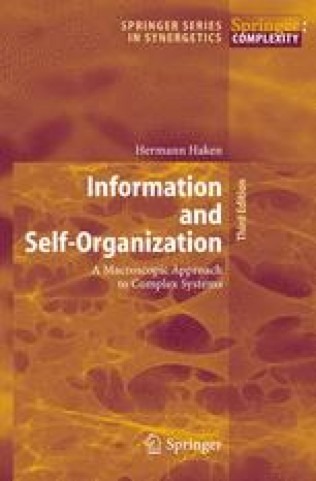
Information and self-organization : A macroscopic approach to complex systems
This book presents the concepts needed to deal with self-organizing complex systems from a unifying point of view that uses macroscopic data. The various meanings of the concept "information" are discussed and a general formulation of the maximum information (entropy) principle is used. With the aid of results from synergetics, adequate objective constraints for a large class of self-organizing systems are formulated and examples are given from physics, life and computer science. The relationship to chaos theory is examined and it is further shown that, based on possibly scarce and noisy data, unbiased guesses about processes of complex systems can be made and the underlying deterministic and random forces determined. This allows for probabilistic predictions of processes, with applications to numerous fields in science, technology, medicine and economics. The extensions of the third edition are essentially devoted to an introduction to the meaning of information in the quantum context. Indeed, quantum information science and technology is presently one of the most active fields of research at the interface of physics, technology and information sciences and has already established itself as one of the major future technologies for processing and communicating information on any scale.

Information and knowledge : A constructive type-theoretical approach
This book develops a philosophical and logical interpretation of the concept of information within the formal structure of Constructive Type Theory (CTT), in a manner concurrent with a diverse range of contemporary perspectives on the philosophy of information. On the basis of this conceptual framework, the problem of analyticity for logical derivations is faced and a solution is proposed.The text begins with a presentation of the formal structure of CTT, paying particular attention to some topics that have been neglected by current researchers in Type Theory. Information and Knowledge presents a new interesting perspective on the constructive interpretation of knowledge processes, suggesting the reliability of such an approach for the logical modeling of epistemic problems and proposing a unifying frame from one of the more important contemporary philosophical perspectives.

Information and its role in nature
Infromation and Its Role in Nature presents an in-depth interdisciplinary discussion of the concept of information and its role in the control of natural processes. After a brief review of classical and quantum information theory, the author addresses numerous central questions, including: Is information reducible to the laws of physics and chemistry? Does the Universe, in its evolution, constantly generate new information? Or are information and information-processing exclusive attributes of living systems, related to the very definition of life? If so, what is the role of information in classical and quantum physics? In what ways does information-processing in the human brain bring about self-consciousness? Accessible to graduate students and professionals from all scientific disciplines, this stimulating book will help to shed light on many controversial issues at the heart of modern science.

Information and Complexity in Statistical Modeling
The main theme in this book is to teach modeling based on the principle that the objective is to extract the information from data that can be learned with suggested classes of probability models. The intuitive and fundamental concepts of complexity, learnable information, and noise are formalized, which provides a firm information theoretic foundation for statistical modeling.

Information and Communications Security ; Vol. 4307 ; 8th International Conference, ICICS 2006, Raleigh, NC, USA, December 4-7, 2006, Proceedings
It is our great pleasure to welcome you to the Eighth International Conference on Information and Communications Security (ICICS 2006), held in Raleigh, North Carolina, USA, December 4–7, 2006. The ICICS conference series is an established forum that brings together researchersand scholars involved in m- tiple disciplines of Information and Communications Security in order to foster exchangeof ideas. The past sevenICICS conferences wereheld in Beijing, China (ICICS 1997); Sydney, Australia (ICICS 1999); Xi’an China (ICICS 2001); S- gapore (ICICS 2002); Hohhot City, China (ICICS 2003); Malaga, Spain (ICICS 2004); and Beijing, China (ICICS 2005). The conference proceedings of the past seven events have been published by Springer in the Lecture Notes in Computer Science series, in LNCS1334,LNCS1726,LNCS2229,LNCS 2513,LNCS 2836, LNCS 3269, and LNCS 3783, respectively. This year we received a total of 119 submissions on various aspects of - hoc and sensor network security. The Program Committee selected 22 regular papers and 17 short papers that cover a variety of topics, including security protocols, applied cryptography and cryptanalysis, access control in distributed systems, privacy, malicious code, network and systems security, and security implementations. Putting together ICICS 2006 was a team e?ort. First of all, we would like to thank the authors of every paper, whether accepted or not, for submitting their papers to ICICS 2006. We would like to express our gratitude to the Program Committee members and the external reviewers, who worked very hard in - viewing the papers and providing suggestions for their improvements.

Information and communications security ; Vol. 3783 ; 7th International conference, ICICS 2005, Beijing, China, December 10-13, 2005, Proceedings
The Seventh International Conference on Information and Communications - curity,ICICS2005,washeldinBeijing,China,10-13December2005. TheICICS conference series is an established forum for exchanging new research ideas and development results in the areas of information security and applied crypt- raphy. The ?rst event began here in Beijing in 1997. Since then the conference series has been interleaving its venues in China and the rest of the world: ICICS 1997 in Beijing, China; ICICS 1999 in Sydney, Australia; ICICS 2001 in Xi’an, China; ICICS 2002 in Singapore; ICICS 2003 in Hohhot City, China; and ICICS 2004 in Malaga, Spain. The conference proceedings of the past events have - ways been published by Springer in the Lecture Notes in Computer Science series, with volume numbers, respectively: LNCS 1334,LNCS 1726,LNCS 2229, LNCS 2513, LNCS 2836, and LNCS 3269. ICICS 2005 was sponsored by the Chinese Academy of Sciences (CAS); the Beijing Natural Science Foundation of China under Grant No. 4052016; the National Natural Science Foundation of China under Grants No. 60083007 and No. 60573042;the NationalGrandFundamentalResearch973ProgramofChina under Grant No. G1999035802, and Hewlett-Packard Laboratories, China. The conference was organized and hosted by the Engineering Research Center for Information Security Technology of the Chinese Academy of Sciences (ERCIST, CAS) in co-operation with the International Communications and Information Security Association (ICISA). The aim of the ICICS conference series has been to o?er the attendees the opportunity to discuss the latest developments in theoretical and practical - pects of information and communications security.
