



Page 106
Page 106

Forest Diversity and Management
Natural forests with thousands of years of ecological continuity are unrivalled as the treasure store of terrestrial biodiversity on Earth. And while there is currently no fully comprehensive inventory of the biota associated with any given forest, it is reasonable to assume that in conserving natural forests we can conserve the myriads of unnamed bacteria, fungi, insects, mites and nematodes that forests support. Drawing on diverse research from biodiversity experts around the world, this collection of papers reflects the diversity of forest types and forest issues that concern forest scientists globally. Forest types considered vary from savannah and tropical rainforests to the ancient oak forests of Poland; issues explored include the effects of logging, management practices, forest dynamics and climate change on forest structure and biodiversity.
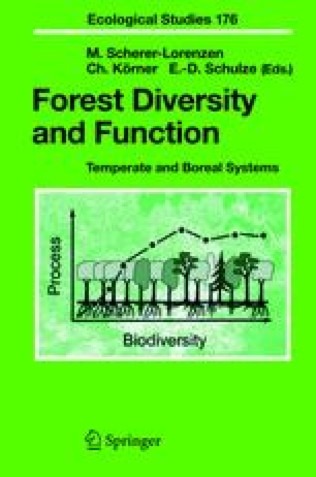
Forest Diversity and Function : Temperate and Boreal Systems
One of the central research themes in ecology is evaluating the extent to which biological richness is necessary to sustain the Earth's system and the functioning of individual ecosystems. In this volume, for the first time, the relationship between biodiversity and ecosystem processes in forests is thoroughly explored. The text examines the multiple effects of tree diversity on productivity and growth, biogeochemical cycles, animals, pests, and disturbances.

Forest and Rangeland Soils of the United States Under Changing Conditions : A Comprehensive Science Synthesis
This book synthesizes leading-edge science and management information about forest and rangeland soils of the United States. It offers ways to better understand changing conditions and their impacts on soils, and explores directions that positively affect the future of forest and rangeland soil health.

Forensic pathology reviews ; Vol. 3
Maintaining the high quality achieved in earlier volumes, leading national and international forensic pathologists provide in Forensic Pathology Reviews, Volume 3 evidence-based accounts of special topics of current interest from various fields of forensic pathology and death-scene investigation. The authors offer cutting-edge insights into the medicolegal investigation of bodies found in water, the forensic aspects of the human immunodeficiency virus (HIV)-1 infection of the central nervous system, deaths in a head-down position, and forensic bitemark analysis. Additional chapters address taphonomic changes in human bodies during the early postmortem interval, arrhythmogenic ventricular dysplasia that produces sudden death in young people, the postmortem diagnosis of death in anaphylaxis, and iatrogenic deaths. The forensic aspects of suicide, murder-suicide, and suicide trends in the United States are also discussed, along with the evaluation of fatal pulmonary thromboembolism and the use of radiology in medicolegal investigations. A comprehensive, up-to-date review of the international literature is given for each chapter. Evidence-based and state-of-the-art, Forensic Pathology Reviews, Volume 3 synthesizes the practical advances made in a variety of important subspecialties of forensic pathology, demonstrating how the latest medical and scientific advances are being applied to solve current problems of high interest to forensic pathologists today.

Forensic neuropathology and associated neurology
Incorporating the most recent literature and state-of-the-art methods, this practical work and atlas covers the entire domain of neuropathology for forensic pathologists as well as for specialists in associated fields. Its concise, direct style provides the reader with succinct and easy-to-find answers to forensic, pathological, pathophysiological, biomechanical, and molecular biology problems.

Forensic Ethics and the Expert Witness
The expert witness’ job is often described as a balancing act: duty to clients on the one hand, duty to society on the other. Forensic Ethics and the Expert Witness probes beyond this familiar conflict of interest framework to present a new, innovative model of professional ethics. Richly illustrated with cases from medicine, psychiatry, and law, this elegantly written volume examines the common moral ground that links these usually separate domains, and relates forensic ethics to larger concepts of morality and justice. In this integrative approach, the expert witness is redefined as one who can balance professional with societal and personal codes in what the authors call "robust professionalism."

Foreign Exchange Rate Forecasting using Artificial Neural Networks
In this monograph, the authors try to apply artificial neural networks (ANNs) to exchange rates forecasting. Selection of the ANN approach for - change rates forecasting is because of ANNs’ unique features and powerful pattern recognition capability. Unlike most of the traditional model-based forecasting techniques, ANNs are a class of data-driven, self-adaptive, and nonlinear methods that do not require specific assumptions on the und- lying data generating process. These features are particularly appealing for practical forecasting situations where data are abundant or easily available, even though the theoretical model or the underlying relationship is - known. Furthermore, ANNs have been successfully applied to a wide range of forecasting problems in almost all areas of business, industry and engineering.

Forefoot Reconstruction
For a long time, forefoot surgery had many disadvantages including a painful postoperative period and recurrence of deformities. New techniques – notably Scarf, the first metatarsal osteotomy and the Weil osteotomy of the lesser metatarsal – provide a significant improvement in the treatment of static forefoot disorders. The great toe osteotomy has also been greatly improved. Since 1991, the author has introduced these techniques in many countries, while developing and studying the corresponding implants and the postoperative period. He has also developed surgical management techniques that bridge these different osteotomies. More than 1000 surgeons around the world are using these techniques, which are now widely taught. In this second edition of the book the general presentation is clearer and more pleasant and many pictures have been replaced. Several topics are emphasized, notably the great toe proximal phalanx osteotomy, the joint preservative surgery in severe forefoot disorders, including revision after failed bunionectomy and rheumatoid forefoot following the "ms” point for an accurate and effective metatarsal shortening. Lastly, new procedures are exposed, particularly in Claw toe and hammer with the PIP plantar release and the surgery of the middle phalanx and also the Weil osteotomy of the first metatarsal in hallux limitus.

Forecasting and Assessing Risk of Individual Electricity Peaks
The overarching aim of this open access book is to present self-contained theory and algorithms for investigation and prediction of electric demand peaks. A cross-section of popular demand forecasting algorithms from statistics, machine learning and mathematics is presented, followed by extreme value theory techniques with examples.
Forces, Growth and Form in Soft Condensed Matter : At the Interface between Physics and Biology
This volume comprises the proceedings of a NATO Advanced Study Institute held at Geilo, Norway, 24 March - 3 April 2003, the seventeenth ASI in a series held every two years since 1971. The objective of this ASI was to identify and discuss areas where synergism between modern physics, soft condensed matter and biology might be most fruitful. The main pedagogical approach was to have lecturers focussing on basic understanding of important aspects of the relative role of the various interaction- electrostatic, hydrophobic, steric, conformational, van der Waals etc. Soft condensed matter and the connection between physics and biology have been the themes of several earlier Geilo Schools. A return to these subjects thus allowed a fresh look and a possibility for defining new directions for research. Examples of soft materials, which were discussed at this ASI, included colloidal dispersions, gels, biopolymers and charged polymer solutions, polyelectrolytes, protein/membrane complexes, nucleic acids and their complexes. Indeed, most forms of condensed matter are soft and these substances are composed of aggregates and macromolecules, with interactions that are too weak and complex to form crystals spontaneously. A characteristic feature is that small external forces, slight perturbations in temperature, pressure or concentration, can all be enough to induce significant structural changes. Thermal fluctuations are almost by definition strong in soft materials and entropy is a predominant determinant of structure, so that disorder, slow dynamics and plastic deformation are the rule. Hence the phrase ‘soft condensed matter’ has been coined.

Football Traumatology : Current Concepts : From Prevention to Treatment
Lesions associated with football are on the increase and their typology has also changed over the years. Football, like many other sports, has undergone major changes: the increase in the intensity and speed of the game, the modern training methodologies, the technical and tactical innovations are all factors contributing to increased risks of traumatic injury. The footballers, the trainers, the sport's medical staff are asking for greater information and knowledge on the traumatic lesions associated with this sport. The primary role of those who are concerned with the health of footballers is to enforce preventive measures to reduce wherever possible the risks of trauma.

Foot-and-Mouth Disease Virus
The chapters in this volume provide an account of the present knowledge and understanding of Foot and Mouth disease virus pathogenesis and global epidemiology, the detailed structure of the virus itself and the properties of its RNA genome. Also considered are the immune response of the host and the state of the art in vaccine production, and the nature of virus evolution.

Foot and ankle in rheumatoid arthritis
This book broaches the theme of the most recent medicinal treatments, that of orthoses, made-to-measure shoes (the prescription of which practitioners and the rheumatologists often hand over to the orthopaedic surgeons), and finally that of local injections. These elements constitute the main treatment of the rheumatoid foot. Taking care of the ill subject does not necessarily stop there and a surgeon may need to operate on the forefoot, which is more common, or on the mid-foot or the ankle.

Food Safety and Ways to Prevent Life-Threatening Pollutants
The fears regarding food safety started long time ago, and till this very moment of ours, the international organizations and INGOs pay lots of hard work to minimize and achieve reduction in the effects and the suffering caused to people around the world by contaminated foods each year. This research talks about the main patterns of food contaminants, and they are chemical, physical, biological, and last but not least the contamination caused by radioactive substances. It is also important to talk about the methods of precaution and protection against the diseases and illnesses produced by contaminated foods, as well about the role of INGOs which are dedicated and specialized in law and regulations enactment for bounding the incidence of food contamination in the world, for raising the public awareness towards food safety, and to keep up with the latest updates of events. This research also contains vast Information about Covid-19 and its spreading process via contaminated food.

Food powders : Physical properties, processing, and functionality
Food Powders: Physical Properties, Processing, and Functionality is a comprehensive review on the characterization of ingredients, semi-processed and finished products when they are in a powdered form. It includes the description of different industrial unit operations such as drying, grinding, mixing, agglomeration, and encapsulation that supply food powders of different composition and microstructure. It also includes several analytical tools to characterize food powders by their particle size, size distribution, physical properties, and functionality.
Food physics : Physical properties : Measurement and applications
Food Physics deals with the physical properties of food, food ingredients and their measurement. Physical properties of food play a key role in all fields where modern technological processes are applied for the generation of food raw materials and the production of food. The determination of physical properties of food and related products are a pre-requisite for planning, production engineering and automation processes in today’s food, pharmaceutical and cosmetics industries as well as in all related quality control activities.This book describes the principles of food physics starting with the very basics and focuses on the needs of practitioners without omitting important basic principles.

Food nanotechnology
Nanotechnology is increasingly being utilized within the food industry to create innovative products with new or improved properties. This book introduces the history of nanotechnology applications in the food industry. It then discusses the key physicochemical and structural characteristics of the different kinds of nanoparticles found in foods, as well as showing how these characteristics lead to their unique functional attributes. Applications of nanotechnology in the food and agricultural industries are then covered, including the creation of nanopesticides, nanofertilizers, nutrient delivery systems, functional ingredients, smart packaging materials, nanofilters, and sensors, as well as for the conversion of waste materials into value-added products. Finally, the potential toxicity of both organic and inorganic nanoparticles found in foods is critically assessed. The author is a Distinguished Professor of food science who uses physics, chemistry, and biology to improve the quality, safety, and healthiness of foods. He has published over a thousand scientific articles and numerous books in this area and is currently the most highly cited food scientist in the world. He has won numerous awards for his scientific achievements.

Food lens = فود لينس
Food lens is an innovative application designed to revolutionize dietary management by leveraging advanced image recognition and nutritional analysis. The primary objective of this senior project is to develop a user-friendly tool that identifies various foods through a camera interface and provides detailed nutritional information. This application not only enhances the user's understanding of their dietary intake but also assists in achieving personalized health and fitness goals. The core functionality of Food Lens involves the integration of a robust image recognition system capable of accurately identifying a wide range of foods. Upon identification, the application retrieves comprehensive nutritional data, including calorie content, macronutrient distribution (proteins, fats, carbohydrates), and essential micronutrients (vitamins and minerals). This data is then seamlessly integrated into the user's dietary profile. Food Lens is designed to track the user's daily caloric intake and compare it against personalized recommendations based on age, gender, weight, height, and activity level. By maintaining a dynamic record of consumed foods, the application provides real-time feedback on the user’s nutritional progress. This feature is particularly beneficial for individuals aiming to manage weight, address dietary restrictions, or improve overall health.
Food Engineering : Integrated Approaches
Food Engineering: Integrated Approaches presents an up-to-date review of important food engineering concepts, issues and recent advances in the field. Distinguished food engineers and food scientists from key institutions worldwide have contributed chapters that provide a deep analysis of their particular subjects. At the same time, each topic is framed within the context of a broader more integrated approach, demonstrating its relationship and interconnectedness to other areas. The premise of this work, therefore, is to offer both a comprehensive understanding of food engineering as a whole and a thorough knowledge of individual subjects. This approach appropriately conveys the basic fundamentals, state-of-the-art technology, and applications of the involved disciplines.

Food Emulsifiers and Their Applications
Thoroughly revised and updated, the second edition of Food Emulsifiers and their Applications integrates theoretical background with practical orientation and serves as the definitive reference on subject. It offers practitioners an overview of the manufacture, analysis, physical properties, interactions and applications of emulsifiers used in processed food. Written for food technologists as well as R & D and product development personnel, begins with the design and preparation of emulsifiers (including interactions with other food ingredients), which leads in to product categories, including dairy, infant nutrition, bakery, confectionery, and margarine, followed by nutrition improvement and processing techniques.
