



Page 4
Page 4

Automotive software - connected services in mobile networks ; 1st Automotive software workshop, ASWSD 2004, San Diego, CA, USA, January 10-12, 2004, Revised Selected Papers
Software development for the automotive domain is currently subject to a silent revolution. On the one hand, software has become the enabling technology for almost all safety-critical and comfort functions o?ered to the customer. A total of 90 % of all innovations in automotive systems are directly or indirectly - abled by software. the following list highlights three of the corresponding challenges: First, the dependencies between safety-critical and comfort functions are rapidly increasing;a simple example is the interplay of airbag controland power seat control in the case of an accident. Careful analysis and design of these dependencies are necessary to yield correct software solutions. Second, advances in wired and wireless networking infrastructures enable - terconnection between cars and backend service providers .
Automorphic forms and even unimodular lattices : Kneser neighbors of niemeier lattices
This book includes a self-contained approach of the general theory of quadratic forms and integral Euclidean lattices.It explains how the new advances in the Langlands program mentioned above pave the way for a solution. This study proves to be very rich, leading us to classical themes such as theta series, Siegel modular forms, the triality principle, L-functions and congruences between Galois representations.

Automated deduction – CADE 28 ; 28th International Conference on automated deduction, Virtual Event, July 12–15, 2021, Proceedings
This book constitutes the proceeding of the 28th International Conference on Automated Deduction, CADE 28, held virtually in July 2021. The 29 full papers and 7 system descriptions presented together with 2 invited papers were carefully reviewed and selected from 76 submissions. CADE is the major forum for the presentation of research in all aspects of automated deduction, including foundations, applications, implementations, and practical experience. The papers are organized in the following topics: Logical foundations; theory and principles; implementation and application; ATP and AI; and system descriptions.
Artificial neural networks with Java : Tools for Building Neural Network Applications
Covers the internals of front and back propagation and helps you understand the main principles of neural network processing. You also will learn how to prepare the data to be used in neural network development and you will be able to suggest various techniques of data preparation for many unconventional tasks. You will learn: Use Java for the development of neural network applications / Prepare data for many different tasks / Carry out some unusual neural network processing / Use a neural network to process non-continuous functions / Develop a program that recognizes handwritten digits

Artificial neural networks : Biological Inspirations – ICANN 2005 ; 15th International Conference, Warsaw, Poland, September 11-15, 2005, Proceedings, Part I
The two volume set LNCS 3696 and LNCS 3697 constitutes the refereed proceedings of the 15th International Conference on Artificial Neural Networks, ICANN 2005, held in Warsaw, Poland in September 2005. The over 600 papers submitted to ICANN 2005 were thoroughly reviewed and carefully selected for presentation. The first volume includes 106 contributions related to Biological Inspirations; topics addressed are modeling the brain and cognitive functions, development of cognitive powers in embodied systems spiking neural networks, associative memory models, models of biological functions, projects in the area of neuroIT, evolutionary and other biological inspirations, self-organizing maps and their applications, computer vision, face recognition and detection, sound and speech recognition, bioinformatics, biomedical applications, and information- theoretic concepts in biomedical data analysis.
Artificial neural network-based optimized design of reinforced concrete structures
Introduces AI-based Lagrange optimization techniques that can enable more rational engineering decisions for concrete structures while conforming to codes of practice. It shows how objective functions including cost, CO2 emissions, and structural weight of concrete structures are optimized either separately or simultaneously while satisfying constraining design conditions using an ANN-based Lagrange algorithm. Any design target can be adopted as an objective function. Many optimized design examples are verified by both conventional structural calculations and big datasets. Uniquely applies the new powerful tools of AI to concrete structural design and optimization Multi-objective functions of concrete structures optimized either separately or simultaneously Design requirements imposed by codes are automatically satisfied by constraining conditions Heavily illustrated in color with practical design examples

Applied cryptography and network security ; 19th International Conference, ACNS 2021, Kamakura, Japan, June 21–24, 2021, Proceedings, Part I
The two-volume set LNCS 12726 + 12727 constitutes the proceedings of the 19th International Conference on Applied Cryptography and Network Security, ACNS 2021, which took place virtually during June 21-24, 2021. The 37 full papers presented in the proceedings were carefully reviewed and selected from a total of 186 submissions. They were organized in topical sections as follows: Part I: Cryptographic protocols; secure and fair protocols; cryptocurrency and smart contracts; digital signatures; embedded system security; lattice cryptography; Part II: Analysis of applied systems; secure computations; cryptanalysis; system security; and cryptography and its applications.

Applied algebra, algebraic algorithms and error-correcting codes ; 17th International Symposium, AAECC-17, Bangalore, India, December 16-20, 2007, Proceedings
Among the subjects addressed are block codes, including list-decoding algorithms; algebra and codes: rings, fields, algebraic geometry codes; algebra: rings and fields, polynomials, permutations, lattices; cryptography: cryptanalysis and complexity; computational algebra: algebraic algorithms and transforms; sequences and boolean functions.

An Invitation to Abstract Mathematics
this book begins with a playful exploration of the building blocks of mathematics, such as definitions, axioms, and proofs. A study of the fundamental concepts of logic, sets, and functions follows, before focus turns to methods of proof. Having covered the core of a transition course, the author goes on to present a selection of advanced topics that offer opportunities for extension or further study. Throughout, appendices touch on historical perspectives, current trends, and open questions, showing mathematics as a vibrant and dynamic human enterprise.This second edition has been reorganized to better reflect the layout and curriculum of standard transition courses. It also features recent developments and improved appendices. An Invitation to Abstract Mathematics is ideal for those seeking a challenging and engaging transition to advanced mathematics, and will appeal to both undergraduates majoring in mathematics, as well as non-math majors interested in exploring higher-level concepts.
An Introduction to Language Processing with Perl and Prolog : An Outline of Theories, Implementation, and Application with Special Consideration of English, French, and German
This book teaches the principles of natural language processing, first covering linguistics issues such as encoding, entropy, and annotation schemes; defining words, tokens and parts of speech; and morphology. It then details the language-processing functions involved, including part-of-speech tagging using rules and stochastic techniques; using Prolog to write phase-structure grammars; parsing techniques and syntactic formalisms; semantics, predicate logic and lexical semantics; and analysis of discourse, and applications in dialog systems. The key feature of the book is the author's hands-on approach throughout, with extensive exercises, sample code in Prolog and Perl, and a detailed introduction to Prolog. The reader is supported with a companion website that contains teaching slides, programs, and additional material.
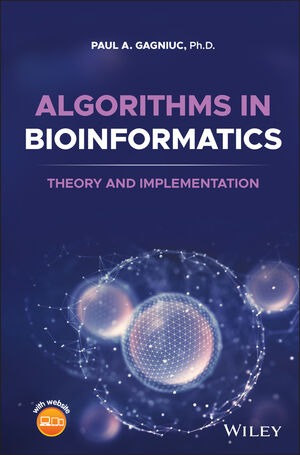
Algorithms in Bioinformatics : Theory and Implementation
Explores a comprehensive and insightful treatment of the practical application of bioinformatic algorithms in a variety of fields. Delivers a fulsome treatment of some of the main algorithms used to explain biological functions and relationships. It introduces readers to the art of algorithms in a practical manner which is linked with biological theory and interpretation. The book covers many key areas of bioinformatics, including global and local sequence alignment, forced alignment, detection of motifs, Sequence logos, Markov chains or information entropy. Other novel approaches are also described, such as Self-Sequence alignment, Objective Digital Stains (ODSs) or Spectral Forecast and the Discrete Probability Detector (DPD) algorithm. Readers will also benefit from the inclusion of: A detailed presentation of new methods, such as Self-sequence alignment, Objective Digital Stains and Spectral Forecast ; A treatment of sequence alignment, including local sequence alignment, global sequence alignment and forced sequence alignment with full implementations ; Discussions of position-specific weight matrices, including the count, weight, relative frequencies, and log-likelihoods matrices ; A detailed presentation of the methods related to Markov Chains as well as a description of their implementation in Bioinformatics and adjacent fields ; An examination of information and entropy, including sequence logos and explanations related to their meaning ; A chapter on philosophical transactions that allows the reader a broader view of the prediction process ; Extensive worked examples with detailed case studies that point out the meaning of different results

Algebraic Biology ; 2nd International Conference, AB 2007, Castle of Hagenberg, Austria, July 2-4, 2007, Proceedings
This volume constitutes the refereed proceedings of the Second International Conference on Algebraic Biology. The conference served as an interdisciplinary forum for the presentation of research on all aspects of the application of symbolic computation in biology, including computer algebra, computational logic, and related methods.
Advances in Discrete Differential Geometry
On a newly emerging field of discrete differential geometry and an excellent way to access this exciting area. It surveys the fascinating connections between discrete models in differential geometry and complex analysis, integrable systems and applications in computer graphics. The authors take a closer look at discrete models in differential geometry and dynamical systems. Their curves are polygonal, surfaces are made from triangles and quadrilaterals, and time is discrete. Nevertheless, the difference between the corresponding smooth curves, surfaces and classical dynamical systems with continuous time can hardly be seen. This is the paradigm of structure-preserving discretizations. Current advances in this field are stimulated to a large extent by its relevance for computer graphics and mathematical physics.
Advances in cryptology - EUROCRYPT 90 ; Workshop on the theory and application of cryptographic techniques, Aarhus, Denmark, May 21-24, 1990. Proceedings
Eurocrypt is a conference devoted to all aspects of cryptologic research, both theoretical and practical, sponsored by the International Association for Cryptologic Research (IACR). Eurocrypt 90 took place in Åarhus, Denmark, in May 1990. From the 85 papers submitted, 42 were selected for presentation at the conference and for inclusion in this volume. In addition to the formal contributions, short abstracts of a number of informal talks are included in these proceedings. The proceedings are organized into sessions on protocols, number-theoretic algorithms, boolean functions, binary sequences, implementations, combinatorial schemes, cryptanalysis, new cryptosystems, signatures and authentication, and impromptu talks.
Advances in cryptology - EUROCRYPT 2008 ; 27th Annual international conference on the theory and applications of cryptographic techniques, Istanbul, Turkey, April 13-17, 2008. Proceedings
Here are the refereed proceedings of the 27th Annual International Conference on the Theory and Applications of Cryptographic Techniques, EUROCRYPT 2008.

Advances in cryptology - EUROCRYPT 2007 ; 26th Annual international conference on the theory and applications of cryptographic techniques, Barcelona, Spain, May 20-24, 2007, Proceedings
Address all current foundational, theoretical and research aspects of cryptology, cryptography, and cryptanalysis as well as advanced applications.
Advances in cryptology – ASIACRYPT 2007 ; 13th International conference on the theory and application of cryptology and information security, Kuching, Malaysia, December 2-6, 2007, Proceedings
The book are organized in topical sections on number theory and elliptic curve, protocol, hash function design, group/broadcast cryptography, mac and implementation, multiparty computation, block ciphers, foundation, public key encryption, and cryptanalysi.
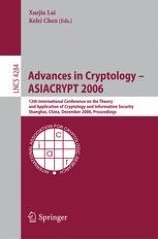
Advances in cryptology -- ASIACRYPT 2006 ; 12th International conference on the theory and application of cryptology and information security, Shanghai, China, December 3-7, 2006, Proceedings
This book constitutes the refereed proceedings of the 12th International Conference on the Theory and Application of Cryptology and Information Security, held in Shanghai, China, December 2006. The 30 revised full papers cover attacks on hash functions, stream ciphers, biometrics and ECC computation, id-based schemes, public-key schemes, RSA and factorization, construction of hash function, protocols, block ciphers, and signatures.
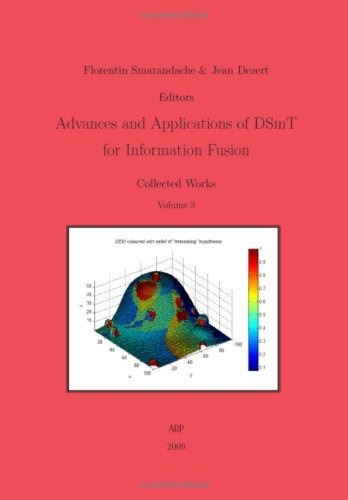
Advances and applications of DSmT for information fusion: Collected works ; Vol.3
One of the most comprehensive and flexible fusion theory based on belief functions. It can work in all fusion spaces: power set, hyper-power set, and super-power set, and has various fusion and conditioning rules that can be applied depending on each application. Some new generalized rules are introduced in this volume with codes for implementing some of them. For the qualitative fusion, the DSm Field and Linear Algebra of Refined Labels (FLARL) is proposed which can convert any numerical fusion rule to a qualitative fusion rule. When one needs to work on a refined frame of discernment, the refinement is done using Smarandache s algebraic codification. New interpretations and implementations of the fusion rules based on sampling techniques and referee functions are proposed, including the probabilistic proportional conflict redistribution rule.
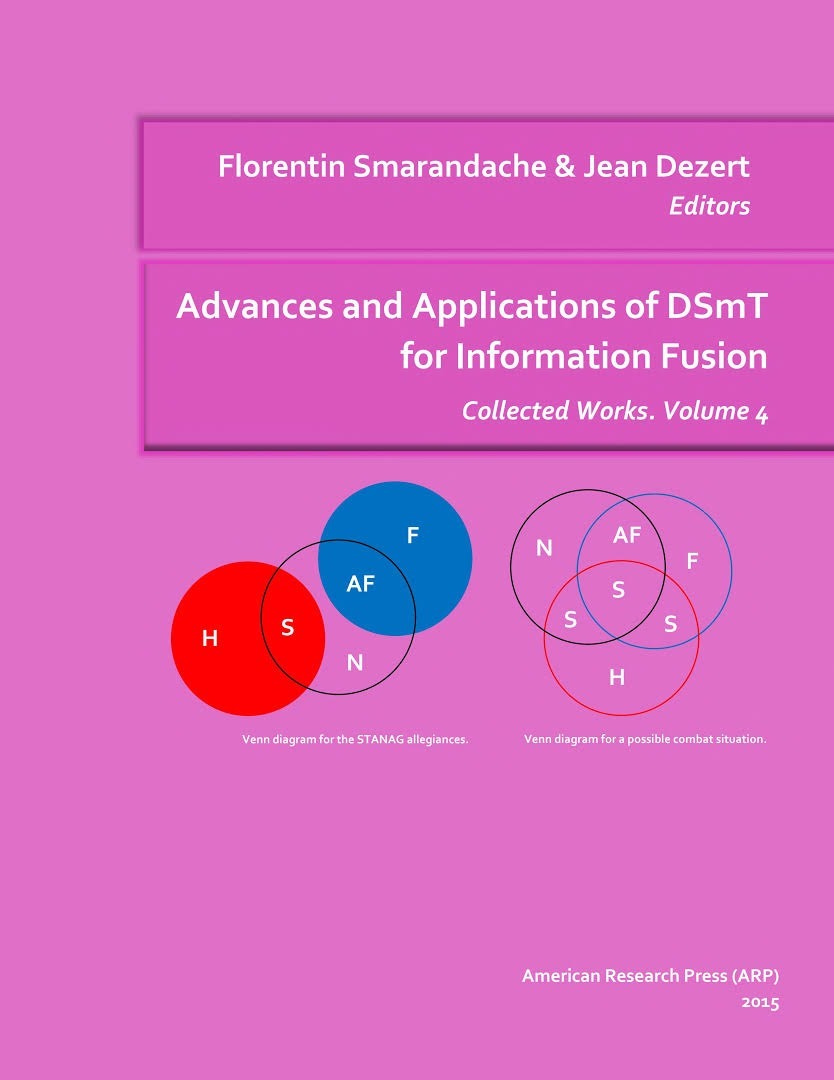
Advances and applications of DSmT for information fusion ; Vol. 4
One of the most comprehensive and flexible fusion theory based on belief functions. It can work in all fusion spaces: power set, hyper-power set, and super-power set, and has various fusion and conditioning rules that can be applied depending on each application. Some new generalized rules are introduced in this volume with codes for implementing some of them. For the qualitative fusion, the DSm Field and Linear Algebra of Refined Labels (FLARL) is proposed which can convert any numerical fusion rule to a qualitative fusion rule. When one needs to work on a refined frame of discernment, the refinement is done using Smarandache s algebraic codification. New interpretations and implementations of the fusion rules based on sampling techniques and referee functions are proposed, including the probabilistic proportional conflict redistribution rule.
