



Page 16
Page 16
Advances in computer science - ASIAN 2004 : Higher level decision making ; 9th Asian computing ccience conference ; Dedicated to Jean-Louis Lassez on the occasion of his 5th cycle birthday, Chiang Mai, Thailand, December 8-10, 2004
Constitutes the proceedings of the 9th Asian Computing Science Conference was held in Chiang Mai in Decem-ber 2004. This volume contains papers that were presented at that conference. Its theme was “higher-level decision-making”.Philippe Flajolet was invited to give the opening keynote address, whileYuzuru Tanaka and Phillip Rogaway werealso keynote speakers. In additionto the keynote speakers, distinguished colleagues of Jean-Louis Lassez were in-vited to present talks in his honour. Many of those talks are represented bypapers in this volume, this book Include Topics : Theory of Computation / Artificial Intelligence / Software Engineering / Programming and Operating Systems / Cryptology / Discrete Mathematics in Computer Science / Information Systems Applications (incl. Internet)
Advances in bioinformatics and computational biology ; 2nd Brazilian symposium on bioinformatics, BSB 2007, Angra dos Reis, Brazil, August 29-31, 2007, Proceedings
This book address a broad range of current topics in computationl biology and bioinformatics featuring original research in computer science, mathematics and statistics as well as in molecular biology, biochemistry, genetics, medicine, microbiology and other life sciences.
Advances in artificial intelligence: models, optimization, and machine learning
Contains all the articles accepted and published in the Special Issue “Advances in Artificial Intelligence: Models, Optimization, and Machine Learning” of the MDPI Mathematics journal, which covers a wide range of topics connected to the theory and applications of artificial intelligence and its subfields. These topics include, among others, deep learning and classic machine learning algorithms, neural modelling, architectures and learning algorithms, biologically inspired optimization algorithms, algorithms for autonomous driving, probabilistic models and Bayesian reasoning, intelligent agents and multiagent systems.
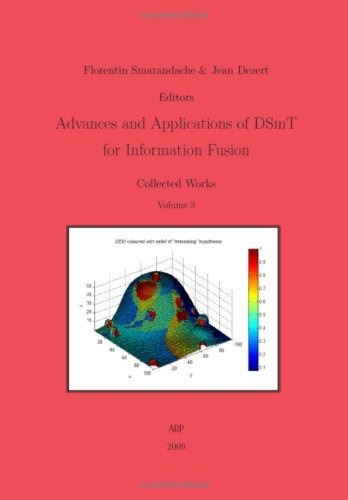
Advances and applications of DSmT for information fusion: Collected works ; Vol.3
One of the most comprehensive and flexible fusion theory based on belief functions. It can work in all fusion spaces: power set, hyper-power set, and super-power set, and has various fusion and conditioning rules that can be applied depending on each application. Some new generalized rules are introduced in this volume with codes for implementing some of them. For the qualitative fusion, the DSm Field and Linear Algebra of Refined Labels (FLARL) is proposed which can convert any numerical fusion rule to a qualitative fusion rule. When one needs to work on a refined frame of discernment, the refinement is done using Smarandache s algebraic codification. New interpretations and implementations of the fusion rules based on sampling techniques and referee functions are proposed, including the probabilistic proportional conflict redistribution rule.
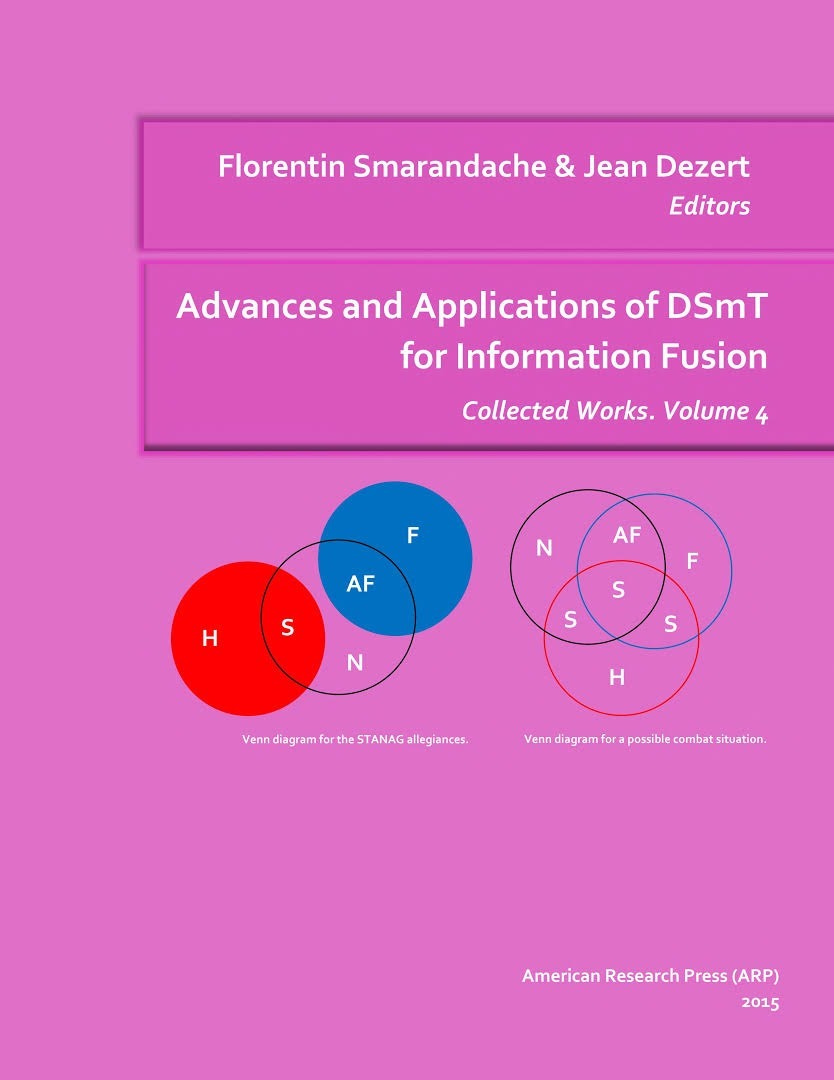
Advances and applications of DSmT for information fusion ; Vol. 4
One of the most comprehensive and flexible fusion theory based on belief functions. It can work in all fusion spaces: power set, hyper-power set, and super-power set, and has various fusion and conditioning rules that can be applied depending on each application. Some new generalized rules are introduced in this volume with codes for implementing some of them. For the qualitative fusion, the DSm Field and Linear Algebra of Refined Labels (FLARL) is proposed which can convert any numerical fusion rule to a qualitative fusion rule. When one needs to work on a refined frame of discernment, the refinement is done using Smarandache s algebraic codification. New interpretations and implementations of the fusion rules based on sampling techniques and referee functions are proposed, including the probabilistic proportional conflict redistribution rule.
Advanced mathematical science for mobility society
The automotive industry has made steady progress in technological innovations under the names of Connected Autonomous-Shared-Electric (CASE) and Mobility as a Service (MaaS). Needless to say, mathematics and informatics are important to support such innovations. As the concept of cars and movement itself is diversifying, they are indispensable for grasping the essence of the future mobility society and building the foundation for the next generation. This book contains three main contents. 1. Mathematical models of flow 2. Mathematical methodsfor huge data and network analysis 3. Algorithm for mobility society The first one discusses mathematical models of pedestrian and traffic flow, as they are important for preventing accidents and achieving efficient transportation.
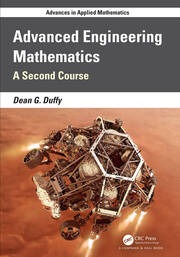
Advanced engineering mathematics : A second course with MatLab
Presents a wide variety of topics needed by today's engineers. The fifth edition of that book, available now, has been broken into two parts: topics currently needed in mathematics courses and a new stand-alone volume presenting topics not often included in these courses and consequently unknown to engineering students and many professionals.
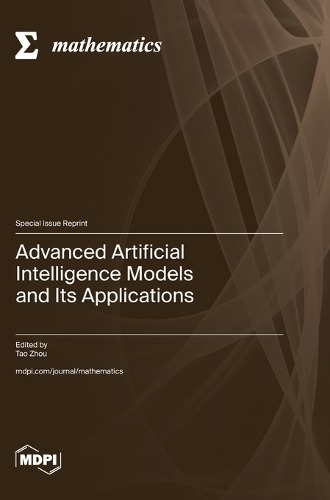
Advanced artificial intelligence models and its applications
The field of artificial intelligence (AI) has undergone enormous expansion since its inception in the mid-20th century, as demonstrated by its application across an array of engineering and scientific challenges. Particularly in the last decade, AI has witnessed a significant breakthrough with the advent of deep learning, which has facilitated the employment of various AI models across a multitude of domains. This reprint features ten papers accepted for publication in the Special Issue titled "Advanced Artificial Intelligence Models and Their Applications," published in the MDPI Mathematics journal. These papers explore numerous facets of advanced artificial intelligence models and their applications, covering areas such as cybersecurity, image classification, logistics optimization, automatic music generation, human capital investment, writer recognition, remote sensing image indexing, target tracking, and more.
Adaptive and natural computing algorithms ; Proceedings of the International Conference in Coimbra, Portugal, 2005
The ICANNGA series of Conferences has been organised since 1993 and has a long history of promoting the principles and understanding of computational intelligence paradigms within the scientific community and is a reference for established workers in this area.and this book about Proceedings of the International Conference in Coimbra, Portugal, 2005 including Topics Artificial Intelligence Simulation and Modeling / Mathematics of Computing / Computer Applications

A Practical Programming Model for the Multi-Core Era ; 3rd International Workshop on OpenMP, IWOMP 2007, Beijing, China, June 3-7, 2007 Proceedings
This book constitutes the thoroughly refereed post-workshop proceedings of the Third International Workshop on OpenMP, IWOMP 2007, held in Beijing, China, in June 2007.The 14 revised full papers and 8 revised short papers presented were carefully reviewed and selected from 28 submissions. The papers address all topics related to OpenMP, such as OpenMP performance analysis and modeling, OpenMP performance and correctness tools and proposed OpenMP extensions, as well as applications in various domains, e.g., scientific computation, video games, computer graphics, multimedia, information retrieval, optimization, text processing, data mining, finance, signal and image processing, and numerical solvers.
A Guide to Graph Algorithms
Offers high-quality content in the research area of graph algorithms and explores the latest developments in graph algorithmics. The reader will gain a comprehensive understanding of how to use algorithms to explore graphs. It is a collection of texts that have proved to be trend setters and good examples of that. The book aims at providing the reader with a deep understanding of the structural properties of graphs that are useful for the design of efficient algorithms. These algorithms have applications in finite state machine modelling, social network theory, biology, and mathematics. The book contains many exercises, some up at present-day research-level. The exercises encourage the reader to discover new techniques by putting things in a clear perspective.
A First Course in Statistical Inference
Offers a modern and accessible introduction to Statistical Inference, the science of inferring key information from data. Aimed at beginning undergraduate students in mathematics, it presents the concepts underpinning frequentist statistical theory. Written in a conversational and informal style, this concise text concentrates on ideas and concepts, with key theorems stated and proved. Detailed worked examples are included and each chapter ends with a set of exercises, with full solutions given at the back of the book. Examples using R are provided throughout the book, with a brief guide to the software included. Topics covered in the book include: sampling distributions, properties of estimators, confidence intervals, hypothesis testing, ANOVA, and fitting a straight line to paired data.
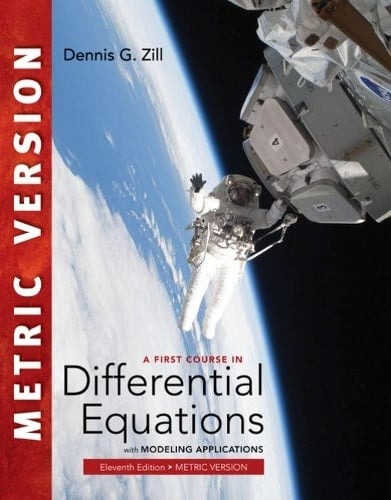
A first course in differential equations with modeling applications
A comprehensive treatment of ordinary differential equations, concisely presenting basic and essential results in a rigorous manner. Including various examples from physics, mechanics, natural sciences, engineering and automatic theory, Differential Equations is a bridge between the abstract theory of differential equations and applied systems theory.
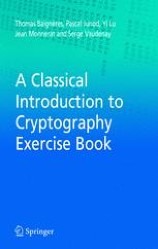
A Classical Introduction to Cryptography Exercise Book
A Classical Introduction to Cryptography Exercise Book for A Classical Introduction to Cryptography: Applications for Communications Security covers a majority of the subjects that make up today's cryptology, such as symmetric or public-key cryptography, cryptographic protocols, design, cryptanalysis, and implementation of cryptosystems. Exercises do not require a large background in mathematics, since the most important notions are introduced and discussed in many of the exercises.
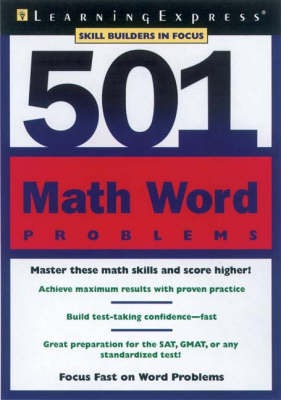
501 Math Word Problems
Contains only word problems - the kinds you encounter at school and on high stakes tests. Gaining familiarity with this specific question type is a proven technique for increasing test scores. The Skill Builder in Focus method provides the targeted practice on these questions necessary to attain higher scores. Questions are divided into six chapters: algebra, geometry, fractions, percents, decimals, and miscellaneous math. Within each chapter, questions move from easy to advanced, giving test-takers the opportunity to gain confidence in each math area. Each chapter contains questions, answers, and detailed explanations to reinforce learning and understanding. Diagrams and useful terminology help clarify math rules for effective studying and retention.
