



Page 1
Page 1

Satellite Communications Systems : Systems, Techniques and Technology
Contains information on the most recent advances related to satellite communications systems, technologies, network architectures and new requirements of services and applications. The authors – noted experts on the topic – cover the state-of-the-art satellite communication systems and technologies and examine the relevant topics concerning communication and network technologies, concepts, techniques and algorithms. New to this edition is information on internetworking with the broadband satellite systems, more intensive coverage of Ka band technologies, GEO high throughput satellite (HTS), LEO constellations and the potential to support the current new broadband Internet services as well as future developments for global information infrastructure.
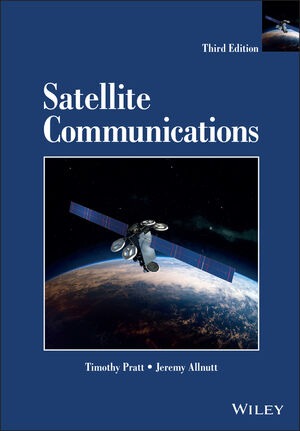
Satellite communications
There has been a complete transition from analog to digital communication systems, withanalog techniques replaced by digital modulation and digital signal processing. While distribution of television programming remains the largest sector of commercial satellite communications, low earth orbit constellations of satellites for Internet access are set to challenge that dominance. this book: Focuses on the fundamental theory of satellite communications / Explains the underlying principles and essential mathematics required to understand the physics and engineering of satellite communications / Discusses the expansion of satellite communication systems in areas such as direct-broadcast satellite TV, GPS, and internet access / Introduces the rapidly advancing field of small satellites, referred to as SmallSats or CubeSats / Provides relevant practice problems based on real-world satellite systems

Resource Management in Satellite Networks : Optimization and Cross-Layer Design
Resource Management in Satellite Networks: Optimization and Cross-Layer Design addresses the emergent research area of cross-layer air interface design for satellite systems. A detailed analysis of cross-layer methods is presented along with new analytical and simulation results demonstrating that these techniques can assures high QoS levels for differentiated traffic classes. The research presented integrates the expertise of a wide range of researchers, and addresses all aspects of system design (e.g., propagation issues, resource management techniques, link design, QoS, transport protocols, etc.). Of particular importance is the inclusion of research applicable to both fixed and mobile satellite systems.

Methods of Celestial Mechanics ; Vol. II : Application to Planetary System, Geodynamics and Satellite Geodesy
G. Beutler's Methods of Celestial Mechanics is a coherent textbook for students as well as an excellent reference for practitioners. Volume II is devoted to the applications and to the presentation of the program system CelestialMechanics. Three major areas of applications are covered: (1) Orbital and rotational motion of extended celestial bodies. The properties of the Earth-Moon system are developed from the simplest case (rigid bodies) to more general cases, including the rotation of an elastic Earth, the rotation of an Earth partly covered by oceans and surrounded by an atmosphere, and the rotation of an Earth composed of a liquid core and a rigid shell (Poincaré model). (2) Artificial Earth Satellites. The oblateness perturbation acting on a satellite and the exploitation of its properties in practice is discussed using simulation methods (CelestialMechanics) and (simplified) first order perturbation methods. The perturbations due to the higher-order terms of the Earth's gravitational potential and resonant perturbations are considered thereafter. Special attention is paid to satellites of the Global Navigation Satellite Systems and to geostationary satellites. The characteristics of and models for the two most important non-gravitational forces, atmospheric drag and radiation pressure, are presented as well as the most relevant forces acting on high- and low-orbiting satellites. (3) Evolution of the Planetary System. The outer planetary system consisting of the planets Jupiter to Pluto is studied over long time intervals using simulation methods and spectral analysis (CelestialMechanics). The properties of the inner systems, in particular of the Earth's orbit, are made visible by integrating the entire system over long time intervals relevant for climate change. The distribution of minor planets and their orbital properties, regular orbits, and chaotic orbits are easily generated and analyzed using CelestialMechanics. The volume concludes with the discussion of important mathematical tools of the program system and of the principles of spectral analysis.
IP Networking over Next-Generation Satellite Systems ; International Workshop, Budapest, July 2007
Highlights the very latest research output of several EU satellite-related projects and addresses many unresolved issues in next-generation satellite systems, such as efficient deployment of IPv6 over satellites, working with WLAN and WiMax, QoS provisioning over multi-segment networks (including satellite networks), multicast networks and security.

Digital Satellite Communications
Digital Satellite Communications focuses on the study and design of efficient and flexible physical layers for broadband mobile and fixed satellite links. The chapters address long-term developments for advanced physical layer techniques in broadband communications, fixed and mobile terminals, and 4G evolutions with a potential convergence between different technologies. A general description of satellite systems and services is provided which organizes the material into a generalized and readable framework. The approach is both analytical and descriptive.

Location- and Context-Awareness ; Vol. 3479 ; First International Workshop, LoCA 2005, Oberpfaffenhofen, Germany, May 12-13, 2005, Proceedings
The workshop was organized by the Institute of Communications and Navigation of the German Aerospace Center (DLR) in Oberpfa?enhofen, and the Mobile and Distributed Systems Group of the University of Munich. During the workshop, novel positioning algorithms and location sensing techniques were discussed, comprising not only enhancements of singular systems, like positioning in GSM or WLAN, but also hybrid technologies, such as the integration of global satellite systems with inertial positioning. Furthermore, improvements in sensor technology, as well as the integration and fusion of sensors, were addressed both on a theoretical and on an implementation level. Personal and confidential data, such as location data of users, have p- found implications for personal information privacy. Thus privacy protection, privacy-oriented location-aware systems, and how privacy aspects the feasibility and usefulness of systems were also addressed in the workshop.

Atmosphere and Climate : Studies by Occultation Methods
In this book we focus on sensors on Low Earth Orbit (LEO) satellites, which exploit solar, lunar, stellar, GNSS (Global Navi- tion Satellite Systems), and LEO-crosslink signals for observing the Earth's - mosphere and climate. The methods all share the key properties of self-calibration, high accuracy and vertical resolution, global coverage, and (if using radio signals) all-weather ca- bility. The atmospheric parameters obtained extend from the fundamental va- ables temperature, density, pressure and water vapor via trace gases, aerosols and cloud liquid water to ionospheric electron density. Occultation data are therefore of high value in a wide range of fields including climate monitoring and research, atmospheric physics and chemistry, operational meteorology, and ionospheric physics.
A Software-Defined GPS and Galileo Receiver : A Single-Frequency Approach
Satellite navigation receivers are used to receive, process, and decode space-based navigation signals, such as those provided by the GPS constellation of satellites. There is an increasing need for a unified open platform that will enable enhanced receiver development and design, as well as cost-effective testing procedures for various applications. This book provide hands-on exploration of new technologies in this rapidly growing field. One of the unique features of the work is the interactive approach used, giving readers the ability to construct their own Global Navigation Satellite Systems (GNSS) receivers. To construct such a reconfigurable receiver with a wide range of applications, the authors discuss receiver architecture based on software-defined radio (SDR) techniques. The presentation unfolds in a systematic, user-friendly style and goes from the basics to cutting-edge research.
