



Page 1
Page 1

Subspace Methods for System Identification
the mathematical preliminaries are dealt with: numerical linear algebra; system theory; stochastic processes; and Kalman filtering. The second part explains realization theory, particularly that based on the decomposition of Hankel matrices, as it is applied to subspace identification methods. Two stochastic realization results are included, one based on spectral factorization and Riccati equations, the other on canonical correlation analysis (CCA) for stationary processes. Part III uses the development of stochastic realization results, in the presence of exogenous inputs, to demonstrate the closed-loop application of subspace identification methods CCA and ORT (based on orthogonal decomposition).

Realization Theory and Design of Digital Images
Thismonographisconcernedwithdescriptionanddesignfortwo-dimensional and three-dimensional images; it will be of special interest to researchers and graduate students who specialized in image processing and system theory. From the data in digital images, mathematical models will be constructed. Then new systems which describe faithfully any two-dimensional or thr- dimensional digital images will be proposed.

Operator Theory in Krein Spaces and Nonlinear Eigenvalue Problems
They deal with spectral and perturbation theory of linear operators in indefinite inner product spaces and their applications. The topics include extension theory of symmetric operators, normal operators, realization theory and models of generalized Nevanlinna functions, interpolation problems, reproducing kernel spaces, matrix and operator pencils, locally definitizable functions, and semigroups.

Introduction to Mathematical Systems Theory : Linear Systems, Identification and Control
This book provides an introduction to the theory of linear systems and control for students in business mathematics, econometrics, computer science, and engineering. The focus is on discrete time systems, which are the most relevant in business applications, as opposed to continuous time systems, requiring less mathematical preliminaries. The subjects treated are among the central topics of deterministic linear system theory: controllability, observability, realization theory, stability and stabilization by feedback, LQ-optimal control theory. Kalman filtering and LQC-control of stochastic systems are also discussed, as are modeling, time series analysis and model specification, along with model validation.
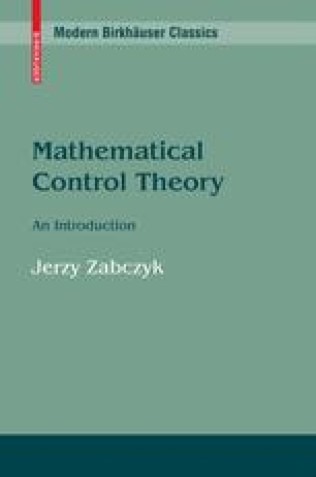
Mathematical Control Theory : An Introduction
Mathematical Control Theory: An Introduction presents, in a mathematically precise manner, a unified introduction to deterministic control theory. With the exception of a few more advanced concepts required for the final part of the book, the presentation requires only a knowledge of basic facts from linear algebra, differential equations, and calculus. In addition to classical concepts and ideas, the author covers the stabilization of nonlinear systems using topological methods, realization theory for nonlinear systems, impulsive control and positive systems, the control of rigid bodies, the stabilization of infinite dimensional systems, and the solution of minimum energy problems.
