



Page 1
Page 1

The Ecophysiology of Plant-Phosphorus Interactions
Takes an in-depth look at these diverse plant-phosphorus interactions in natural and agricultural environments, presenting a series of critical reviews on the current status of research. In particular, the book presents a wealth of information on the genetic and phenotypic variation in natural plant ecosystems adapted to low P availability, which could be of particular relevance to developing new crop varieties with enhanced abilities to grow under P-limiting conditions. The book provides a valuable reference material for graduates and research scientists working in the field of plant-phosphorus interactions, as well as for those working in plant breeding and sustainable agricultural development.

Oxygen isotopes of inorganic phosphate in environmental samples : Purification and analysis
This book distinguished itself from other publications by offering step-by-step instructions on how to extract, purify, provide modifications, and major issues to be encountered during the process. For the δ18OP method to progress, further fundamental research as well as field and laboratory studies need to be conducted for a better understanding of P cycling in the environment.

Nutrient Cycling in Terrestrial Ecosystems
The first part of the book presents the fundamentals of nutrient cycling. Topics included are cycling of carbon, nitrogen, phosphorus, sulphur and micronutrients. The second part discusses nutrient cycling at an ecosystem scale, covering cropping systems, pastures, natural grasslands, arid lands, tundras and forests. The final chapter reviews current models of nutrient cycling.

Nutraceuticals and bone health
Here is an informative volume on the importance of nutraceuticals and herbal remedies for bone health. It explains the probable mechanisms of nutraceuticals for the prevention, treatment, and management of bone-related diseases as well as their curable effects on bone injuries. The volume covers the progression and development of bones, which is a multifaceted process that requires an endless and ample supply of nutrients, such as calcium, phosphorus, potassium, protein, vitamin D, magnesium, and fluoride. The book delves into the beneficial effects of nutraceuticals on overall bone health and for the treatment of bone disorders such as osteoporosis, bone fractures, scoliosis and related complications, rheumatoid arthritis, Paget’s disease, bursitis, gout, and carpal tunnel syndrome. It also addresses the use of nutraceuticals for inflammatory deformities and rickets.

New Aspects in Phosphorus Chemistry V
The use of polyphosphazenes as fluoroelastomers, flame retardants and self-extinguishing macromolecules, polymeric ionic conductors, biomaterials, and photosensitive polymeric compounds is outlined. This volume,as well as the four precedent volumes,describes only in part the huge number of original papers on phosphorus-related topics. Some further volumes will be necessary in the future to cover all aspects of this chemistry in perpetual rebirth.

Microorganisms in soils : Roles in genesis and functions
The following key topics are covered: Microorganisms in bioerosion, humification, mineralization and soil aggregation; Microbial energetics and microbes in biogeochemical processes such as carbon and nitrogen cycles and phosphorus bio-availability; Interactions in the mycorrhizosphere, e.g. between mycorrhizal fungi and bacteria; Impact of microbes on plant nutrient cycling and the possible effects of transgenic rhizospheres on soil fungi; Functions of microbes in specific soil compartments such as soil surface or toxic metal polluted soils; Regulation of microbial activities in functional domains that are influenced by biotic or abiotic factors; Use of marker genes and isotopes as examples for modern techniques in soil microbiology.

Eutrophication Management and Ecotoxicology
This book aims to bridge the gap between ecotoxicology and limnology. The intended readers of the book are water managers, policy makers with a scientific background as well as researchers/advisors in the area of water management. The book provides an ecotoxicological perspective on lake management and describes eutrophication of shallow, temperate lakes. It surveys the influence of toxic substances (e.g., agricultural pesticides) on the aquatic ecosystem, especially the relation between algae and daphnids. The message of the book is that nutrients such as phosphorus are not the only important factor in explaining and managing eutrophication: toxic disturbance of to-down control is also an important factor to be considered. The results of extensive studies and experiments (some unpublished) on lake eutrophication are presented in this book.
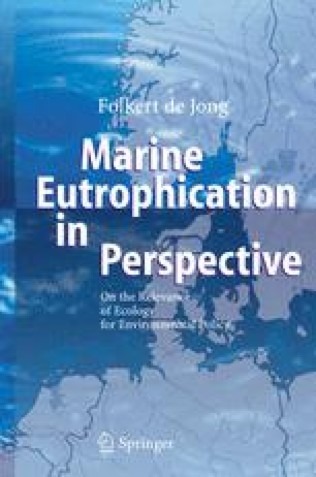
Marine Eutrophication in Perspective : On the Relevance of Ecology for Environmental Policy
Is ecological knowledge relevant for environmental policy and if so, to what extent and in what way? These are some of the basic questions addressed in this book. Triggered by a series of oxygen depletion events in German, Danish and Swedish coastal waters at the beginning of the 1980s, international policies to reduce inputs of nitrogen and phosphorus to the North Sea were agreed upon by the North Sea states. The book provides a critical analysis of the role, scientists and scientific information, as well as civil servants, have played in the formulation and implementation of these decisions.
Lake Verevi, Estonia : A highly stratified hypertrophic lake
The present book summarises investigations on Lake Verevi (surface 12.6 ha, mean depth 3.6 m). The seventeen articles in this issue deal with a wide range of questions, starting with a holistic overview of the ecological status, over assessments of long-term changes in biotic and abiotic conditions and finishing with proposed restoration plans. Abiotic chapters provide calculations on water and mass balance, distribution and fractions of phosphorus in the sediment, optical properties and penetration of radiation in the water column, sedimentation rate during the formation of stratification, and nitrogen circulation characteristics.
Chiral Diazaligands for Asymmetric Synthesis
The use of phosphine derivatives has historically induced the tremendous development of catalysis (both non-asymmetric and asymmetric). Although the chemistry of amines is more documented, the use of nitrogen-containing ligands only appeared recently. Nevertheless, during the last ten years, the results describing chiral diamine preparations and their uses in asymmetric catalysis and synthesis are increasing faster than their phosphorus counterparts. The reader will find in this volume the most recent methods for the synthesis of chiral diamines as well as their applications in asymmetric catalysis of CC bond formation. Particular attention will be given to spartein and derivatives of such diamines. Recently, the particular properties and the chemistry of amines allowed to obtain catalysts easy to separate and recycle and new types of ligands such as diaminocarbenes, ureas and thioureas. Finally, the complexing properties of some diamines allowed the formation of complexes with chirality "at the metal " which is of major theoretical interest and presents numerous potential applications.
Carbon in the Geobiosphere : Earth's outer shell
Carbon and carbon dioxide always played an important role in the geobiosphere that is part of the Earth’s outer shell and surface environment. The book’s eleven chapters cover the fundamentals of the biogeochemical behavior of carbon near the Earth’s surface, in the atmosphere, minerals, waters, air-sea exchange, and inorganic and biological processes fractionating the carbon isotopes, and its role in the evolution of inorganic and biogenic sediments, ocean water, the coupling to nutrient nitrogen and phosphorus cycles, and the future of the carbon cycle in the Anthropocene. This book is mainly a reference text for Earth and environmental scientists; it presents an overview of the origins and behavior of the carbon cycle and atmospheric carbon dioxide, and the human effects on them. The book can also be used for a one-semester course at an intermediate to advanced level addressing the behavior of the carbon and related cycles.
