



Page 1
Page 1

Equilibrium Between Phases of Matter : Phenomenology and Thermodynamics
The phase behaviour of materials and their thermodynamic properties are a central subject in all fields of materials research. The first Volume of the work, meant for graduate students in chemistry, geology, physics, and metallurgy, and their engineering counterparts, is split up in three levels, such that from level to level the portion and importance of thermodynamics and mathematics are increased. In the ground level it is shown that the basic principles of phase equilibria can be understood without the use of thermodynamics – be it that the concept of chemical potential is introduced right from the beginning. The intermediate level is an introduction to thermodynamics; culminating in the Gibbs energy as the arbiter for equilibrium – demonstrated for systems where the phases in equilibrium are pure substances. In the third level the accent is on binary systems, where one or more phases are solutions of the components.
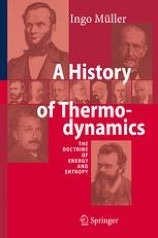
A History of Thermodynamics : The Doctrine of Energy and Entropy
The development of thermodynamics in the second half of the 19th century has had a strong impact on both technology and natural philosophy. It is true that the steam engine for the conversion of heat into work existed before thermodynamics was developed as a branch of physics. However, the systematic theory improved the conversion process, and it succeeded in developing other processes essential to modern life, notably refrigeration and rectification. So, altogether thermodynamics has provided humanity with cheap energy, and cheap fuel, -- consequently with cheap, and abundant, and unspoiled food. Thus thermodynamics has made populations grow, and life expectancy increase beyond anything people could possibly have imagined 200 years ago.
