



Page 1
Page 1

Intelligent Organizations : Powerful Models for Systemic Management
This innovative book opens a path to overcoming the crisis of management in the face of complexity. The systems approach on which this work is grounded enables the development of the new kind of intelligent organizations so urgently needed. Powerful models, grounded in organizational cybernetics and system dynamics
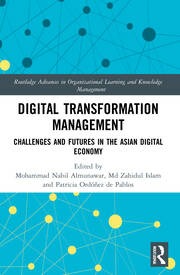
Digital transformation management : Challenges and futures in the Asian digital economy
Addresses key topics related to organization design and knowledge management in the digital economy with organizational context, particularly in Asia. the book conceptualizes organization design into three dimensions, people, information, and technology, and offers readers a unique valued insight, bringing new perspectives to understanding emerging business opportunities and challenges in Asia. it presents a valuable collection of 14 chapters with empirical studies from leading researchers. the book addresses digital transformation in companies and organizations in Asia, analysing how disruptive technologies can help them to have more efficient organization processes, create innovative products and services, be more resilient and achieve sustainable goals in post-pandemic time.

Designing Organizations : 21st Century Approaches
The design of organizations has been an ongoing concern of management theory and practice over the past several decades. Over this time, there has been little change in the fundamental theory, principles and concepts of Organization Design (OD). Recently organizational life has changed dramatically with the advent of: new communication systems, adaptive mechanisms, information technology, knowledge management systems, innovation processes and more. This book systemically examines these developments and their impact on OD with contributions from leading scholars in the area. Also featured in the book are the practical issues with implementing OD in organizations. The individual chapters are organized into five sections: (1) Putting Contingency Theory in its Place, (2) Focus on Individuals Who Make up the Organization, (3) Innovation Processes and Organization Design, (4) Adaptation and Technology, and (5) Design for Performance. Each chapter examines aspects of the book’s threefold theme: (1) core issues in organization design, (2) emerging theoretical perspectives in OD, and (3) new developments and directions in OD. A special feature of each chapter is: 1) implications for theory, and 2) implications for practice.

Cross-Business Synergies : A Typology of Cross-Business Synergies and a Mid-range Theory of Continuous Growth Synergy Realization
Sebastian Knoll investigates what cross-business synergies actually are and how they are realized successfully. In a first step, a theory-based typology of cross-business synergies is developed and two new types of synergies are conceptualized: (1) Growth synergies, i.e. profitable growth advantages from recombining complementary operative resources across businesses, and (2) corporate management synergies, i.e. performance advantages from leveraging corporate management capabilities across businesses. In a second step, the author focuses on growth synergies and inducts a framework for their continuous realization from a longitudinal in-depth single case study. He suggests that the successful realization of growth synergies is associated with a selective focus on specific growth opportunities, decentralized cross-business collaboration that motivates productive business unit self-interest, and a corporate management approach that guides and balances this self-interest in an evolutionary fashion.
