



Page 1
Page 1

Multi-Agent-Based Simulation VIII ; International Workshop, MABS 2007, Honolulu, HI, USA, May 15, 2007, Revised and Invited Papers
This book constitutes the thoroughly refereed post-proceedings of the 8th International Workshop on Multi-Agent-Based Simulation, MABS 2007, held in Honolulu, HI, USA in May 2007 as an associated event of AAMAS 2007, the main international conference on autonomous agents and multi-agent systems.The 10 revised full papers presented were carefully reviewed and selected from 20 submissions.The papers are organized in topical sections on architectures; teams, learning, education; economy, trust and reputation.

Multi-Agent-Based Simulation VII ; International Workshop, MABS 2006, Hakodate, Japan, May 8, 2006, Revised and Invited Papers
This book constitutes the thoroughly refereed proceedings of the 7th International Workshop on Multi-Agent-Based Simulation, MABS 2006. The 12 revised full papers presented together with three short papers and two invited papers were carefully reviewed and selected from 25 submissions during two rounds of reviewing.
Multi-Agent-Based Simulation VI ; International Workshop, MABS 2005, Utrecht, The Netherlands, July 25, 2005, Revised and Invited Papers
This book constitutes the thoroughly refereed post-proceedings of the 6th International Workshop on Multi-Agent-Based Simulation, MABS 2005, held in Utrecht, The Netherlands in July 2005 as an associated event of AAMAS 2005, the main international conference on autonomous agents and multi-agent systems. The 12 revised full papers presented together with 1 invited talk were carefully reviewed. The papers are organized in topical sections on coalition emergence, theories and models, applications, and environments.

Multi-Agent Systems and Applications ; 9th ECCAI Advanced Course ACAI 2001 and Agent Link's 3rd European Agent Systems Summer School, EASSS 2001, Prague, Czech Republic, July 2-13, 2001. Selected Tutorial Papers
The Advanced Course on Artificial Intelligence ACAI 2001 with the subtitle M ulti- Agent Systems and Their Applications , held in Prague, Czech Republic, was a joint event of ECCAI (the European Coordinating Committee for Artificial Intelligence) and AgentLink, the European Network of Excellence for Agent-Based Computing. Whereas ECCAI organizes two-week ACAI courses on different topics every second year, AgentLink s European Agent Systems Summer School (EASSS) has been an annual event since 1999. This year, both of these important events were merged together, giving weight to the fact that multi-agent systems currently represent one of the hottest topics in AI research. The name, ACAI 2001 Summer School, is intended to emphasize that this event continues the tradition of regular ECCAI activities (ACAI), as well as the EASSS summer schools of AgentLink.

Multiagent System Technologies ; 5th German Conference, MATES 2007, Leipzig, Germany, September 24-26, 2007, Proceedings
The papers are organized in topical sections on engineering multi-agent systems, multi-agent planning and learning, multi-agent communication, interaction, and coordination, multi-agent resource allocation, multi-agent planning and simulation, as well as trust and reputation.
Multiagent based Supply Chain Management
The authors takes a close look at what has been done recently in the field of supply chain management using agent technology and more specifically multiagent systems. The book contains sixteen chapters organized in four main parts; Introductory Papers; Multiagent Based Supply Chain Modeling, Collaboration and Coordination Between Agents in a Supply Chain and Multiagent Based Supply Chain Management: Applications. This book is intended as reference material for researchers, graduate students, and practitioners alike who are interested in pursuing research and development in this area, and who need for that, a comprehensive view of the existing literature, and some ideas for future directions.

Monetary and Wage Policies in the Euro Area
This book studies the interactions between monetary and wage policies in the euro area. It carefully discusses the process of policy competition and the structure of policy cooperation. As to policy competition, the focus is on competition between the European central bank, the American central bank, the German labour union, and the French labour union. As to policy cooperation, the focus is on the same institutions. These are higher-dimensional issues. The policy targets are price stability and full employment. The policy decisions are taken sequentially or simultaneously. Monetary and wage policies have spillover effects. Special features of this book are numerical simulations of policy competition and numerical solutions to policy cooperation.

Monetary and Fiscal Policies in the Euro Area
This book studies the interactions between monetary and fiscal poUcies in the euro area. It carefully discusses the process of policy competition and the structure of policy cooperation. As to policy competition, the focus is on competition between the European central bank, the American central bank, the German government, and the French government. As to policy cooperation, the focus is on the same institutions. These are higher-dimensional issues. The pohcy targets are price stability and full employment. The policy makers follow co- turkey or gradualist strategies. The policy decisions are taken sequentially or simultaneously. Monetary and fiscal policies have spillover effects. Special features of this book are numerical simulations of policy competition and numerical solutions to policy cooperation. The present book is part of a larger research project on European Monetary Union, see the references at the back of the book. Some parts of this project were presented at the World Congress of the International Economic Association. Other parts were presented at the International Conference on Macroeconomic Analysis, at the International Institute of Public Finance, at the Macro Study Group of the German Economic Association, at the Annual Meeting of the Austrian Economic Association, at the Gottingen Workshop on International Economics, at the Halle Workshop on Monetary Economics, at the Research Seminar on Macroeconomics in Freiburg, and at the Passau Workshop on International Economics.

Modern avenues in metal-nucleic acid chemistry
Provides a timely overview of selected relevant developments in a field which previously had a pronounced focus on fundamental chemistry aspects such as coordination principles, structural chemistry, and consequences for biological processes and disease-related medicinal issues. More recently, also as a consequence of the advent of supramolecular chemistry, advancements in nanochemistry, and new bio-analytical methods, novel aspects of this field have emerged. MILS-25 gives a state-of-the-art account on the present state of research in this field, addressing, among others, porous materials, non-covalent interactions, stimuli-responsive bioconjugates, DNA-templated metal arrays and nanoclusters, genotyping, guanine quadruplexes, and riboswitches.

Model Driven Engineering Languages and Systems ; Vol. 4199 ; 9th International Conference, MoDELS 2006, Genova, Italy, October 1-6, 2006, Proceedings
This book constitutes the refereed proceedings of the 9th International Conference on Model Driven Engineering Languages and Systems (formerly the UML series of conferences), MoDELS 2006, held in Genova, Italy, in October 2006. The 51 revised full papers and 2 invited papers presented were carefully reviewed and selected from 178 initial submissions. The papers are organized in topical sections on evaluating UML, MDA in software development, concrete syntax, applying UML to interaction and coordination, aspects, model integration, formal semantics of UML, security, model transformation tools and implementation, analyzing dynamic models, specifying transformations, MOF, bridging models, risk, trust and dependability, tool environments, OCL, roundtrip engineering, real time and embedded systems, as well as workshops, tutorials and panels.

Measuring human trafficking : Complexities and pitfalls
Measuring Human Trafficking needs to be read by scholars, professionals, and policymakers in the criminology and human rights fields. The ideas in this important volume can serve to improve the global knowledge base, strengthen coordination between agencies, and develop more effective solutions for combating this most pressing moral issue.

Mathematical Models of Distribution Channels
In Chapters 1 and 2 the authors provide an introduction to the current, analytical literature on distribution channels, and they present an intuitively appealing prologue to the Channel Myths that are developed rigorously in later Chapters. In Chapters 3, 4, and 10 they extend the literature by ascertaining the relationship between the manufacturer-optimal wholesale-price strategy and channel breadth. Specific analyses include multiple, non-competing retailers, multiple states-of-nature, and multiple, competing retailers. In Chapters 5-7 the authors determine the profitability of various wholesale-price strategies; this analysis culminates in Chapters 8 and 9 with the determination of the (very limited) conditions under which channel coordination can be optimal for the manufacturer. In Chapter 11 they prove that existing methods of measuring the effect of a change in the degree of inter-retailer substitutability are totally misleading. They then develop an original, theoretical basis for measuring the impact of a change in the degree of inter-retailer substitutability that yields insightful, intuitively appealing results. In Chapter 12 the authors set forth an agenda for future research based on a meta-model that embraces all existing models in the literature. They also issue an appeal for creation of a "Unifying Theory of Distribution Channels" that will enable researchers to work independently and yet to contribute toward the common goal of deepening the marketing science professions’ understanding of distribution channels.
International Economic Policy Coordination
The book investigates the interplay of brand equity and technological assets at the corporate level. In a grounded theory approach it develops a model of how companies in technology intensive industries can improve the appropriation of the returns of their intangible technological assets with the help of brand equity and thus improve their competitiveness. The theoretical discussions are supported by two extensive case studies on Bayer Aspirin and Cisco Systems as well as an extensive econometric analysis. The developed model points out how the strategic relevance of immaterial technological assets and brand equity develop along the technology-life-cycle and indicates how companies can, by an integrated technology and brand equity management, appropriate the returns of their initial technological advantage in the long-run. The implications of the findings for business companies as well as researchers are clearly revealed.

Intelligent robotics and applications ; 1st International Conference, ICIRA 2008, Wuhan, China, October 15-17, 2008, Proceedings, Part I
These two volumes constitute the refereed proceedings of the First International Conference on Intelligent Robotics and Applications, ICIRA 2008, held in Wuhan, China, in October 2008.The 265 revised full papers presented were thoroughly reviewed and selected from 552 submissions; they are devoted but not limited to robot motion planning and manipulation; robot control; cognitive robotics; rehabilitation robotics; health care and artificial limb; robot learning; robot vision; human-machine interaction & coordination; mobile robotics.

Intelligent robotics and applications ; 1st International Conference, ICIRA 2008 Wuhan, China, October 15-17, 2008 Proceedings, Part II
This two volumes constitute the refereed proceedings of the First International Conference on Intelligent Robotics and Applications, ICIRA 2008, held in Wuhan, China, in October 2008.The 265 revised full papers presented were thoroughly reviewed and selected from 552 submissions; they are devoted but not limited to robot motion planning and manipulation; robot control; cognitive robotics; rehabilitation robotics; health care and artificial limb; robot learning; robot vision; human-machine interaction & coordination; mobile robotics.

Intelligent Agents and Multi-Agent Systems ; 11th Pacific Rim International Conference on Multi-Agents, PRIMA 2008, Hanoi, Vietnam, December 15-16, 2008. Proceedings
This book constitutes the proceedings of the the 11th Pacific Rim International Conference on Multi-Agents, PRIMA 2008, held in Hanoi, Vietnam, in December 2008.The 19 regular papers and 22 short papers presented together with 3 keynote speeches, were carefully reviewed and selected from 56 submissions. Many current subjects in multi-agent research and development are addressed, ranging from theoretical and methodological issues to various applications in different fields. There was a track on multi-issue negotiation and agents and HCI.

Innovation Policy in a Knowledge-Based Economy : Theory and Practice
Why Analyze Innovation Policies From a Knowledge- Based Perspective? It is broadly accepted that we have moved (or are moving) to a knowled- based economy, characterized at least by two main features: that knowl edge is a major factor in economic growth, and innovation processes are systemic by nature. It is not surprising that this change in the economic paradigm requires new analytical foundations for innovation policies. One of the purposes of this book is to make suggestions as to what they should include. Underpinning all the chapters in this book is a conviction of the impor tance of dynamic and systemic approaches to innovation policy. Nelson and Arrow saw innovation and the creation of new knowl edge as the emergence and the diffusion of new information, characterized essentially as a public good. The more recent theoretical literature regarded the rationale for innovation policies as being to provide solutions to "mar ket failures". Today, however, knowledge is seen as multidimensional (tacit vs. codified) and open to interpretation. Acknowledging that the creation, coordination and diffusion of knowledge are dynamic and cumu lative processes, and that innovation processes result from the coordination of distributed knowledge, renders the "market failure" view of innovation policies obsolete. Innovation policies must be systemic and dynamic
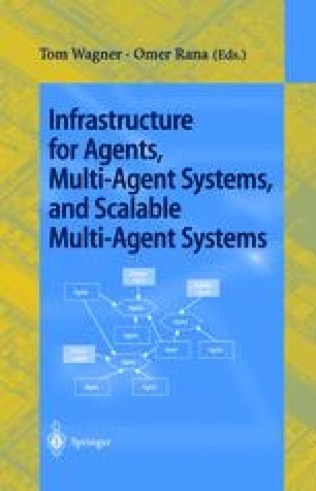
Infrastructure for Agents, Multi-Agent Systems, and Scalable Multi-Agent Systems ; International Workshop on Infrastructure for Scalable Multi-Agent Systems, Barcelona, Spain, June 3-7, 2000 Revised Papers
Building research grade multi-agent systems usually involves a broad variety of software infrastructure ingredients like planning, scheduling, coordination, communication, transport, simulation, and module integration technologies and as such constitutes a great challenge to the individual researcher active in the area. The book presents a collection of papers on approaches that will help make deployed and large scale multi-agent systems a reality. The first part focuses on available infrastructure and requirements for constructing research-grade agents and multi-agent systems. The second part deals with support in infrastructure and software development methods for multi-agent systems that can directly support coordination and management of large multi-agent communities; performance analysis and scalability techniques are needed to promote deployment of multi-agent systems to professionals in software engineering and information technology.

Hybrid Methods of Molecular Modeling
Hybrid Methods of Molecular Modeling is a self-contained advanced review volume. It provides a step by step derivation of the consistent theoretical picture of hybrid modeling methods and a thorough analysis of the concepts and current practical methods of hybrid modeling based on this theory. The book presents its material sequentially, paying attention both to the physical soundness of the approximations used and to the mathematical rigor necessary for the practical development of the robust modeling code.

Hartree-Fock-Slater Method for Materials Science: The DV-X Alpha Method for Design and Characterization of Materials
Molecular-orbital calculations for materials design such as alloys, ceramics, and coordination compounds are now possible for experimentalists. Molecuar-orbital calculations for the interpretation of chemical effect of spectra are also possible for experimentalists. The most suitable molecular-orbital calculation method for these purpose is the DV-Xa method, which is robust in such a way that the calculation converges to a result even if the structure of the molecule or solid is impossible in the pressure and temperature ranges on earth. This book specially addresses the methods to design novel materials and to predict the spectrallline shape of unknown materials using the DV-Xa molecular-orbital method, but is also useful for those who want to calculate electronic structures of materials using any kind of method.
