



Page 1
Page 1
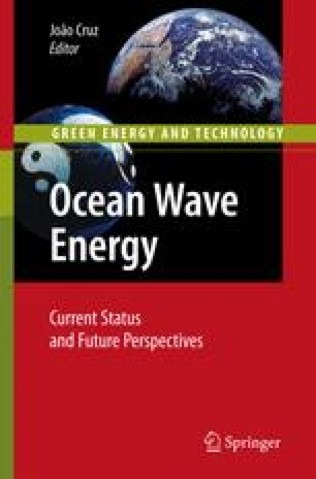
Ocean Wave Energy : Current Status and Future Prespectives
The authors of this reference provide an updated and global view on ocean wave energy conversion for wave energy developers as well as for students and professors. The book is orientated to the practical solutions that this new industry has found so far and the problems that any device needs to face. It describes the actual principles applied to machines that convert wave power in electricity. Additionally, an historical review, state of the art of modern systems, a full scale prototype experience, and future perspectives are given.

Introduction to Permanent Plug and Abandonment of Wells
This book offers a timely guide to challenges and current practices to permanently plug and abandon hydrocarbon wells. With a focus on offshore North Sea, it analyzes the process of plug and abandonment of hydrocarbon wells through the establishment of permanent well barriers.
Handbook of ocean wave energy
This book offers a concise, practice-oriented reference-guide to the field of ocean wave energy. The ten chapters highlight the key rules of thumb, address all the main technical engineering aspects and describe in detail all the key aspects to be considered in the techno-economic assessment of wave energy converters. Written in an easy-to-understand style, the book answers questions relevant to readers of different backgrounds, from developers, private and public investors, to students and researchers. It is thereby a valuable resource for both newcomers and experienced practitioners in the wave energy sector.
Aging, shaking, and cracking of infrastructures : From mechanics to concrete dams and nuclear structures
Focuses on the safety assessment of existing structures subjected to multi-hazard scenarios through advanced numerical methods. Whereas the focus is on concrete dams and nuclear containment structures, the presented methodologies can also be applied to other large-scale ones. This book is composed of seven sections: Fundamentals: theoretical coverage of solid mechnics, plasticity, fracture mechanics, creep, / seismology, dynamic analysis, probability and statistics / Damage: that can affect concrete structures, such as cracking of concrete, AAR, chloride ingress, and rebar corrosion, / Finite Element: formulation for both linear and nonlinear analysis including stress, heat and fracture mechanics, / Engineering Models: for soil/fluid-structure interaction, uncertainty quantification, probablilistic and random finite element analysis, machine learning, performance based earthquake engineering, ground motion intensity measures, seismic hazard analysis, capacity/fragility functions and damage indeces, / Applications to dams through potential failure mode analyses, risk-informed decision making, deterministic and probabilistic examples, / Applications to nuclear structures through modeling issues, aging management programs, critical review of some analyses, / Other applications and case studies: massive RC structures and bridges, detailed assessment of a nuclear containment structure evaluation for license renewal.
