



Page 1
Page 1

Mirror Geometry of Lie Algebras, Lie Groups and Homogeneous Spaces
As K. Nomizu has justly noted [K. Nomizu, 56], Differential Geometry ever will be initiating newer and newer aspects of the theory of Lie groups. This monograph is devoted to just some such aspects of Lie groups and Lie algebras. New differential geometric problems came into being in connection with so called subsymmetric spaces, subsymmetries, and mirrors introduced in our works dating back to 1957 [L.V. Sabinin, 58a,59a,59b]. In addition, the exploration of mirrors and systems of mirrors is of interest in the case of symmetric spaces. Geometrically, the most rich in content there appeared to be the homogeneous Riemannian spaces with systems of mirrors generated by commuting subsymmetries, in particular, so called tri-symmetric spaces introduced in [L.V. Sabinin, 61b]. As to the concrete geometric problem which needs be solved and which is solved in this monograph, we indicate, for example, the problem of the classification of all tri-symmetric spaces with simple compact groups of motions. Passing from groups and subgroups connected with mirrors and subsymmetries to the corresponding Lie algebras and subalgebras leads to an important new concept of the involutive sum of Lie algebras [L.V. Sabinin, 65]. This concept is directly concerned with unitary symmetry of elementary par- cles (see [L.V. Sabinin, 95,85] and Appendix 1). The first examples of involutive (even iso-involutive) sums appeared in the - ploration of homogeneous Riemannian spaces with and axial symmetry. The consideration of spaces with mirrors [L.V. Sabinin, 59b] again led to iso-involutive sums.

Metric Structures for Riemannian and Non-Riemannian Spaces
The first stages of the new developments were presented in Gromov's course in Paris, which turned into the famous "Green Book" by Lafontaine and Pansu (1979). The present English translation of that work has been enriched and expanded with new material to reflect recent progress. Additionally, four appendices—by Gromov on Levy's inequality, by Pansu on "quasiconvex" domains, by Katz on systoles of Riemannian manifolds, and by Semmes overviewing analysis on metric spaces with measures—as well as an extensive bibliography and index round out this unique and beautiful book.

Metric Spaces
The abstract concepts of metric ces are often perceived as difficult. This book offers a unique approach to the subject which gives readers the advantage of a new perspective familiar from the analysis of a real line. Rather than passing quickly from the definition of a metric to the more abstract concepts of convergence and continuity, the author takes the concrete notion of distance as far as possible, illustrating the text with examples and naturally arising questions. Attention to detail at this stage is designed to prepare the reader to understand the more abstract ideas with relative ease.

Metric Spaces
This volume provides a complete introduction to metric space theory for undergraduates. It covers the topology of metric spaces, continuity, connectedness, compactness and product spaces, and includes results such as the Tietze-Urysohn extension theorem, Picard's theorem on ordinary differential equations, and the set of discontinuities of the pointwise limit of a sequence of continuous functions.

Matrix Convolution Operators on Groups
In the last decade, convolution operators of matrix functions have received unusual attention due to their diverse applications. This monograph presents some new developments in the spectral theory of these operators. The setting is the Lp spaces of matrix-valued functions on locally compact groups. The focus is on the spectra and eigenspaces of convolution operators on these spaces, defined by matrix-valued measures. Among various spectral results, the L2-spectrum of such an operator is completely determined and as an application, the spectrum of a discrete Laplacian on a homogeneous graph is computed using this result. The contractivity properties of matrix convolution semigroups are studied and applications to harmonic functions on Lie groups and Riemannian symmetric spaces are discussed. An interesting feature is the presence of Jordan algebraic structures in matrix-harmonic functions.

Gradient Flows : in Metric Spaces and in the Space of Probability Measures ; 2nd ed.
Devoted to a theory of gradient flows in spaces which are not necessarily endowed with a natural linear or differentiable structure, this book focuses on gradient flows in metric spaces. It covers gradient flows in the space of probability measures on a separable Hilbert space, endowed with the Kantorovich-Rubinstein-Wasserstein distance.

Gradient Flows : In Metric Spaces and in the Space of Probability Measures ; 1st ed.
This book is devoted to a theory of gradient flows in spaces which are not nec- sarily endowed with a natural linear or differentiable structure. It is made of two parts, the first one concerning gradient flows in metric spaces and the second one 2 1 devoted to gradient flows in the L -Wasserstein space of probability measures on p a separable Hilbert space X (we consider the L -Wasserstein distance, p? (1,?), as well). The two parts have some connections, due to the fact that the Wasserstein space of probability measures provides an important model to which the “metric” theory applies, but the book is conceived in such a way that the two parts can be read independently, the first one by the reader more interested to Non-Smooth Analysis and Analysis in Metric Spaces, and the second one by the reader more oriented to theapplications in Partial Differential Equations, Measure Theory and Probability.
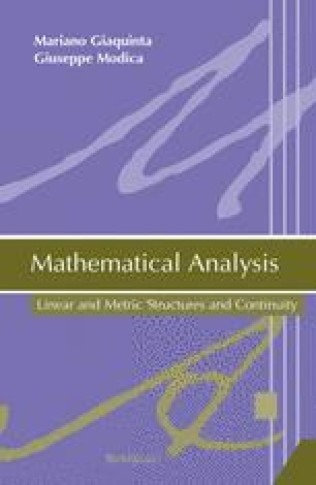
Mathematical Analysis : Linear and Metric Structures and Continuity
The book is divided into three parts. The first part introduces the basic ideas of linear and metric spaces, including the Jordan canonical form of matrices and the spectral theorem for self-adjoint and normal operators. The second part examines the role of general topology in the context of metric spaces and includes the notions of homotopy and degree. The third and final part is a discussion on Banach spaces of continuous functions, Hilbert spaces and the spectral theory of compact operators.
Linear Functional Analysis
This introduction to the ideas and methods of linear functional analysis shows how familiar and useful concepts from finite-dimensional linear algebra can be extended or generalized to infinite-dimensional spaces. Aimed at advanced undergraduates in mathematics and physics, the book assumes a standard background of linear algebra, real analysis (including the theory of metric spaces), and Lebesgue integration, although an introductory chapter summarizes the requisite material. The initial chapters develop the theory of infinite-dimensional normed spaces, in particular Hilbert spaces, after which the emphasis shifts to studying operators between such spaces. Functional analysis has applications to a vast range of areas of mathematics; the final chapters discuss the particularly important areas of integral and differential equations.
Lie Theory Vol.229 : Unitary Representations and Compactifications of Symmetric Spaces
It focuses on two fundamental questions in the theory of semisimple Lie groups: the geometry of Riemannian symmetric spaces and their compactifications; and branching laws for unitary representations, i.e., restricting unitary representations to (typically, but not exclusively, symmetric) subgroups and decomposing the ensuing representations into irreducibles.Ji's introductory chapter motivates the subject of symmetric spaces and their compactifications with carefully selected examples. A discussion of Satake and Furstenberg boundaries and a survey of the geometry of Riemannian symmetric spaces in general provide a good background for the second chapter, namely, the Borel–Ji authoritative treatment of various types of compactifications useful for studying symmetric and locally symmetric spaces. Borel–Ji further examine constructions of Oshima, De Concini, Procesi, and Melrose, which demonstrate the wide applicability of compactification techniques. Kobayashi examines the important subject of branching laws. Important concepts from modern representation theory, such as Harish–Chandra modules, associated varieties, microlocal analysis, derived functor modules, and geometric quantization are introduced. Concrete examples and relevant exercises engage the reader.
Lie theory ; Vol.230 : Harmonic analysis on symmetric spaces, general Plancherel theorems
Van den Ban’s introductory chapter explains the basic setup of a reductive symmetric space along with a careful study of the structure theory, particularly for the ring of invariant differential operators for the relevant class of parabolic subgroups. Advanced topics for the formulation and understanding of the proof are covered, including Eisenstein integrals, regularity theorems, Maass–Selberg relations, and residue calculus for root systems. Schlichtkrull provides a cogent account of the basic ingredients in the harmonic analysis on a symmetric space through the explanation and definition of the Paley–Wiener theorem. Approaching the Plancherel theorem through an alternative viewpoint, the Schwartz space, Delorme bases his discussion and proof on asymptotic expansions of eigenfunctions and the theory of intertwining integrals.
Complex, Contact and Symmetric Manifolds : In Honor of L. Vanhecke
This volume contains introductory and contextual material, describe recent developments and research trends in spectral geometry, the theory of geodesics and curvature, contact and symplectic geometry, complex geometry, algebraic topology, homogeneous and symmetric spaces, and various applications of partial differential equations and differential systems to geometry. One of the key strengths of these articles is their appeal to non-specialists, as well as researchers and differential geometers.
Compactifications of Symmetric and Locally Symmetric Spaces
Noncompact symmetric and locally symmetric spaces naturally appear in many mathematical theories, including analysis (representation theory, nonabelian harmonic analysis), number theory (automorphic forms), algebraic geometry (modulae) and algebraic topology (cohomology of discrete groups). In most applications it is necessary to form an appropriate compactification of the space. The literature dealing with such compactifications is vast. The main purpose of this book is to introduce uniform constructions of most of the known compactifications with emphasis on their geometric and topological structures. The book is divided into three parts. Part I studies compactifications of Riemannian symmetric spaces and their arithmetic quotients. Part II is a study of compact smooth manifolds. Part III studies the compactification of locally symmetric spaces.
Buildings : Theory and Applications
This book treats Jacques Tits's beautiful theory of buildings, making that theory accessible to readers with minimal background. It includes all the material of the earlier book Buildings by the second-named author, published by Springer-Verlag in 1989, which gave an introduction to buildings from the classical (simplicial) point of view. This new book also includes two other approaches to buildings, which nicely complement the simplicial approach: On the one hand, buildings may be viewed as abstract sets of chambers with a Weyl-group-valued distance function; this point of view has become increasingly important in the theory and applications of buildings. On the other hand, buildings may be viewed as metric spaces. Beginners can still use parts of the new book as a friendly introduction to buildings, but the book also contains valuable material for the active researcher.
Advanced Linear Algebra
The first part of the book contains a careful but rapid discussion of the basics of linear algebra, including vector spaces, linear transformations, quotient spaces, and isomorphism theorems. The author then proceeds to modules, emphasizing a comparison with vector spaces. A thorough discussion of inner product spaces, eigenvalues, eigenvectors, and finite dimensional spectral theory follows, culminating in the finite dimensional spectral theorem for normal operators. The second part of the book is a collection of topics, including metric vector spaces, metric spaces, Hilbert spaces, tensor products, and affine geometry. The last chapter discusses the umbral calculus, an area of modern algebra with many important applications.
