



Page 1
Page 1

International Prosecution of Human Rights Crimes
It is intended for a wide variety of readers: academics, all kinds of jurists, as well as human rights activists, who sometimes know more about the applicable law than the legal experts. It owes its existence to a paradox: On the one hand, new structures for dealing with the most serious international crimes are being put into place.

International criminal law practitioner library: international criminal procedure
Volume 3 completes the review of international criminal law begun in Volumes 1 and 2, which analyse the forms of responsibility and the elements of the core crimes. This volume reviews the procedural law and practices of the international criminal tribunals from investigation to trial, appeal, and punishment, and examines the framework within which the substantive law operates. The authors present a critical study of those procedures that are essential to effective investigations and fair trials.

International criminal law : Using or abusing legality
Analyses the relationship between law and violence, the utility of law over violence and whether legality as an approach has an inherent disability in addressing mass violence as a crime. The study is located within international law and assesses whether prosecuting political violence would necessarily entail an abuse of the legal process. The intention is to encourage definition of criminal aggression via legal processes laid down by the International Criminal Court,

Individual Criminal Responsibility for Core International Crimes : Selected Pertinent Issues
The media has, of course, played a crucial role in increasing awareness of this concept, especially amongst the general populace. Indeed, the concept has, arguably, a much higher profile today, than ever before in its history. However, the concept of individual criminal responsibility for core inter- tional crimes is neither as straightforward nor as single-facetted, as might appear on first glance. While the general principle behind the concept does not generate too many difficulties, it is in its practical application that the more challenging aspects of the concept are brought to the fore. Each of these ‘challenging - pects’ can also be described as a ‘pertinent issue’ of the concept of individual criminal responsibility for core international crimes.

Learning in Modern International Society : On the Cognitive Problem Solving Abilities of Political Actors
Claudia Hofmann engages in a theoretical modelling of international learning processes and the substantiation of this model through three cases from international politics. She answers two questions: How may international actors learn as a collective? And how may the lessons learned influence actor behaviour and problem solving processes? As a foundation for answering these questions she examines the nature of actor behaviour within a social international system and integrates the diffusion of norms and values among macro-level actors.
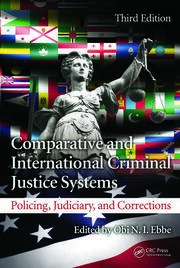
Comparative and international criminal justice systems : policing, judiciary, and corrections
The Nature of Comparative and International Criminal JusticeThe Purpose of Comparative and International Criminal Justice Systems; Crime and Criminal Law: Global PerspectiveCrime: International and Comparative;Overview of Model Criminal Justice Systems
