



Page 1
Page 1
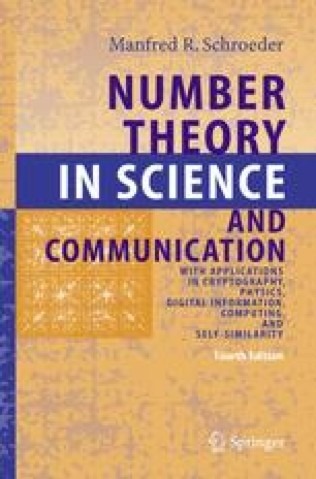
Number theory in science and communication : With applications in cryptography, physics, digital information, computing, and self-similarity
"Number Theory in Science and Communication" is a well-known introduction for non-mathematicians to this fascinating and useful branch of applied mathematics . It stresses intuitive understanding rather than abstract theory and highlights important concepts such as continued fractions, the golden ratio, quadratic residues and Chinese remainders, trapdoor functions, pseudoprimes and primitive elements. Their applications to problems in the real world are one of the main themes of the book. This revised fourth edition is augmented by recent advances in primes in progressions, twin primes, prime triplets, prime quadruplets and quintruplets, factoring with elliptic curves, quantum factoring, Golomb rulers and "baroque" integers.

Number Theory ; Vol. II : Analytic and Modern Tools
The central theme of this graduate-level number theory textbook is the solution of Diophantine equations, i.e., equations or systems of polynomial equations which must be solved in integers, rational numbers or more generally in algebraic numbers. This theme, in particular, is the central motivation for the modern theory of arithmetic algebraic geometry. In this text, this is considered through three aspects.

Number Theory ; Vol. I : Tools and Diophantine Equations
The central theme of this graduate-level number theory textbook is the solution of Diophantine equations, i.e., equations or systems of polynomial equations which must be solved in integers, rational numbers or more generally in algebraic numbers. This theme, in particular, is the central motivation for the modern theory of arithmetic algebraic geometry. In this text, this is considered through three aspects.

Number Theory : An Introduction to Mathematics ; Part A
This book attempts to provide such an understanding of the nature and extent of mathematics. It is a modern introduction to the theory of numbers, emphasizing its connections with other branches of mathematics. This part A, which should be accessible to a first-year undergraduate, deals with elementary number theory.

Nonlinear Integer Programming
It is not an exaggeration that much of what people devote in their hfe re solves around optimization in one way or another. On one hand, many decision making problems in real applications naturally result in optimization problems in a form of integer programming. On the other hand, integer programming has been one of the great challenges for the optimization research community for many years, due to its computational difficulties: Exponential growth in its computational complexity with respect to the problem dimension. This book addresses the topic of the general nonlinear integer programming (NLIP). The overall goal of the book is to bring the state of the art of the theoretical foundations and solution methods of NLIP to readers who are interested in optimization, operations research and computer science. This book investigates the theory and solution methodologies for the general NLIP and provides the developments
Modern parallel programming with C++ and assembly language : X86 SIMD development using AVX, AVX2, and AVX-512
Understand the essential details about x86 SIMD architectures and instruction sets including AVX, AVX2, and AVX-512. / Master x86 SIMD data types, arithmetic instructions, and data management operations using both integer and floating-point operands. / Code performance-enhancing functions and algorithms that fully exploit the SIMD capabilities of a modern x86 processor. Employ C++ intrinsic functions and x86-64 assembly language code to carry out arithmetic calculations using common programming constructs including arrays, matrices, and user-defined data structures. Harness the x86 SIMD instruction sets to significantly accelerate the performance of computationally intense algorithms in applications such as machine learning, image processing, computer graphics, statistics, and matrix arithmetic. / Apply leading-edge coding strategies and techniques to optimally exploit the x86 SIMD instruction sets for maximum possible performance.
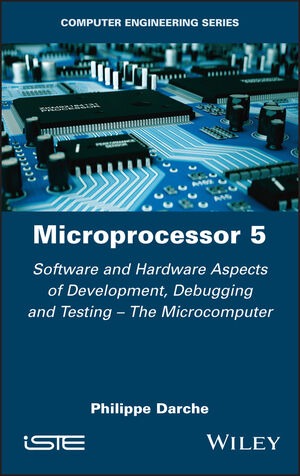
Microprocessor 5 : Software and hardware aspects of development, debugging and testing - the microcomputer
Focuses more particularly on the first two generations of microprocessors, those that handle 4- and 8- bit integers. Microprocessor 5 – the fifth and final volume of this series of books – first presents the hardware and software aspects of the development chain of a microprocessor-based digital system. Finally, to round up the series and offer a historical perspective, the architectures of the first microcomputers are detailed. A comprehensive approach is used, with examples drawn from current and past technologies that illustrate theoretical concepts, making them accessible.

Microprocessor 2 : Communication in a digital system
Focuses more particularly on the first generations of microprocessors, that is to say those that handle integers in 4 and 8-bit formats. The first chapter presents the calculation function and reminds the memory function. The following is devoted to notions of calculation model and architecture. The concept of bus is then presented. Chapters 4 and 5 can then address the internal organization and operation of the microprocessor first in hardware and then software. The mechanism of the function call, conventional and interrupted, is more particularly detailed in a separate chapter. The book ends with a presentation of architectures of the first microcomputers for a historical perspective. The knowledge is presented in the most exhaustive way possible with examples drawn from current and old technologies that illustrate and make accessible the theoretical concepts. Each chapter ends if necessary with corrected exercises and a bibliography. The list of acronyms used and an index are at the end of the book.

Integration of AI and OR Techniques in Constraint Programming for Combinatorial Optimization Problems ; Vol.3990 ; 3rd International Conference, CPAIOR 2006, Cork, Ireland, May 31 - June 2, 2006, Proceedings
Constitutes the refereed proceedings of the Third International Conference on Integration of AI and OR Techniques in Constraint Programming for Combinatorial Optimization Problems, CPAIOR 2006. The 20 revised full papers presented together with 3 invited talks address methodological and foundational issues from AI, OR, and algorithmics and present applications to the solution of combinatorial optimization problems in various fields via constraint programming.

Integration of AI and OR Techniques in Constraint Programming for Combinatorial Optimization Problems ; Vol.3524 : 2nd International Conference, CPAIOR 2005, Prague, Czech Republic, May 31 -- June 1, 2005
Intended primarily as a forum to focus on the integration and hybridization of the approaches of constraint programming (CP), arti?cial intelligence (AI), and operations research (OR) technologies for solving large-scale and complex real-life optimization problems. Therefore, CPAIOR is never far from industrial applications. The high number of submissions received this year, almost 100 papers, in witness to the interest of the research community in this conference. From these submissions, we chose 26 to be published in full in the proceedings. This volume includes summaries of the invited talks of CPAIOR: one from industry, one from the embedded system research community, and one from the operations research community.

Integer programming and combinatorial optimization ; 9th International IPCO Conference, Cambridge, MA, USA, May 27-29, 2002. Proceedings
This volume contains the papers selected for presentation at IPCO 2002, the NinthInternationalConferenceonIntegerProgrammingandCombinatorial- timization, Cambridge, MA (USA), May 27–29, 2002. The IPCO series of c- ferences highlights recent developments in theory, computation, and application of integer programming and combinatorial optimization. IPCO was established in 1988 when the ?rst IPCO program committee was formed. IPCO is held every year in which no International Symposium on Ma- ematical Programming (ISMP) takes places. The ISMP is triennial, so IPCO conferences are held twice in every three-year period. The eight previous IPCO conferences were held in Waterloo (Canada) 1990, Pittsburgh (USA) 1992, Erice (Italy) 1993, Copenhagen (Denmark) 1995, Vancouver (Canada) 1996, Houston (USA) 1998, Graz (Austria) 1999, and Utrecht (The Netherlands) 2001. In response to the call for papers for IPCO 2002, the program committee received 110 submissions, a record number for IPCO. The program committee met on January 7 and 8, 2002, in Aussois (France), and selected 33 papers for inclusion in the scienti?c program of IPCO 2002. The selection was based on originality and quality, and re?ects many of the current directions in integer programming and combinatorial optimization research.

Integer programming and combinatorial optimization ; 13th International Conference, IPCO 2008 Bertinoro, Italy, May 26-28, 2008 Proceedings
The volume contains the papers selected for presentation at IPCO 2008, the 13th International Conference on Integer Programming and Combinatorial - timization that was held in Bertinoro (Italy), May 26–28, 2008. The IPCO series of conferences, sponsored by the Mathematical Progr- ming Society, highlights recent developments in theory, computation, and app- cation of integer programming and combinatorial optimization. The frst conf- ence took place in 1990; starting from IPCO 1995, the proceedings are published in the Lecture Notes in Computer Science series. The 12 previous IPCO conferences were held in Waterloo (Canada) 1990.

Integer programming and combinatorial optimization ; 12th International IPCO Conference, Ithaca, NY, USA, June 25-27, 2007, Proceedings
Constitutes the refereed proceedings of the 12th International Conference on Integer Programming and Combinatorial Optimization, IPCO 2007, held in Ithaca, NY, USA, in June 2007. This book presents 36 revised full papers that were reviewed and selected from over 120 submissions.
Integer Programming and Combinatorial Optimization ; 11th International IPCO Conference, Berlin, Germany, June 8-10, 2005, Proceedings
Since its start in 1990, the IPCO conference series (held under the auspices of theMathematicalProgrammingSociety)hasbecomeanimportantforumforthe presentation of recent results in Integer Programming and Combinatorial Op- mization. This volume compiles the papers presented at IPCO XI, the eleventh conference in this series, held June 8–10, 2005, at the Technische Universit¨ at Berlin. The high interest in this conference series is evident in the large number of submissions. For IPCO XI, 119 extended abstracts of up to 10 pages were submitted. During its meeting on January 29–30, 2005, the Program Committee carefully selected 34 contributions for presentation in non-parallel sessions at the conference. The ?nal choices were not easy at all, since, due to the limited number of time slots, many very good papers could not be accepted. During the selection process the contributions were refereed according to the standards of refereed conferences. As a result of this procedure, you have in your hands a volume that contains papers describing high-quality research e?orts. The page limit for contributions to this proceedings volume was set to 15. You may ?nd full versions of the papers in scienti?c journals in the near future. We thank all the authors who submitted papers. Furthermore, the Program Committee is indebted to the many reviewers who, with their speci?c expertise, helped a lot in making the decisions.

Feasibility and Infeasibility in Optimization : Algorithms and Computational Methods
Feasibility and Infeasibility in Optimization is a timely expository book that summarizes the state of the art in both classical and recent algorithms related to feasibility and infeasibility in optimization, with a focus on practical methods. All model forms are covered, including linear, nonlinear, and mixed-integer programs. Connections to related work in constraint programming are shown. Part I of the book addresses algorithms for seeking feasibility quickly, including new methods for the difficult cases of nonlinear and mixed-integer programs. Part II provides algorithms for analyzing infeasibility by isolating minimal infeasible (or maximum feasible) subsets of constraints, or by finding the best repair for the infeasibility. Infeasibility analysis algorithms have arisen primarily over the last two decades, and the book covers these in depth and detail. Part III describes applications in numerous areas outside of direct infeasibility analysis such as finding decision trees for data classification, analyzing protein folding, radiation treatment planning, automated test assembly, etc.

Evolutionary computation in combinatorial optimization ; 8th European Conference, EvoCOP 2008, Naples, Italy, March 26-28, 2008. Proceedings
Metaheuristics have been shown to be e?ective for di?cult combinatorial - timization problems appearing in various industrial, economical, and scientifc domains. Prominent examples of metaheuristics are evolutionary algorithms, tabu search, simulated annealing, scatter search, memetic algorithms, variable neighborhood search, iterated local search, greedy randomized adaptive search procedures, ant colony optimization and estimation of distribution algorithms. Problems solved successfully include scheduling, timetabling, network design, transportation and distribution, vehicle routing, the travelling salesman pr- lem, packing and cutting, satisfability and general mixed integer programming.

Essays and Surveys in Global Optimization
Global optimization aims at solving the most general problems of deterministic mathematical programming: to find the global optimum of a nonlinear, nonconvex, multivariate function of continuous and/or integer variables subject to constraints which may be themselves nonlinear and nonconvex. In addition, once the solutions are found, proof of its optimality is also expected from this methodology. Therefore, with these difficulties in mind, global optimization is becoming an increasingly powerful and important methodology. Essays and Surveys in Global Optimization is the most recent examination of its mathematical capability, power, and wide ranging solutions to many fields in the applied sciences.

Eisenstein Series and Applications
Eisenstein series are an essential ingredient in the spectral theory of automorphic forms and an important tool in the theory of L-functions. They have also been exploited extensively by number theorists for many arithmetic purposes. Bringing together contributions from areas that are not usually interacting with each other, this volume introduces diverse users of Eisenstein series to a variety of important applications. With this juxtaposition of perspectives, the reader obtains deeper insights into the arithmetic of Eisenstein series. The exposition focuses on the common structural properties of Eisenstein series occurring in many related applications that have arisen in several recent developments in arithmetic: Arakelov intersection theory on Shimura varieties, special values of L-functions and Iwasawa theory, and equidistribution of rational/integer points on homogeneous varieties.

Difference Equations : From Rabbits to Chaos
Difference equations are models of the world around us. From clocks to computers to chromosomes, processing discrete objects in discrete steps is a common theme. Difference equations arise naturally from such discrete descriptions and allow us to pose and answer such questions as: How much? How many? How long? Difference equations are a necessary part of the mathematical repertoire of all modern scientists and engineers.The book cover the basics of difference equations and some of their applications in computing and in population biology. Each chapter leads to techniques that can be applied by hand to small examples or programmed for larger problems. Along the way, the reader will use linear algebra and graph theory, develop formal power series, solve combinatorial problems, visit Perron—Frobenius theory, discuss pseudorandom number generation and integer factorization, and apply the Fast Fourier Transform to multiply polynomials quickly.

Decomposition Techniques in Mathematical Programming : Engineering and Science Applications
This textbook for students and practitioners presents a practical approach to decomposition techniques in optimization. It provides an appropriate blend of theoretical background and practical applications in engineering and science, which makes the book interesting for practitioners, as well as engineering, operations research and applied economics graduate and postgraduate students. "Decomposition Techniques in Mathematical Programming" is based on clarifying, illustrative and computational examples and applications from electrical, mechanical, energy and civil engineering as well as applied mathematics and economics. It addresses decomposition in linear programming, mixed-integer linear programming, nonlinear programming, and mixed-integer nonlinear programming, and provides rigorous decomposition algorithms as well as heuristic ones.
