



Page 1
Page 1

Neo-Liberalism, State Power and Global Governance
Part One explores the pattern of national differences in the exercise of state power in a variety of industrialized and developing economies, despite the pressure to converge towards the dominant neo-liberal paradigm. Part Two analyses a variety of trans-national policy prescriptions for neo-liberalism and state power. Part Three explores whether the governance of labour markets is a special case in the global economy. Part Four sets out the need for institutional reform of the neo-liberal order in trade and finance. The volume concludes that there is the prospect of a more plural approach to state power and global governance, and one that recognizes the importance of the public domain of citizenship for delivering the global public goods of security, prosperity and environmental sustainability in the twenty-first century.

Institutional Reform for Innovation and Entrepreneurship : An Agenda for Europe
The authors of this book advise the economies of the European Union to become more entrepreneurial in promoting innovation and economic growth. The authors propose a reform strategy with respect to several aspects to achieve this goal. Starting with the rule of law and the protection of property rights; the tax system; the authors deal with regulations governing savings, capital and finance, and the organization of labor markets and social insurance systems. Framework strategies related to the regulations governing goods and service markets, bankruptcy and insolvency are also put forward. A core understanding and future path is also provided towards R&D, commercialization and knowledge spillovers; human capital investments; and informal institutions.

Guardians of public value : How public organisations become and remain institutions
This book presents case studies of twelve organisations which the public have come to view as institutions. From the BBC to Doctors Without Borders, from the Amsterdam Concertgebouw Orchestra to CERN, this volume examines how some organisations rise to prominence and remain in high public esteem through changing and challenging times

Governing the Pandemic : The politics of navigating a Mega-Crisis
This book offers unique insights into how governments and governing systems, particularly in advanced economies, have responded to the immense challenges of managing the coronavirus pandemic and the ensuing disease COVID-19.

Economic Liberalization and Integration Policy : Options for Eastern Europe and Russia
The authors of this book analyze the dynamics of macroeconomic and structural developments in Eastern Europe and Russia, with special attention paid to problems of international and national integration, "Dutch disease" and natural resource dependency, and distortions in institutional reforms. The analysis also sheds light on how these problems have implications for cooperation among OECD-countries. A critical focus is on institutional adjustment and learning, human capital formation, trade and foreign investment.
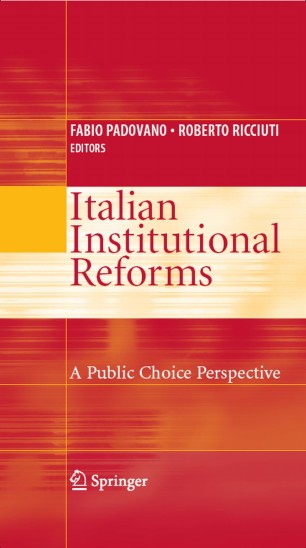
Italian Institutional Reforms : A Public Choice Perspective
Using a public choice perspective, this book explains the evolution and political and economic impact of recent changes to the Italian institutional framework. Because these changes are so numerous and broad, their implementation serves as a case study for other Western governments. Particular attention is paid to the introduction of the EURO, the reform of voting from proportional to majoritarian rule, the impact of corporatism, constraints imposed by the Maastricht Treaty, and the switch from a highly centralized government to a federal organization.
Advances in Integrated Soil Fertility Research in sub-Saharan Africa : Challenges and Opportunities
Food insecurity is a central concern and a fundamental challenge for human welfare and economic growth in Africa. Low agricultural production, results in low incomes, poor nutrition, vulnerability to risks and lack of empowerment. Land degradation and soil fertility depletion are considered the major threats to food security and natural resource conservation in sub-Saharan Africa (SSA). Investments in technology, policy and institutional reforms are needed to increase agricultural productivity to ensure food security and sustained national economies. Past research has generated numerous soil fertility management technologies which if adopted could propel the African continent out of the poverty trap. However, these technologies have had little, if any, impact due to low adoption by the smallholder farmers.
