



Page 1
Page 1

Natural Disasters as Interactive Components of Global-Ecodynamics
This book opens a new approach to the study of global environmental changes having unfavourable character for mankind and other living systems. The main advantage of the book consists in the accumulation of knowledge from different sciences to parametrize the global ecodynamic process. Natural catastrophes are considered as an interactive element of global natural dynamics which are described by means of simulation models of global nature/society. The realization of this approach allows the integration within a complex structure of all international and national means of environmental monitoring and provides a tool for objective evaluation of the environmental quality. The main purpose of this book is to develop a universal information technology to estimate the state of environmental subsystems functioning under various climatic and anthropogenic conditions.

Geological Approaches to Coral Reef Ecology
By reconstructing the ecological history of coral reefs, the authors are able to evaluate whether or not recent, dramatic changes to reef ecosystems are novel events or part of a long-term trend or cycle. The contributions examine the interacting causes of change, which include hurricane damage, regional outbreaks of coral-consuming predators, disease epidemics, sea-level rise, nutrient loading, global warming and acidification of the oceans. Crucial predictions about the future of coral reefs lead to practical strategies for the successful restoration and management of reef ecosystems.

Fog and boundary layer clouds : Fog visibility and forecasting
The e?ect of fog on human life was recognized in the early ages of mankind but its impact has signi?cantly increased during recent decades due to increasing air, marine, and road tra?c. In fact, the ?nancial and human losses related to fog and low visibility became comparable to the losses from other weather events, e.g., tornadoes or, in some situations, even hurricanes. The purpose of this review is to summarize the earlier works on fog and to lay a basis for the articles presented in this special issue and outline perspectives for future fog research.

E-Content: Technologies and Perspectives for the European Market
Technologies develop rapidly and reach hurricane levels of velocity but quality E-Content and innovative applications lag behind. This book addresses the question how content industries change within a digital environment and what role information and communication technologies play in transforming the competitive landscape. The authors argue that post-industrial societies tend to pay substantial amounts for equipment and gadgets but invest far too little in the quality of the content. As a result, much effort is and has to be spent on the enhancement of E-Content.
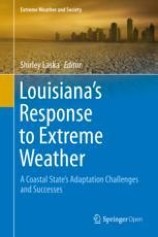
Louisiana's response to extreme weather : A coastal state's adaptation challenges and successes
Takes an in-depth look at Louisiana as a state which is ahead of the curve in terms of extreme weather events, both in frequency and magnitude, and in its responses to these challenges including recovery and enhancement of resiliency.
Climate-Smart Food
This book asks just how climate-smart our food really is. It follows an average day's worth of food and drink to see where it comes from, how far it travels, and the carbon price we all pay for it. From our breakfast tea and toast, through breaktime chocolate bar, to take-away supper, Dave Reay explores the weather extremes the world’s farmers are already dealing with, and what new threats climate change will bring. Readers will encounter heat waves and hurricanes, wildfires and deadly toxins, as well as some truly climate-smart solutions. In every case there are responses that could cut emissions while boosting resilience and livelihoods. Ultimately we are all in this together, our decisions on what food we buy and how we consume it send life-changing ripples right through the global web that is our food supply.
Atmospheric and Oceanic
This volume contains many original findings on mesoscale processes in atmospheric and oceanic systems through mathematical modeling, numerical simulations and field experiments. These scientific papers examine and provide the latest developments on a range of topics that include tropical cyclones/hurricanes, mesoscale variability and modeling, seasonal monsoons and land surface processes including atmospheric boundary layer. This volume will be useful as a reading material in graduate level courses dealing with mesoscale systems, weather, climate, monsoon variability and boundary layer.
