



Page 1
Page 1
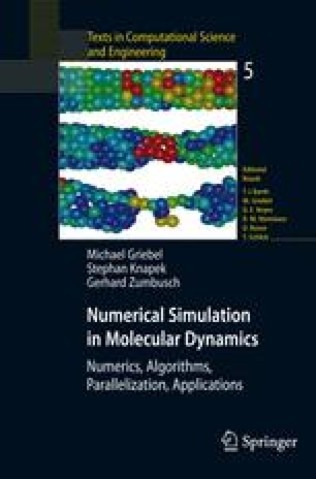
Numerical Simulation in Molecular Dynamics : Numerics, Algorithms, Parallelization, Applications
Particle models play an important role in many applications in physics, chemistry and biology. They can be studied on the computer with the help of molecular dynamics simulations. This book presents in detail both the necessary numerical methods and techniques (linked-cell method, SPME-method, tree codes, multipole technique) and the theoretical background and foundations. It illustrates the aspects modelling, discretization, algorithms and their parallel implementation with MPI on computer systems with distributed memory. Furthermore, detailed explanations are given to the different steps of numerical simulation, and code examples are provided.

Number Theory : An Introduction via the Distribution of Primes
This book provides an introduction and overview of number theory based on the distribution and properties of primes. This unique approach provides both a firm background in the standard material as well as an overview of the whole discipline. All the essential topics are covered: fundamental theorem of arithmetic, theory of congruences, quadratic reciprocity, arithmetic functions, and the distribution of primes.

Mysteries of the Rectangle : Essays on painting
In Mysteries of the Rectangle, Hustvedt concentrates her narrative gifts on the works of such masters as Francisco Goya, Jan Vermeer, Jean-Baptiste-Siméon Chardin, Gerhard Richter, and Joan Mitchell. Through her own personal experiences, Hustvedt is able to reveal things until now hidden in plain sight: an egglike detail in Vermeer's Woman with a Pearl Necklace and the many hidden self-portraits in Goya's series of drawings, Los Caprichos, as well as in his infamous painting The Third of May. Most importantly, these essays exhibit the passion, thrill, and sheer pleasure of bewilderment a work of art can produce—if you simply take the time to look.

Molecular Marker Systems in Plant Breeding and Crop Improvement
Successful release of new and better crop varieties increasingly requires genomics and molecular biology. This volume presents basic information on plant molecular marker techniques from marker location up to gene cloning. The text includes a description of technical approaches in genome analysis such as comparison of marker systems, positional cloning, and array techniques in 19 crop plants. A special section focuses on converting this knowledge into general and specific breeding strategies, particularly in relation to biotic stress. Theory and practice of marker assisted selection for QTL, gene pyramiding and the future of MAS are summarized and discussed for maize, wheat, and soybean. Furthermore, approaches in silviculture on the examples of Fagus, Populus, Eucalyptus, Picea and Abies are presented. The volume ends with a comprehensive review of the patents relevant for using molecular markers and marker assisted selection.

Modular Algorithms in Symbolic Summation and Symbolic Integration
Brings together two streams in computer algebra: symbolic integration and summation on the one hand, and fast algorithmics on the other hand. In many algorithmically oriented areas of computer science, the analysis of al gorithms placed into the lime light by DonKnuth’stalkat the 1970ICM –provides a crystal-clear criterion for success. The researcher who designs an algorithm that is faster (asymptotically, in the worst case) than any previous method receives instant gratification : her result will be recognized as valuable. Al as, the downside is that such results come along quite infrequently, despite our best efforts. An alternative evaluation method is to run a new algorithm on examples; this has its obvious problems, but is sometimes the best we can do. George Collins, one of the fathers of computer algebra and a great experimenter,wrote in 1969: “I think this demonstrates again that a simple analysis is often more revealing than a ream of empirical data (although both are important). ” Within computer algebra, some areas have traditionally followed the former methodology, notably some parts of polynomial algebra and linear algebra. Other areas, such as polynomial system solving, have not yet been amenable to this - proach. The usual “input size” parameters of computer science seem inadequate, and although some natural “geometric” parameters have been identified (solution dimension, regularity), not all (potential) major progress can be expressed in this framework. Symbolic integration and summation have been in a similar state.
Methods of Celestial Mechanics: Vol. I: Physical, Mathematical, and Numerical Principles
G. Beutler's Methods of Celestial Mechanics is a coherent textbook for students in physics, mathematics and engineering as well as an excellent reference for practitioners. This Volume I gives a thorough treatment of celestial mechanics and presents all the necessary mathematical details that a professional would need. After a brief review of the history of celestial mechanics, the equations of motion (Newtonian and relativistic versions) are developed for planetary systems (N-body-problem), for artificial Earth satellites, and for extended bodies (which includes the problem of Earth and lunar rotation). Perturbation theory is outlined in an elementary way from generally known mathematical principles without making use of the advanced tools of analytical mechanics. The variational equations associated with orbital motion - of fundamental importance for parameter estimation (e.g., orbit determination), numerical error propagation, and stability considerations - are introduced and their properties discussed in considerable detail. Numerical methods, especially for orbit determination and orbit improvement, are discussed in considerable depth. The algorithms may be easily applied to objects of the planetary system and to Earth satellites and space debris.

Methods of Celestial Mechanics ; Vol. II : Application to Planetary System, Geodynamics and Satellite Geodesy
G. Beutler's Methods of Celestial Mechanics is a coherent textbook for students as well as an excellent reference for practitioners. Volume II is devoted to the applications and to the presentation of the program system CelestialMechanics. Three major areas of applications are covered: (1) Orbital and rotational motion of extended celestial bodies. The properties of the Earth-Moon system are developed from the simplest case (rigid bodies) to more general cases, including the rotation of an elastic Earth, the rotation of an Earth partly covered by oceans and surrounded by an atmosphere, and the rotation of an Earth composed of a liquid core and a rigid shell (Poincaré model). (2) Artificial Earth Satellites. The oblateness perturbation acting on a satellite and the exploitation of its properties in practice is discussed using simulation methods (CelestialMechanics) and (simplified) first order perturbation methods. The perturbations due to the higher-order terms of the Earth's gravitational potential and resonant perturbations are considered thereafter. Special attention is paid to satellites of the Global Navigation Satellite Systems and to geostationary satellites. The characteristics of and models for the two most important non-gravitational forces, atmospheric drag and radiation pressure, are presented as well as the most relevant forces acting on high- and low-orbiting satellites. (3) Evolution of the Planetary System. The outer planetary system consisting of the planets Jupiter to Pluto is studied over long time intervals using simulation methods and spectral analysis (CelestialMechanics). The properties of the inner systems, in particular of the Earth's orbit, are made visible by integrating the entire system over long time intervals relevant for climate change. The distribution of minor planets and their orbital properties, regular orbits, and chaotic orbits are easily generated and analyzed using CelestialMechanics. The volume concludes with the discussion of important mathematical tools of the program system and of the principles of spectral analysis.

Mechanics of Biological Tissue
The mechanics of biological tissues is a multidisciplinary and rapidly expanding area of research. This book highlights some important research directions that combine mechanical sciences with exciting new developments in biology. This collection of papers should be of interest to theoretical, computational and experimental researchers and doctoral students in the area of biomechanics and in related areas of engineering, biology and medicine.

Interiors Construction Manual : Integrated Planning, Finishings and Fitting-Out, Technical Services
Supports planners in their daily work as a practical planning aid and reference work with the relevant standards, guidelines, reference details, and constructional solutions, all illustrated by built example projects. It brings together the crucial facts on all aspects of interior construction and presents the key fundamentals of building physics, fire protection, interior construction systems, and openings. In addition, it offers concrete tips on integrated planning approaches, energy and sustainability issues, materials used in interior construction, hazardous substances, and dealing with building services and light planning.
Information and Management Systems for Product Customization
This book consists of three parts. In the first part, within the theoretical basics of mass customization are discussed, and within the theoretical context, the main problems that are encountered with the implementation of mass customization are outlined. Part two deals with the development of appropriate information systems for mass customization. Part three discusses the topic of product modularity. More specifically, this part develops a managerial approach or tool to assess and solve complexity issues induced by the variety of needs expressed by customers. Using the tools and the conceptual frameworks developed in INFORMATION AND MANAGEMENT SYSTEMS FOR PRODUCT CUSTOMIZATION, the main problems of mass customization can be resolved. The book is the result of a privately funded, multi-year research project on "Modeling Planning, and Assessment of Business Transformation Processes in the area of Mass Customization."

Illuminating : Natural Light in Residential Architecture
"Illuminating" examines central aspects of light planning. General characteristics and fundamental principles as well as subtle facets of an intelligent treatment of daylight are discussed and critically examined within an expanded architecture- and cultural-historical context.

Handbook of mathematics
This guide book to mathematics contains in handbook form the fundamental working knowledge of mathematics which is needed as an everyday guide for working scientists and engineers, as well as for students. Easy to understand, and convenient to use, this guide book gives concisely the information necessary to evaluate most problems which occur in concrete applications. In the newer editions emphasis was laid on those fields of mathematics that became more important for the formulation and modeling of technical and natural processes, namely Numerical Mathematics, Probability Theory and Statistics, as well as Information Processing. For the 5th edition, the chapters "Computer Algebra Systems" and "Dynamical Systems and Chaos" were fundamentally revised, updated and expanded. In the chapter "Algebra and Discrete Mathematics" a section on "Finite Fields and Shift Registers" was added.

Geometric numerical integration : Structure-preserving algorithms for ordinary differential equations
Numerical methods that preserve properties of Hamiltonian systems, reversible systems, differential equations on manifolds and problems with highly oscillatory solutions are the subject of this book. A complete self-contained theory of symplectic and symmetric methods, which include Runge-Kutta, composition, splitting, multistep and various specially designed integrators, is presented and their construction and practical merits are discussed. The long-time behaviour of the numerical solutions is studied using a backward error analysis (modified equations) combined with KAM theory. The book is illustrated by many figures, it treats applications from physics and astronomy and contains many numerical experiments and comparisons of different approaches.

Foundation models for natural language processing : pre-trained language models integrating media
Covers basic natural language processing models, pre-trained language models BERT, GPT, and sequence-to-sequence converters, as well as the concepts of self-attention and context-sensitive embedding. Various approaches to improving these models are then discussed, such as expanding the pre-training parameters, increasing the length of input texts, or incorporating additional knowledge. An overview of the best performing models is then provided for about twenty application areas, e.g., question answering, translation, story generation, dialogue systems, image generation from text, etc. For each application area, the strengths and weaknesses of existing models are discussed, and an overview of further developments is provided. In addition, links to freely available code are provided. The concluding chapter summarizes the economic opportunities, risk mitigation, and potential developments of AI.

Environmental Geology : Handbook of Field Methods and Case Studies
As earth’s population continues to grow and the detrimental aftereffects of industrialization and environmental negligence become more apparent, society has become more aware of, and concerned about, stewardship of the natural environment – water, soil, and air. Sustainable development has become more widely received and promoted in many parts of the world. The need is now critical for earth and environmental scientists and engineers to work together to implement technologies that can preserve our environment. The Earth’s population was 6.6 billion as of April 2007 according to the U.S. Census Bureau. This number is expected to rise to 9.4 billion by 2050. The population is increasing the demand for natural resources and energy, and increasing stress on the environment. Thus, protection of the environment and remediation of damage to the environment must be a priority. It is also important to develop procedures that will help to avert further damage to the environment and to recognize as early as possible the risks associated with changes in the environment. Many methodologies and technologies have become more advanced in the past few decades, and new technologies and approaches have been developed, all to address the growing need for environmental assessment, monitoring, and remediation. As these technologies have grown, the need for interdisciplinary cooperation has also become more apparent.

Engineering Design : A Systematic Approach
Engineering Design (3rd edition) describes a systematic approach to engineering design. The authors argue that such an approach, applied flexibly and adapted to a particular task, is essential for successful product development. The design process is first broken down into phases and then into distinct steps, each with its own working methods. The third edition of this internationally-recognised text is enhanced with new perspectives and the latest thinking. These include extended treatment of product planning; new sections on organisation structures, simultaneous engineering, leadership and team behaviour; and updated chapters on quality methods and estimating costs. New examples have been added and existing ones extended, with additions on design to minimise wear, design for recycling, mechanical connections, mechatronics, and adaptronics.

Drug Discovery and Evaluation : Safety and Pharmacokinetic Assays
This book is a landmark in the continuously changing world of drugs. It is essential reading for scientists and managers in the pharmaceutical industry who are involved in drug finding, drug development and decision making in the development process.

Drug Discovery and Evaluation
The 3rd edition of this successful reference book contains an updated selection of the most frequently used assays for reliably detecting the pharmacological effects of potential drugs. Effects covered include cardiovascular, analgesic, endocrine, psychotropic, respiratory, renal, and immunomodulatory activities. Each of the more than 1000 assays comprises a detailed protocol outlining the purpose and rationale of the method, a critical assessment of the results and their pharmacological and clinical relevance. In addition, animal models of rare diseases are described.

Dictionary of Pharmaceutical Medicine
Defines various terms typically used in pharmaceutical medicine. A new, 4th edition includes adaptations of the text to the steadily increasing regulatory requirements, particularly in the area of genetics/gene therapy, product quality (e.g., protection against falsified medicines) and of product safety (pharmacovigilance). Further evolving areas that are covered by the 4th edition are typical “grey zones” (health effects often borderline to medicinal products) such as cosmetics and dietary supplements where misleading information is prohibited on one hand but where any health claims need formal authorisation on the other.

Developments in Telecommunications : With a Focus on SS7 Network Reliability
This book summarizes important developments in telecommunications, including SS7 over IP, with a focus on SS7 network reliability.
