



Page 1
Page 1

Modeling, Estimation and Control : Festschrift in Honor of Giorgio Picci on the Occasion of his Sixty-Fifth Birthday
Coefficients of Variations in Analysis of Macro-Policy Effects: An example of two-parameter Poisson-Dirichlet distributions.- How Many Experiments Are Needed to Adapt?- A Mutual Information Based Distance for Multivariate Gaussian Processes.- Differential Forms and Dynamical Systems.- An Algebraic Framework for Bayes Nets of Time Series.- A Birds Eye View on System Identification.- Further Results on the Byrnes-Georgiou-Lindquist Generalized Moment Problem.- Factor Analysis and Alternating Minimization.- Tensored PolynomialModels.- Distances Between Time-Series and Their Autocorrelation Statistics.- Global Identifiability of Complex Models, Constructed from Simple Submodels.- Identification of Hidden MarkovModels - Uniform LLN-s.- Identifiability and Informative Experiments in Open and Closed-Loop Identification.- On Interpolation and the Kimura-Georgiou Parametrization.- The Control of Error in Numerical Methods.- Contour Reconstruction and Matching Using Recursive Smoothing Splines.- Role of LQ Decomposition in Subspace Identification Methods.- Canonical Operators on Graphs.

Fundamentals of pattern recognition and machine learning
Fundamentals of Pattern Recognition and Machine Learning is designed for a one or two-semester introductory course in Pattern Recognition or Machine Learning at the graduate or advanced undergraduate level. The book combines theory and practice and is suitable to the classroom and self-study.

Dependence in Probability and Statistics
This book gives a detailed account of some recent developments in the field of probability and statistics for dependent data. The book covers a wide range of topics from Markov chain theory and weak dependence with an emphasis on some recent developments on dynamical systems, to strong dependence in times series and random fields. A special section is devoted to statistical estimation problems and specific applications. The book is written as a succession of papers by some specialists of the field, alternating general surveys, mostly at a level accessible to graduate students in probability and statistics, and more general research papers mainly suitable to researchers in the field. The first part of the book considers some recent developments on weak dependent time series, including some new results for Markov chains as well as some developments on new notions of weak dependence. This part also intends to fill a gap between the probability and statistical literature and the dynamical system literature. The second part presents some new results on strong dependence with a special emphasis on non-linear processes and random fields currently encountered in applications. Finally, in the last part, some general estimation problems are investigated, ranging from rate of convergence of maximum likelihood estimators to efficient estimation in parametric or non-parametric time series models, with an emphasis on applications with non-stationary data.
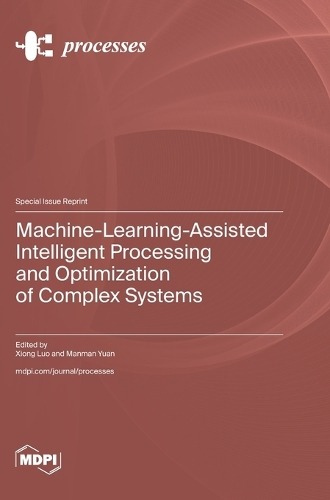
Machine-learning-assisted intelligent processing and optimization of complex systems
Focuses on the most recent developments in intelligent optimization methods and their applications in various test cases. The reprint covers various topics, including distributed multiagent modeling, metaheuristic algorithms, multisource data fusion, mobile computing and mobile sensing, machine learning-based intelligent processing for modeling complex manufacturing systems, and data-driven intelligent modeling
Kernel Methods for Machine Learning with Math and Python: 100 Exercises for Building Logic
Addresses the fundamentals of kernel methods for machine learning by considering relevant math problems and building Python programs. The book’s main features are as follows: Includes 100 exercises, which have been carefully selected and refined. As their solutions are provided in the main text, readers can solve all of the exercises by reading the book. / The mathematical premises of kernels are proven and the correct conclusions are provided, helping readers to understand the nature of kernels. / Source programs and running examples are presented to help readers acquire a deeper understanding of the mathematics used. / Once readers have a basic understanding of the functional analysis topics covered in Chapter 2, the applications are discussed in the subsequent chapters. Here, no prior knowledge of mathematics is assumed. / Considers both the kernel for reproducing kernel Hilbert space (RKHS) and the kernel for the Gaussian process; a clear distinction is made between the two.
