



Page 1
Page 1
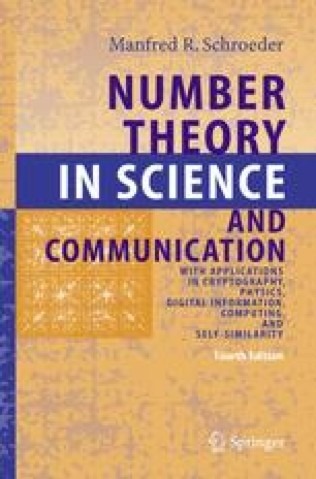
Number theory in science and communication : With applications in cryptography, physics, digital information, computing, and self-similarity
"Number Theory in Science and Communication" is a well-known introduction for non-mathematicians to this fascinating and useful branch of applied mathematics . It stresses intuitive understanding rather than abstract theory and highlights important concepts such as continued fractions, the golden ratio, quadratic residues and Chinese remainders, trapdoor functions, pseudoprimes and primitive elements. Their applications to problems in the real world are one of the main themes of the book. This revised fourth edition is augmented by recent advances in primes in progressions, twin primes, prime triplets, prime quadruplets and quintruplets, factoring with elliptic curves, quantum factoring, Golomb rulers and "baroque" integers.
Networked RFID Systems and Lightweight Cryptography : Raising Barriers to Product Counterfeiting
This book considers the methods used by illicit manufactures and traders to introduce counterfeit goods into the supply chain, the extent of their success, the various barriers that may be brought against their actions, and the effectiveness of those barriers. The new field of lightweight cryptography is described in the context of using RFID systems in the fight against counterfeit products, its cost effectiveness is examined and feasible approaches to its deployment are described. Research problems and likely avenues for solutions are also presented to guide a global effort in anti-counterfeiting.

Modern cryptography ; Vol.1 : A classical introduction to informational and mathematical principle
This book systematically explores the statistical characteristics of cryptographic systems, the computational complexity theory of cryptographic algorithms and the mathematical principles behind various encryption and decryption algorithms. The theory stems from technology. Based on Shannon's information theory, this book systematically introduces the information theory, statistical characteristics and computational complexity theory of public key cryptography, focusing on the three main algorithms of public key cryptography, RSA, discrete logarithm and elliptic curve cryptosystem.

Introduction to Modern Number Theory: Fundamental Problems, Ideas and Theories
"Introduction to Modern Number Theory" surveys from a unified point of view both the modern state and the trends of continuing development of various branches of number theory. Motivated by elementary problems, the central ideas of modern theories are exposed. Some topics covered include non-Abelian generalizations of class field theory, recursive computability and Diophantine equations, zeta- and L-functions. This substantially revised and expanded new edition contains several new sections, such as Wiles' proof of Fermat's Last Theorem, and relevant techniques coming from a synthesis of various theories. Moreover, the authors have added a part dedicated to arithmetical cohomology and noncommutative geometry, a report on point counts on varieties with many rational points, the recent polynomial time algorithm for primality testing, and some others subjects.

Intersections de deux quadriques et pinceaux de courbes de genre 1 = Intersections of two quadrics and pencils of curves of genus 1
This research monograph focuses on the arithmetic, over number fields, of surfaces fibred into curves of genus 1 over the projective line, and of intersections of two quadrics in projective space. The first half contains a complete account of the technique initiated by Swinnerton-Dyer in 1993 for studying rational points on pencils of curves of genus 1, while incorporating and generalising most of its subsequent refinements. The second half, which builds upon the first, is devoted to quartic del Pezzo surfaces and higher-dimensional intersections of two quadrics.

Information security, practice and experience ; 3rd International Conference, ISPEC 2007, Hong Kong, China, May 7-9, 2007, Proceedings
ISPEC is an annual conference that brings together researchers and practitioners to provide a con?uence of new information security technologies, their applications and their integration with IT systems in various vertical s- tors. In 2005 and 2006,the ?rst and second conferences were held successfully in Singapore and Hangzhou, China, respectively.

Information security practice and experience ; 4th International Conference, ISPEC 2008 Sydney, Australia, April 21-23, 2008 Proceedings
The 4 th Information Security Practice and Experience Conference (ISPEC2008) was held at Crowne Plaza, Darling Harbour, Sydney, Australia, during April 21-23, 2008. The previous three conferences were held in Singapore in 2005, Hangzhou, China in 2006 and Hong Kong, China in 2007. As with the previous three conference proceedings, the proceedings of ISPEC 2008 were published in the LNCS series by Springer. The conference received 95 submissions, out of which the Program Committee selected 29 papers for presentation at the conference. These papers are included in the proceedings. The accepted papers cover a range of topics in mathem- ics, computer science and security applications.

Information security and privacy ; Vol. 3574 : 10th Australasian Conference, ACISP 2005, Brisbane, Australia, July 4-6, 2005, Proceedings
Constitutes the refereed proceedings of the 10th Australasian Conference on Information Security and Privacy, ACISP 2005, held in Brisbane, Australia in July 2005. The papers are organized in topical sections on network security, cryptanalysis, group communication, elliptic curve cryptography, mobile security, side channel attacks, and more.

Information security and privacy ; 13th Australasian Conference, ACISP 2008, Wollongong, Australia, July 7-9, 2008. Proceedings
This book constitutes the refereed proceedings of the 13th Australasian Conference on Information Security and Privacy, ACISP 2008, held in Wollongong, Australia, in July 2008.The 33 revised full papers presented were carefully reviewed and selected from 111 submissions. The papers cover a range of topics in information security, including authentication, key management, public key cryptography, privacy, anonymity, secure communication, ciphers, network security, elliptic curves, hash functions, and database security.

Information Hiding ; 9th International Workshop, IH 2007, Saint Malo, France, June 11-13, 2007, Revised Selected Papers
This book constitutes the thoroughly refereed post-proceedings of the 9th International Workshop on Information Hiding, IH 2007, held in Saint Malo, France, in June 2007.

Cryptology and Network Security ; 7th International Conference, CANS 2008, Hong-Kong, China, December 2-4, 2008. Proceedings
This book constitutes the refereed proceedings of the 7th International Conference on Cryptology and Network Security, CANS 2008, held in Hong-Kong, China, in December 2008.

Cryptology and Network Security ; 19th International Conference, CANS 2020, Vienna, Austria, December 14–16, 2020, Proceedings
This book constitutes the refereed proceedings of the 19th International Conference on Cryptology and Network Security, CANS 2020, held in Vienna, Austria, in December 2020.* The 30 full papers were carefully reviewed and selected from 118 submissions. The papers focus on topics such as cybersecurity; credentials; elliptic curves; payment systems; privacy-enhancing tools; lightweight cryptography; and codes and lattices.

Cryptography, information theory, and error-correction : A handbook for the 21st century ; 2nd ed.
A rich examination of the technologies supporting secure digital information transfers from respected leaders in the field. Is an indispensable resource for anyone interested in the secure exchange of financial information. Identity theft, cybercrime, and other security issues have taken center stage as information becomes easier to access. Three disciplines offer solutions to these digital challenges: cryptography, information theory, and error-correction, all of which are addressed in this book. The book also: Shares vital, new research in the field of information theory / Provides quantum cryptography updates / Includes over 350 worked examples and problems for greater understanding of ideas.
Cryptography Arithmetic : Algorithms and Hardware Architectures
Modern cryptosystems, used in numerous applications that require secrecy or privacy - electronic mail, financial transactions, medical-record keeping, government affairs, social media etc. - are based on sophisticated mathematics and algorithms that in implementation involve much computer arithmetic. And for speed it is necessary that the arithmetic be realized at the hardware (chip) level. This book is an introduction to the implementation of cryptosystems at that level.

Cryptographic hardware and embedded systems - CHES 2008 ; 10th International Workshop, Washington, D.C., USA, August 10-13, 2008. Proceedings
This book constitutes the refereed proceedings of the 10th Interntaional Workshop on Cryptographic Hardware and Embedded Systems, CHES 2008, held in Washington, D.C., USA, during August 10-13, 2008.

Cryptographic hardware and embedded systems - CHES 2005 ; 7th International Workshop, Edinburgh, UK, August 29 - September 1, 2005, Proceedings
Constitutes the refereed proceedings of the 7th International Workshop on Cryptographic Hardware and Embedded Systems, CHES 2005, held in Edinburgh, UK in August/September 2005. The papers in this book are organized in topical sections on side channels, arithmetic for cryptanalysis, special purpose hardware, hardware attacks and more.

Cryptographic Algorithms on Reconfigurable Hardware
This book covers the study of computational methods, computer arithmetic algorithms, and design improvement techniques needed to implement efficient cryptographic algorithms in FPGA reconfigurable hardware platforms. The concepts and techniques reviewed in this book will make special emphasis on the practical aspects of reconfigurable hardware design, explaining the basic mathematics related and giving a comprehensive description of state-of-the-art implementation techniques. The authors show how high-speed cryptographic algorithms implementations can be achieved on reconfigurable hardware devices without posing prohibited high requirements for hardware resources. The material in this book will be of interest to engineering professionals, programmers, hardware designers, and graduate students interested in the development of security and cryptographic mechanisms at a beginning/intermediate level.

Conics and Cubics : A Concrete Introduction to Algebraic Curves
Its focus on curves of degree at most three keeps results tangible and proofs transparent. Theorems follow naturally from high school algebra and two key ideas: homogenous coordinates and intersection multiplicities. By classifying irreducible cubics over the real numbers and proving that their points form Abelian groups, the book gives readers easy access to the study of elliptic curves. It includes a simple proof of Bezout's Theorem on the number of intersections of two curves.The book is a text for a one-semester course on algebraic curves for junior-senior mathematics majors. The only prerequisite is first-year calculus.

Coding and Cryptography ; International Workshop, WCC 2005, Bergen, Norway, March 14-18, 2005, Revised Selected Papers
This volume contains refereed papers devotedtocodingandcrypto graphy.These papers arethe full versionsof a selectionof the best extended abstractsaccepted for presentation at the International Workshop on Coding and Cryptography (WCC 2005) held in Bergen, Norway, March 14–18, 2005. Each of the 118 - tended abstracts originallysubmitted to the workshop were reviewed by at least two members of the Program Committee. As a result of this screening process, 58 papers were selected for presentation, of which 52 were eventually presented at the workshop together with four invited talks.

Codes : An Introduction to Information Communication and Cryptography
Information is an important feature of the modern world. Mathematical techniques underlie the devices that we use to handle it, for example, mobile phones, digital cameras, and personal computers. This book is an integrated introduction to the mathematics of coding, that is, replacing information expressed in symbols, such as a natural language or a sequence of bits, by another message using (possibly) different symbols. There are three main reasons for doing this: economy, reliability, and security, and each is covered in detail. Only a modest mathematical background is assumed, the mathematical theory being introduced at a level that enables the basic problems to be stated carefully, but without unnecessary abstraction.
