



Page 1
Page 1

Internet and Network Economics ; Vol. 4286 ; 2nd International Workshop, WINE 2006, Patras, Greece, December 15-17, 2006, Proceedings
Constitutes the refereed proceedings of the Second International Workshop on Internet and Network Economics, WINE 2006, held in Patras, Greece in December 2006. The 32 revised full papers presented together with 3 invited talks were carefully reviewed and selected from 79 submissions. The papers contain foundational and mathematical work from theories, methodologies, and applications in computer science, economics, mathematics, and management sciences for solving problems arisen in internet technologies, grid computing, network communication protocols, as well as social economic issues in virtual communities enabled through the World Wide Web.

Internet and network economics ; 4th International Workshop, WINE 2008, Shanghai, China, December 17-20, 2008. Proceedings
This book constitutes the refereed proceedings of the 4th International Workshop on Internet and Network Economics, WINE 2008, held in Shanghai, China, in December 2008.The 68 revised full papers presented together with 10 invited talks were carefully reviewed and selected from 126 submissions. The papers are organized in topical sections on market equilibrium, congestion games, information markets, nash equilibrium, network games, solution concepts, algorithms and optimization, mechanism design, equilibrium, online advertisement, sponsored search auctions, and voting problems.

Internet and Network Economics ; 3rd International Workshop,WINE 2007, San Diego, CA, USA, December 12-14, 2007, Proceedings
This book constitutes the refereed proceedings of the Third International Workshop on Internet and Network Economics, WINE 2007, held in San Diego, CA, USA, in December 2007.
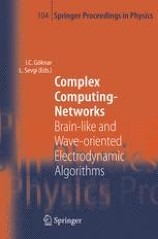
Complex Computing-Networks : Brain-like and Wave-oriented Electrodynamic Algorithms
This book uniquely combines new advances in the electromagnetic and the circuits&systems theory. It integrates both fields regarding computational aspects of common interest. Emphasized subjects are those methods which mimic brain-like and electrodynamic behaviour; among these are cellular neural networks, chaos and chaotic dynamics, attractor-based computation and stream ciphers.
