



Page 1
Page 1

Multimodality in architecture : Collaboration, technology and education
Examines multimodality in architecture and its impacts on collaborative, technical and educational processes or systems. Multimodality is becoming increasingly critical in contemporary architectural practice and education. Creative design teams face new challenges when they embrace new modes of communication, technology, and knowledge development processes. From diverse online modes of communication to shared digital environments, generative AI and advanced hardware solutions, new modes of information creation, sharing, and application are changing the ways architects and designers work. The book presents new research which empowers international researchers and designers to work more effectively in a diverse range of digital environments. Whether the readers are architects, teachers, students, or scholars, this book provides critical insights and practical tools for understanding and optimising processes in architecture and design.

Innovative trends in international business and sustainable management
Describes multidimensional trends, challenges, and opportunities for the development of international business and sustainable management in the context of a global pandemic. This book uniquely highlights new priorities of scientific and practical research in the field of international business and sustainable management that require a systematic knowledge of the ongoing transformations of trends, challenges, and opportunities for the development.

Fighting Terror Online : The Convergence of Security, Technology, and the Law
This book presents the position that the online environment is a significant and relevant theater of activity in the fight against terror, and will identify the threats, the security needs, and the issues that are unique to this environment. We examine whether the unique characteristics of this environment require new legal solutions, or whether existing solutions are sufficient. Three areas of online activity are identified that require reexamination: security, monitoring, and propaganda. For each of these, we will indicate the issues, examine existing legal arrangements, and offer guidelines for formulating legal policy. There is a demonstrated need to relate to the digital environment as a battlefront, map the new security threats.

EU Digital Copyright Law and the End-User
This book is the first comprehensive exploration of the legal framework of EU digital copyright law from the perspective of the ‘end-user’. This multi-faceted actor of the digital environment is a consumer of copyrighted works, a file-sharer of these works on the Internet, and a possible follow-on creator, who builds upon pre-existing digitised materials. All of these activities raise significant issues for national, European and international legal systems.

E-Content: Technologies and Perspectives for the European Market
Technologies develop rapidly and reach hurricane levels of velocity but quality E-Content and innovative applications lag behind. This book addresses the question how content industries change within a digital environment and what role information and communication technologies play in transforming the competitive landscape. The authors argue that post-industrial societies tend to pay substantial amounts for equipment and gadgets but invest far too little in the quality of the content. As a result, much effort is and has to be spent on the enhancement of E-Content.

Congruency, Expectations and Consumer Behavior in Digital Environments
A progress in technologies, the increasing expansion and use of digital environments lead to remarkable shifts of business activities. These transformations not only impact business but also affect consumers’ attitudes, beliefs, and practices. Thus, Frederic Nimmermann sheds light on consumer behavior in central subareas in digital environments such as advertising.
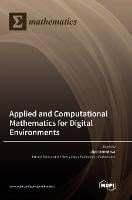
Applied and computational mathematics for digital environments
Contains the 11 papers that were accepted and published in the Special Issue “Applied and Computational Mathematics for Digital Environments” of the MDPI Mathematics journal. The topics of interest include, among others, scientific research, applied tasks, and problems in the following areas: The construction of mathematical and information models of intelligent computer systems for monitoring and controlling the parameters of digital environments; The development of intelligent optimization algorithms that search for optimal parameter values of mathematical and information models in digital environments; Software and mathematical technologies in the implementation of intelligent monitoring and computer control of the parameters of digital environments; The development and application of mathematical and information models, machine learning methods, and artificial intelligence for the analysis and processing of big data in digital environments.
