



Page 1
Page 1

Inverse Problems in Electric Circuits and Electromagnetics
This text treats important new methods in inverse problems in electromagnetics. The inverse problems such as synthesis, diagnostics, fault detection, and identification are becoming one of the most important subjects in the field because of the significant practical applications to electric circuits and electromagnetics. This book introduces the recent achievements in mathematics and computing, while focusing on an approach to inverse problems that provides numerical solutions. The text systematically supplies descriptions of the most important practical inverse problems and the methods to solve them, thereby providing the reader with the best application for these intuitive processes. Also included are descriptions of the properties of inverse problems and known methods of their solution as well as the practical implementation of these methods in electric circuits theory and electromagnetic field theory.
Introduction to Geometric Computing
The geometric ideas in computer science, mathematics, engineering, and physics have considerable overlap and students in each of these disciplines will eventually encounter geometric computing problems. The topic is traditionally taught in mathematics departments via geometry courses, and in computer science through computer graphics modules. This text isolates the fundamental topics affecting these disciplines and lies at the intersection of classical geometry and modern computing.

Global design to gain a competitive edge : An holistic and collaborative design approach based on computational tools
Global Design to Gain a Competitive Edge collects together papers from the 2008 International Conference on Advanced Design and Manufacture (ICADAM). Recent advancements, emerging trends and new challenges in the fields of design and manufacturing are covered, with a particular focus on the understanding of the impact of distributed team-based design and manufacture on research and industrial practices for global companies.

Foundations of Multi-Paradigm Modelling for Cyber-Physical Systems
This book coherently gathers well-founded information on the fundamentals of and formalisms for modelling cyber-physical systems (CPS). Highlighting the cross-disciplinary nature of CPS modelling, it also serves as a bridge for anyone entering CPS from related areas of computer science or engineering.

Finite Element Analysis for Civil Engineering with DIANA Software
Introduces readers to the finite element analysis software DIANA (DIsplacement ANAlyzer) and its applications in civil engineering. Developed by TNO Corporation in the 1970s, DIANA is frequently used in civil engineering and engineering mechanics. This book presents a simplified overview of the basic background theory to help beginners master the software quickly. It also discusses GUI operation and the command console in Python language, and includes examples involving classical modeling operations to help readers review each section.

Digital transformation of the design, construction and management processes of the built environment
This book focuses on the development of methods, interoperable and integrated ICT tools, and survey techniques for optimal management of the building process.
Design for Manufacturability and Yield for Nano-Scale CMOS
This book presented aspects of manufacturability and yield in a nano-CMOS process and how to address each aspect at the proper design step starting with the design and layout of standard cells and how to yield-grade libraries for critical area and lithography artifacts through place and route, CMP model based simulation and dummy-fill insertion, mask planning, simulation and manufacturing, and through statistical design and statistical timing closure of the design. It alerts the designer to the pitfalls to watch for and to the good practices that can enhance a design’s manufacturability and yield. This book is a must read book the serious practicing IC designer and an excellent primer for any graduate student intent on having a career in IC design or in EDA tool development.

Design for Manufacturability and Statistical Design : A Constructive Approach
Design for Manufacturability and Statistical Design: A Constructive Approach provides a thorough treatment of the causes of variability, methods for statistical data characterization, and techniques for modeling, analysis, and optimization of integrated circuits to improve yield.

Design computing and cognition 08 ; Proceedings of the 3rd International conference on design computing and cognition
This is the third volume of the new conference series Design Computing and Cognition (DCC) that takes over from and subsumes the successful series Artificial Intelligence in Design (AID) published by Kluwer (now Springer) since 1992.

Cooperative Design, Visualization, and Engineering ; 5th International Conference, CDVE 2008 Calvià, Mallorca, Spain, September 21-25, 2008 Proceedings
This book constitutes the refereed proceedings of the 5th International Conference on Cooperative Design, Visualization, and Engineering, CDVE 2008, held in Calvià, Mallorca, Spain, in September 2008.

Computer-Aided Innovation (CAI) ; IFIP 20th World Computer Congress, Proceedings of the Second Topical Session on Computer-Aided Innovation, WG 5.4/TC 5 Computer-Aided Innovation, September 7-10, 2008, Milano, Italy
The IFIP series publishes state-of-the-art results in the sciences and technologies of information and communication. The principal aim of the IFIP series is to encourage education and the dissemination and exchange of information about all aspects of computing.
Computer Supported Cooperative Work in Design III ; 10th International Conference, CSCWD 2006, Nanjing, China, May 3-5, 2006, Revised Selected Papers
The design of complex artifacts and systems requires the cooperation of multidiscip- nary design teams using multiple commercial and proprietary engineering software tools (e.g., CAD, modeling, simulation, visualization, and optimization), engineering databases, and knowledge-based systems. Individuals or individual groups of mult- isciplinary design teams usually work in parallel and separately with various en- neering software tools which are located at different sites. In addition, individual members may be working on different versions of a design or viewing the design from different perspectives, at different levels of detail. In order to accomplish the work, it is necessary to have effective and efficient c- laborative design environments. Such environments should not only automate in- vidual tasks, in the manner of traditional computer-aided engineering tools, but also enable individual members to share information, collaborate, and coordinate their activities within the context of a design project. CSCW (computer-supported coope- tive work) in design is concerned with the development of such environments.
Computer Supported Cooperative Work in Design I
The design of complex artifacts and systems requires the cooperation of multidisciplinary design teams using multiple commercial and non-commercial engineering tools such as CAD tools, modeling, simulation and optimization software, engineering databases, and knowledge-based systems. Individuals or individual groups of multidisciplinary design teams usually work in parallel and separately with various engineering tools, which are located on different sites, often for quite a long time. At any moment, individual members may be working on different versions of a design or viewing the design from various perspectives, at different levels of detail. In order to meet these requirements, it is necessary to have effective and efficient collaborative design environments. These environments should not only automate individual tasks, in the manner of traditional computer-aided engineering tools, but also enable individual members to share information, collaborate and coordinate their activities within the context of a design project. CSCW (computer-supported cooperative work) in design is concerned with the development of such environments.

Computer Aided Bridge Engineering : Detail Design of Pre-Stressed Concrete I-Girder / Box-Girder Bridges
Real project design calculations for a deck-girder superstructure are presented along with the design of an abutment and pier with pile foundation as the bridge substructure. The book is proposed to be read in association with processing the design work by using the computer software ASTRA Pro as referred to in the book. The book describes two essential facets of the work, which are 'Analysis of the Grillage Model of the Deck-Girder Superstructure' and the subsequent 'Design of Deck Slab and PSC I-Girder'. The software provides three facets of the work: first is the 'Analysis of the Grillage Model of the Deck-Girder Superstructure', second is the 'Design of Deck Slab and PSC I-Girder, Abutment, Piers along with Pile Foundation', and the third is a 'Set of Sample Editable CAD Drawings for the work'. The drawings may be modified as per the design work and be submitted as required for the construction. The drawings contain information on dimensions, structural detailing, bar-bending schedules, pre-stressing details and construction guides.

Comfort and Perception in Architecture
This book discusses the design of comfortable buildings and shows that design perception and, as a result, comfort should be an intentional feature of architectural design. Modern buildings are often sealed boxes without operable windows or daylighting design. However, contemporary designers increasingly find themselves faced with the task of creating spaces that are comfortable in terms of thermal and visual aspects.

Collaborative and Distributed Chemical Engineering : From Understanding to Substantial Design Process Support; Results of the IMPROVE Project
The focus of IMRPOVE is on understanding, formalizing, evaluating, and, consequently, improving design processes in chemical engineering. In particular, IMPROVE focuses on conceptual design and basic engineering, where the fundamental decisions concerning the design or redesign of a chemical plant are undertaken.
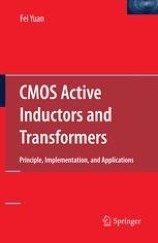
CMOS Active Inductors and Transformers : Principle, Implementation, and Applications
CMOS Active Inductors and Transformers: Principle, Implementation, and Applications provides a systematic presentation and a detailed examination of the operation principles and implementations, and discusses their emerging applications in high-speed analog signal processing and data communications.

Linkage in Evolutionary Computation
The whole volume consisting of 19 chapters is divided into 3 parts: Models and Theories; Operators and Frameworks; Applications. This edited volume will serve as a useful guide and reference for researchers who are currently working in the area of linkage. For postgraduate research students, this volume will serve as a good source of reference. It is also suitable as a text for a graduate level course focusing on linkage issues.
Architecture and design for industry 4.0 : Theory and practice
The book is structured into three sections (research, practice, and technologies), with the goal of creating a new framework useful for widespread awareness necessary to initiate technology transfer processes for the benefit of the public sector, universities, research centers, and innovative companies, and a new professional figure capable of controlling the entire process is essential. Thus, the book chapters arouse a series of relevant topics such as computational and parametric design, performance-based architecture, data-driven design strategies, parametric environmental design and analysis, computational and parametric structural design and analysis
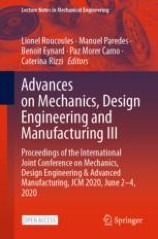
Advances on mechanics, design engineering and manufacturing III ; Proceedings of the international joint conference on mechanics, design engineering & advanced manufacturing, JCM 2020, June 2-4, 2020
This open access book gathers contributions presented at the International Joint Conference on Mechanics, Design Engineering and Advanced Manufacturing (JCM 2020), held as a web conference on June 2–4, 2020.
