



Page 1
Page 1

Multiplicative Invariant Theory
Multiplicative invariant theory, as a research area in its own right within the wider spectrum of invariant theory, is of relatively recent vintage. The present text offers a coherent account of the basic results achieved thus far.. Multiplicative invariant theory is intimately tied to integral representations of finite groups. Therefore, the field has a predominantly discrete, algebraic flavor. Geometry, specifically the theory of algebraic groups, enters through Weyl groups and their root lattices as well as via character lattices of algebraic tori.
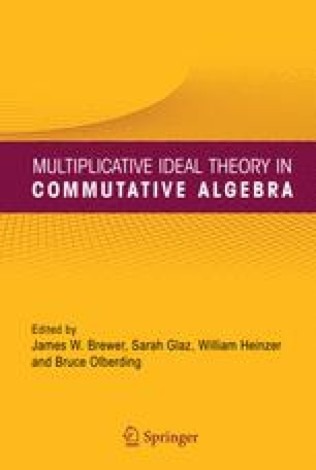
Multiplicative Ideal Theory in Commutative Algebra : A Tribute to the Work of Robert Gilmer
This volume, a tribute to the work of Robert Gilmer, consists of twenty-four articles authored by his most prominent students and followers. These articles combine surveys of past work by Gilmer and others, recent results which have never before seen print, open problems, and extensive bibliographies.

Gruppi : Una introduzione a idee e metodi della Teoria dei Gruppi = Groups : An introduction to the ideas and methods of Group Theory
Born from the university courses of Group Theory held by the author for several years, this book deals with the fundamental arguments of the theory: abelian, nilpotent and solvable groups, free groups, permutations, representations and cohomology. After the first notions, Hölder's program for the classification of finite groups is exposed. A long chapter is dedicated to the action of a group on a set and to the permutations, both under the algebraic and combinatorial aspects, with references to the theory of equations. Some questions of a logical nature are also considered, such as the decidability of the word problem for certain classes of groups. An essential aspect of the book is the presence of a great variety of exercises, about 400, mostly solved.
Algèbre, Chapitres 1 à 3 = Algebra, Chapters 1 to 3
To do algebra is essentially to calculate, that is to say to perform, on elements of a set, (<algebraic operations n, the best-known example of which is provided by the (<four rules)) of elementary arithmetic. This is not the place to retrace the slow process of progressive abstraction by which the notion of algebraic operation, initially restricted to natural integers and to measurable quantities, gradually widened its field, as it grew. at the same time generalized the notion of ((number O, until, going beyond the latter, it came to apply to elements which no longer had any character ((numeric)>, for example to permutations of a - seems (see Historical Note in chap. 1).
Algèbre, Chapitre 9 = Algebra, Chapter 9
Sesquilinear and quadratic forms : The Mathematics Elements of Nicolas BOURBAKI aim to provide a rigorous, systematic presentation without prerequisites of mathematics from their foundations. This ninth chapter of the Book of Algebra, the second Book of the treatise, is devoted to quadratic, symplectic or Hermitian forms and to associated groups.
Algèbre commutative, Chapitre 10 = Commutative Algebra, Chapter 10
Depth, Regularity, Duality The Mathematics Elements of Nicolas BOURBAKI aim to provide a rigorous, systematic presentation without prerequisites of mathematics from their foundations. This volume of the Book of Commutative Algebra, Book 7 of the treatise, is a continuation of the earlier chapters. It introduces in particular the notions of depth and smoothness, fundamental in algebraic geometry. It ends with the introduction of the dualizing modules and the Grothendieck duality.
Algèbre commutative : Chapitres 8 et 9 = Commutative algebra : Chapters 8 and 9
The Mathematics Elements of Nicolas BOURBAKI aim to provide a rigorous, systematic presentation without prerequisites of mathematics from their foundations.
Algèbre commutative : Chapitres 1à 4 = = Commutative algebra : Chapters 1 to 4
Nicolas BOURBAKI's Elements of Mathematics aim to provide a rigorous, systematic presentation without prerequisites of mathematics from their foundations. This first volume of the Book of Commutative Algebra, the seventh Book of the treatise, is devoted to the fundamental concepts of commutative algebra. It includes the chapters, Flat modules, Localization, Graduations, filtrations and topologies, First associated ideals and primary decomposition, It also contains historical notes. This volume is a reprint of the 1969 edition.
