



Page 1
Page 1

Mathematics and the Historians Craft : The Kenneth O. May Lectures
Mathematical practitioners, for pedagogical reasons or to contextualize the work, tend to focus on finding the antecedents for current mathematical theories in a search for how particular subdisciplines and results came to be as they are today. On the other hand, historians of mathematics bypass the current state of affairs, and are more interested in questions that bear on the changing nature of the discipline itself.

Introduction to Soliton Theory : Applications to Mechanics
This monograph provides the application of soliton theory to solve certain problems selected from the fields of mechanics. The present monograph is not a simple translation of its predecessor appeared in Publishing House of the Romanian Academy in 2002. Improvements outline the way in which the soliton theory is applied to solve some engineering problems. The book addresses concrete resolution methods of certain problems such as the motion of thin elastic rod, vibrations of initial deformed thin elastic rod, the coupled pendulum oscillations, dynamics of left ventricle, transient flow of blood in arteries, the subharmonic waves generation in a piezoelectric plate with Cantor-like structure, and some problems related to Tzitzeica surfaces. This comprehensive study enables the readers to make connections between the soliton physical phenomenon and some partical, engineering problems.

Fractal Geometry, Complex Dimensions and Zeta Functions : Geometry and Spectra of Fractal Strings
Number theory, spectral geometry, and fractal geometry are interlinked in this in-depth study of the vibrations of fractal strings, that is, one-dimensional drums with fractal boundary. Key Features The Riemann hypothesis is given a natural geometric reformulation in the context of vibrating fractal strings Complex dimensions of a fractal string, defined as the poles of an associated zeta function, are studied in detail, then used to understand the oscillations intrinsic to the corresponding fractal geometries and frequency spectra Explicit formulas are extended to apply to the geometric, spectral, and dynamical zeta functions associated with a fractal Examples of such explicit formulas include a Prime Orbit Theorem with error term for self-similar flows, and a geometric tube formula The method of Diophantine approximation is used to study self-similar strings and flows Analytical and geometric methods are used to obtain new results about the vertical distribution of zeros of number-theoretic and other zeta functions Throughout new results are examined. The final chapter gives a new definition of fractality as the presence of nonreal complex dimensions with positive real parts, and discusses several open problems and extensions.

Local and Semi-Local Bifurcations in Hamiltonian Dynamical Systems : Results and Examples
Once again KAM theory is committed in the context of nearly integrable Hamiltonian systems. While elliptic and hyperbolic tori determine the distribution of maximal invariant tori, they themselves form n-parameter families. Hence, without the need for untypical conditions or external parameters, torus bifurcations of high co-dimension may be found in a single given Hamiltonian system. The text moves gradually from the integrable case, in which symmetries allow for reduction to bifurcating equilibria, to non-integrability, where smooth parametrisations have to be replaced by Cantor sets. Planar singularities and their versal unfoldings are an important ingredient that helps to explain the underlying dynamics in a transparent way.
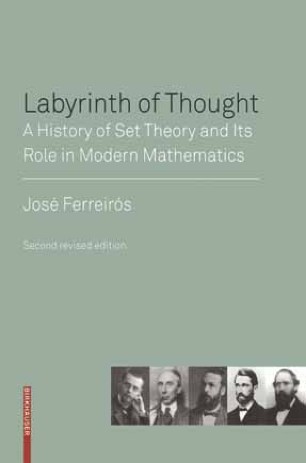
Labyrinth of Thought : A History of Set Theory and Its Role in Modern Mathematics
Labyrinth of Thought discusses the emergence and development of set theory and the set-theoretic approach to mathematics during the period 1850-1940. Rather than focusing on the pivotal figure of Georg Cantor, it analyzes his work and the emergence of transfinite set theory within the broader context of the rise of modern mathematics. The text has a tripartite structure.A new Epilogue for this second edition offers further reflections on the foundations of set theory, including the "dichotomy conception" and the well-known iterative conception.
