



Page 1
Page 1

Design build with the scarcity and creativity studio
Scarcity and Creativity Studio has developed a teaching method which reaffirms a commitment to architecture as a service to society, questions the idea of the individual creator in favour of collaborative design, and challenges the traditional master-student relationship. This book documents the projects and, in so doing, explains the practices and pedagogic methods which the studio has developed in relation to architecture education in general and design build education in particular. Aimed at students, teachers, and professionals who are exploring the possibilities of design build, the 16 built projects are fully documented in text, drawings, and photos and can be used as both inspiration and references. Projects are based in Norway, Finland, Chile, Ecuador (Galápagos), Kenya, South Africa, China, Argentina, and Lebanon.
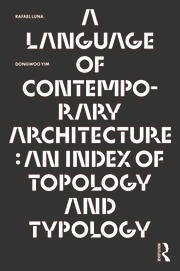
A Language of Contemporary Architecture : An Index of Topology and Typology
Provides an index of ideas, theories, projects, and definitions that string into a methodology for evaluating the contemporary language of architecture described as “contemporism” through a review of topology (form) and typology (system and elements). Trying to answer the postmodern question of how to move beyond modernism through a thread of architectural styles that tried to respond to deficiencies from the modern promise and contextual changes. Yet, the question remains, should this ongoing struggle to move beyond modernism be a stylistic battle? Has the present architectural practice ever left the modernist tendencies, and is there a structure for a contemporary language in architecture?. Presents a collection of highly illustrated projects that have worked under these parameters to break away from modernism in order to present a holistic integration of topology and typology as a language for “contemporism.” The index is illustrated with individual spreads, which can be read sequentially or independently, and encourages the reader to make their own connections. It also includes interviews and contributions from Toyo Ito, Anthony Vidler, Ben van Berkel, Christian Kerez, and Greg Lynn.
