



Page 1
Page 1
Object-Based Image Analysis : Spatial Concepts for Knowledge-Driven Remote Sensing Applications
This book discusses means, technologies and approaches related to the processing and analysis of multi-sensor, multi-resolution data with a focus on the generation, modelling and classification of objects. The applications also address the integration of Geographic Information and the concurrent developments of GIScience and vanquish limitations of pixelwise image processing by exploiting image information context-driven and "intelligently".

Neural Information Processing ; 14th International Conference, ICONIP 2007, Kitakyushu, Japan, November 13-16, 2007, Revised Selected Papers, Part II
The 228 revised full papers presented were carefully reviewed and selected from numerous ordinary paper submissions and 15 special organized sessions. The 116 papers of the first volume are organized in topical sections on computational neuroscience, learning and memory, neural network models ,supervised /unsupervised/reinforcement learning, statistical learning algorithms, optimization algorithms, novel algorithms, as well as motor control and vision. The second volume contains 112 contributions related to statistical and pattern recognition algorithms, neuromorphic hardware and implementations, robotics, data mining and knowledge discovery, real world applications, cognitive and hybrid intelligent systems, bioinformatics, neuroinformatics, brain-conputer interfaces, and novel approaches.

Neural Information Processing ; 14th International Conference, ICONIP 2007, Kitakyushu, Japan, November 13-16, 2007, Revised Selected Papers, Part I
The 228 revised full papers presented were carefully reviewed and selected from numerous ordinary paper submissions and 15 special organized sessions. The 116 papers of the first volume are organized in topical sections on computational neuroscience, learning and memory, neural network models, supervised/unsupervised/reinforcement learning, statistical learning algorithms, optimization algorithms, novel algorithms, as well as motor control and vision. The second volume contains 112 contributions related to statistical and pattern recognition algorithms, neuromorphic hardware and implementations, robotics, data mining and knowledge discovery, real world applications, cognitive and hybrid intelligent systems, bioinformatics, neuroinformatics, brain-conputer interfaces, and novel approaches.

Multiple-Aspect Analysis of Semantic Trajectories ; First International Workshop, MASTER 2019, Held in Conjunction with ECML-PKDD 2019, Würzburg, Germany, September 16, 2019, Proceedings
This book constitutes the refereed post-conference proceedings of the First International Workshop on Multiple-Aspect Analysis of Semantic Trajectories, MASTER 2019, held in conjunction with the 19th European Conference on Machine Learning and Knowledge Discovery in Databases, ECML PKDD 2019, in Würzburg, Germany, in September 2019.

Multimodal User Interfaces : From Signals to Interaction
The book presents a common theoretical framework for fusion and fission of multimodal information using the most advanced signal processing algorithms constrained by HCI rules, described in detail and integrated in the context of a common distributed software platform for easy and efficient development and usability assessment of multimodal tools. The book also demonstrates the use of the multimodal framework for the development of a set of applications in the areas of edutainment, interfaces for disabled people and interfaces for medical applications.

Multimodal Technologies for Perception of Humans ; International Evaluation Workshops CLEAR 2007 and RT 2007, Baltimore, MD, USA, May 8-11, 2007, Revised Selected Papers
This book constitutes the thoroughly refereed joint post-workshop proceedings of two co-located events: the Second International Workshop on Classification of Events, Activities and Relationships, CLEAR 2007, and the 5th Rich Transcription 2007 Meeting Recognition evaluation, RT 2007, held in succession in Baltimore, MD, USA, in May 2007.The workshops had complementary evaluation efforts; CLEAR for the evaluation of human activities, events, and relationships in multiple multimodal data domains; and RT for the evaluation of speech transcription-related technologies from meeting room audio collections.

Multimedia Forensics
Media forensics has never been more relevant to societal life. Not only media content represents an ever-increasing share of the data traveling on the net and the preferred communications means for most users, it has also become integral part of most innovative applications in the digital information ecosystem that serves various sectors of society, from the entertainment, to journalism, to politics. Undoubtedly, the advances in deep learning and computational imaging contributed significantly to this outcome. The underlying technologies that drive this trend, however, also pose a profound challenge in establishing trust in what we see, hear, and read, and make media content the preferred target of malicious attacks.

Motion-Free Super-Resolution
With the explosion of Internet technology and graphics engines, digital images are now everywhere. Image capturing tools are all pervading - in our pockets to inside a satellite. And although imaging applications demand an availability to high resolution images, such images are not picture perfect and may be lacking sufficient details. This requires that these images be super-resolved for improved details. How to achieve this is what constitutes research in the area of image super-resolution. Motion-Free Super-Resolution explores new technology for image super-resolution - applying cues other than the motion cue in super-resolving a scene. This book will serve as an essential reference for both academecians and practicing engineers in the area of image processing and computer vision, as well as providing a basis for ongoing research in this field.

MICAI 2008 : Advances in Artificial Intelligence ;7th Mexican International Conference on Artificial Intelligence, Atizapán de Zaragoza, Mexico, October 27-31, 2008 Proceedings
The 96 revised full papers presented together with 2 invited lectures were carefully reviewed and selected from 363 submissions. The papers are organized in topical sections on logic and reasoning, knowledge-based systems, knowledge representation and acquisition, ontologies, natural language processing, machine learning, pattern recognition, data mining, neural networks, genetic algorithms, hybrid intelligent systems, computer vision and image processing, robotics, planning and scheduling, uncertainty and probabilistic reasoning, fuzzy logic, intelligent tutoring systems, multi-agent systems and distributed ai, intelligent organizations, bioinformatics and medical applications, as well as applications.

Medical Imaging and Informatics ; 2nd International Conference, MIMI 2007, Beijing, China, August 14-16, 2007 Revised Selected Papers
This book constitutes the thoroughly refeered post-conference proceedings of the Second Interational Conference on Medical Imaging and Informatics, MIMI 2007, held in Beijing, China, in August 2007.The 40 revised full papers presented together with 4 keynote talks were carefully reviewed and selected from 110 submissions. The papers are organized in topical sections on medical image segmentation and registration, medical informatics, PET, fMRI, ultrasound and thermal imaging, 3D reconstruction and visualization. The volume is rounded off by 4 papers from 2 workshops on legal, ethical and social issues in medical imaging and informatics, as well as on computer-aided diagnosis (CAD).

Medical Imaging and Augmented Reality ; 4th International Workshop Tokyo, Japan, August 1-2, 2008 Proceedings
Constitutes the refereed proceedings of the 4th International Workshop on Medical Imaging and Augmented Reality, MIAR 2008, held in Tokyo, Japan, in August 2008.The 44 revised full papers presented together with 3 invited papers were carefully reviewed and selected from 90 submissions. The papers are organized in topical sections on surgical planning and simulation, medical image computing, image analysis, shape modeling and morphometry, image-guided robotics, image-guided intervention, interventional imaging, image registration, augmented reality, and image segmentation.

Medical Image Computing and Computer-Assisted Intervention - MICCAI 2008 ; 11th International Conference, New York, NY, USA, September 6-10, 2008, Proceedings, Part II
The program committee carefully selected 258 revised papers from numerous submissions for presentation in two volumes, based on rigorous peer reviews. The first volume includes 127 papers related to medical image computing, segmentation, shape and statistics analysis, modeling, motion tracking and compensation, as well as registration. The second volume contains 131 contributions related to robotics and interventions, statistical analysis, segmentation, intervention, modeling, and registration.
Interactive Curve Modeling : With Applications to Computer Graphics, Vision and Image Processing
Interactive curve modeling techniques and their applications are extremely useful in a number of academic and industrial settings, and specifically play a significant role in multidisciplinary problem solving, such as in font design, designing objects, CAD/CAM, medical operations, scientific data visualization, virtual reality, character recognition, and object recognition, etc. Various problems such as iris, fingerprint, and signature recognition, can also be intelligently solved and automated using curve techniques.

Intelligent robotics and applications ; 1st International Conference, ICIRA 2008, Wuhan, China, October 15-17, 2008, Proceedings, Part I
These two volumes constitute the refereed proceedings of the First International Conference on Intelligent Robotics and Applications, ICIRA 2008, held in Wuhan, China, in October 2008.The 265 revised full papers presented were thoroughly reviewed and selected from 552 submissions; they are devoted but not limited to robot motion planning and manipulation; robot control; cognitive robotics; rehabilitation robotics; health care and artificial limb; robot learning; robot vision; human-machine interaction & coordination; mobile robotics.

Intelligent robotics and applications ; 1st International Conference, ICIRA 2008 Wuhan, China, October 15-17, 2008 Proceedings, Part II
This two volumes constitute the refereed proceedings of the First International Conference on Intelligent Robotics and Applications, ICIRA 2008, held in Wuhan, China, in October 2008.The 265 revised full papers presented were thoroughly reviewed and selected from 552 submissions; they are devoted but not limited to robot motion planning and manipulation; robot control; cognitive robotics; rehabilitation robotics; health care and artificial limb; robot learning; robot vision; human-machine interaction & coordination; mobile robotics.

Image and Signal Processing ; 3rd International Conference, ICISP 2008. Cherbourg-Octeville, France, July 1 - 3, 2008. Proceedings
This book constitutes the refereed proceedings of the Third International Conference on Image and Signal Processing, ICISP 2008, held in Cherbourg-Octeville, France, in July 2008.The 48 revised full papers and 22 revised poster papers presented were carefully reviewed and selected from 193 submissions. The papers are organized in topical sections on image filtering, image segmentation, computer vision, feature extraction, pattern recognition, graph-based representations, motion detection and estimation, new interfaces, document processing, and signal processing.

Image Analysis and Recognition ; 5th International Conference, ICIAR 2008, Póvoa de Varzim, Portugal, June 25-27, 2008. Proceedings
The 110 revised full papers presented together with 2 invited papers were carefully reviewed and selected from 226 submissions. The papers are organized in topical sections on image restoration and enhancement, image and video segmentation, non-linear image processing, image and video coding and encryption, indexing and retrieval, computer vision, feature extraction and classification, shape representation and matching, object recognition, character recognition, texture and motion analysis, tracking, biomedical image analysis, biometrics, face recognition, and a special session on recent advances in multimodal biometric systems and applications.
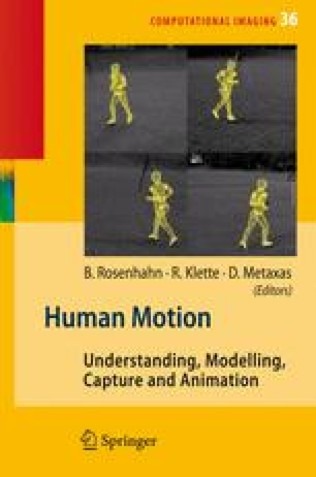
Human motion : Understanding, modeling, capture and animation
Edward Muybridge (1830–1904) is known as the pioneer in motion capt- ing with his famous experiments in 1887 called “Animal Locomotion”. Since then, the feld of animal or human motion analysis has grown in many dir- tions. However, research and results that involve human-like animation and the recovery of motion is still far from being satisfactory. Progress in human motion analysis depends on empirically anchored and grounded research in computer vision, computer graphics, and biomechanics. This book is based on a June 2006 workshop held in Dagstuhl, Germany. This workshop brought together for the frst time researchers from the afo- mentioned disciplines.
Human Ear Recognition by Computer
Human Ear Recognition by Computer is the first book on the automatic recognition of human ears. It presents an entire range of computational algorithms for recognition of humans by their ears. These algorithms have been tested and validated on the largest databases that are available today,This state-of-the-art research reference explores all aspects of 3D ear recognition, including representation, detection, recognition, indexing and performance prediction. It has been written for a professional audience of both researchers and practitioners within industry, and is also ideal as an informative text for graduate students in computer science and engineering.

Hexagonal image processing : A practical approach
Hexagonal Image Processing provides an introduction to the processing of hexagonally sampled images, includes a survey of the work done in the field, and presents a novel framework for hexagonal image processing (HIP) based on hierarchical aggregates. Digital image processing is currently dominated by the use of square sampling lattices, however, hexagonal sampling lattices can also be used to define digital images. The strengths offered by hexagonal lattices over square lattices are considerable: • higher packing density, • uniform connectivity of points (pixels) in the lattice, • better angular resolution by virtue of having more nearest neighbours, and • superlative representation of curves. The utility of the HIP framework is demonstrated by implementing several basic image processing techniques (for the spatial and frequency domain) and some applications. The HIP framework serves as a tool for comparing processing of images defined on a square vs hexagonal grid, to determine their relative merits and demerits. The theory and algorithms covered are supplemented by attention to practical details such as accommodating hardware that support only images sampled on a square lattice. Including a Foreword written by Professor Narendra Ahuja, an eminent researcher in the field of Image Processing and Computer Vision, the book’s fresh approach to the subject offers insight and workable know-how to both researchers and postgraduates.
