



Page 1
Page 1

On the move to meaningful internet systems : OTM 2008 ; OTM 2008 Confederated International Conferences, CoopIS, DOA, GADA, IS, and ODBASE 2008, Monterrey, Mexico, November 9-14, 2008, Proceedings, Part I
This two-volume set LNCS 5331/5332 constitutes the refereed proceedings of the five confederated international conferences on Cooperative Information Systems (CoopIS 2008), Distributed Objects and Applications (DOA 2008), Grid computing, high performAnce and Distributed Applications (GADA 2008), Information Security (IS 2008), and Ontologies, Databases and Applications of Semantics (ODBASE 2008), held as OTM 2008 in Monterrey, Mexico, in November 2008.

New Developments in Classification and Data Analysis ; Proceedings of the Meeting of the Classification and Data Analysis Group (CLADAG) of the Italian Statistical Society, University of Bologna, September 22-24, 2003
This volume contains revised versions of selected papers presented during the biannual meeting of the Classification and Data Analysis Group of SocietA Italiana di Statistica, which was held in Bologna, September 22-24, 2003. The scientific program of the conference included 80 contributed papers. the conference provided a large number of scientists and experts from home and abroad with an attractive forum for discussions and mutual exchange of knowledge. The talks in the different sessions focused on methodological developments in supervised and unsupervised classification and in data analysis, also p- viding relevant contributions in the context of applications. This suggested the presentation of the 43 selected papers in three parts as follows: CLASSIFICATION AND CLUSTERING Non parametric classification Clustering and dissimilarities MULTIVARIATE STATISTICS AND DATA ANALYSIS APPLIED MULTIVARIATE STATISTICS Environmental data Microarray data Behavioural and text data Financial data

Network Classification For Traffic Management : Anomaly detection, feature selection, clustering and classification
Investigates network traffic classification solutions by proposing transport-layer methods to achieve better run and operated enterprise-scale networks. With the massive increase of data and traffic on the Internet within the 5G, IoT and smart cities frameworks, current network classification and analysis techniques are falling short. Novel approaches using machine learning algorithms are needed to cope with and manage real-world network traffic, including supervised, semi-supervised, and unsupervised classification techniques. Accurate and effective classification of network traffic will lead to better quality of service and more secure and manageable networks. Investigates network traffic classification solutions by proposing transport-layer methods to achieve better run and operated enterprise-scale networks. The authors explore novel methods for enhancing network statistics at the transport layer, helping to identify optimal feature selection through a global optimization approach and providing automatic labelling for raw traffic through a SemTra framework to maintain provable privacy on information disclosure properties.

Network Analysis : Methodological Foundations
‘Network’ is a heavily overloaded term, so that ‘network analysis’ means different things to different people. Specific forms of network analysis are used in the study of diverse structures such as the Internet, interlocking directorates, transportation systems, epidemic spreading, metabolic pathways, the Web graph, electrical circuits, project plans, and so on. There is, however, a broad methodological foundation which is quickly becoming a prerequisite for researchers and practitioners working with network models. From a computer science perspective, network analysis is applied graph theory. Unlike standard graph theory books, the content of this book is organized according to methods for specific levels of analysis (element, group, network) rather than abstract concepts like paths, matchings, or spanning subgraphs. Its topics therefore range from vertex centrality to graph clustering and the evolution of scale-free networks. In 15 coherent chapters, this monograph-like tutorial book introduces and surveys the concepts and methods that drive network analysis, and is thus the first book to do so from a methodological perspective independent of specific application areas.

Natural language and information systems ; 13th International Conference on Applications of Natural Language to Information Systems, NLDB 2008 London, UK, June 24-27, 2008 Proceedings
This volume contains the papers presented at NLDB 2008, the 13th Inter- tional Conference on Natural Language and Information Systems, held June 25-27,2008.It also containssome of the best researchproposalsas submitted to the NLDB2008 doctoral symposium heldonJune24,2008.Theprogrammealso includes three invited talks covering the main perspectives of the application of naturallanguageto informationsystems: the wayhumansprocess, communicate and understand natural language, what are the implications and challenges - wardssemanticsearchfor the new Webgeneration, how naturallanguageapplies to the well-established database way of querying as a means to unlock data and information for end users.

Multiwavelength Mapping of Galaxy Formation and Evolution ; Proceedings of the ESO Workshop Held at Venice, Italy, 13-16 October 2003
The possibilities of astronomical observation have dramatically increased over the last decade. Major satellites, like the Hubble Space Telescope, Chandra and XMM Newton, are complemented by numerous large ground-based observatories, from 8m-10m optical telescopes to sub-mm and radio facilities. As a result, observational astronomy has access to virtually the whole electromagnetic spectrum of galaxies, even at high redshifts. Theoretical models of galaxy formation and cosmological evolution now face a serious challenge to match the plethora of observational data. In October 2003, over 170 astronomers from 15 countries met for a 4-day workshop to extensively illustrate and discuss all major observational projects and ongoing theoretical efforts to model galaxy formation and evolution. This volume contains the complete proceedings of this meeting and is therefore a unique and timely overview of the current state of research in this rapidly evolving field.

Multiple Classifier Systems ; 6th International Workshop, MCS 2005, Seaside, CA, USA, June 13-15, 2005, Proceedings
Constitutes the refereed proceedings of the 6th International Workshop on Multiple Classifier Systems, MCS 2005. This book contains papers that are organized in topical sections on boosting, combination methods, performance analysis, and applications. They exemplify the advances in the theory and applications of multiple classifier systems

Multi-Objective Evolutionary Algorithms for Knowledge Discovery from Databases
The present volume provides a collection of seven articles containing new and high quality research results demonstrating the significance of Multi-objective Evolutionary Algorithms (MOEA) for data mining tasks in Knowledge Discovery from Databases (KDD). These articles are written by leading experts around the world. It is shown how the different MOEAs can be utilized, both in individual and integrated manner, in various ways to efficiently mine data from large databases.

Multimedia Retrieval
The single chapters of this textbook explain the general architecture of multimedia information retrieval systems; various metadata languages like Dublin Core, RDF, or MPEG; pattern recognition through Markov models, unsupervised learning, and pattern clustering; various indexing approaches to audio and video streams; interaction and control; the protection of content and user privacy; and search effectiveness and efficiency.

Modern Multivariate Statistical Techniques : Regression, Classification, and Manifold Learning
Remarkable advances in computation and data storage and the ready availability of huge data sets have been the keys to the growth of the new disciplines of data mining and machine learning, while the enormous success of the Human Genome Project has opened up the field of bioinformatics. These exciting developments, which led to the introduction of many innovative statistical tools for high-dimensional data analysis, are described here in detail. The author takes a broad perspective; for the first time in a book on multivariate analysis, nonlinear methods are discussed in detail as well as linear methods.

Modeling Decisions for Artificial Intelligence ; 5th International Conference, MDAI 2008 Sabadell, Spain, October 30-31, 2008. Proceedings
This book constitutes the refereed proceedings of the 5th International Conference on Modeling Decisions for Artificial Intelligence, MDAI 2008, held in Sabadell, Spain, in October 2008.The 19 revised full papers presented together with 2 invited lectures were thoroughly reviewed and selected from 43 submissions; they are devoted to theory and tools for modeling decisions, as well as applications that encompass decision making processes and information fusion techniques. The papers are organized in topical sections on aggregation operators, decision making, clustering and similarity, computational intelligence and optimization, as well as data privacy.

Mining Complex Data ; ECML/PKDD 2007 Third International Workshop, MCD 2007, Warsaw, Poland, September 17-21, 2007, Revised Selected Papers
This book constitutes the refereed proceedings of the Third International Workshop on Mining Complex Data, MCD 2007, held in Warsaw, Poland, in September 2007, co-located with ECML and PKDD 2007.The 20 revised full papers presented were carefully reviewed and selected; they present original results on knowledge discovery from complex data. In contrast to the typical tabular data, complex data can consist of heterogenous data types, can come from different sources, or live in high dimensional spaces. All these specificities call for new data mining strategies.

Methods and Models in Transport and Telecommunications : Cross Atlantic Perspectives
One aspect of the new economy is a transition to a networked society, and the emergence of a highly interconnected, interdependent and complex system of networks to move people, goods and information. An example of this is the in creasing reliance of networked systems (e. g. , air transportation networks, electric power grid, maritime transport, etc. ) on telecommunications and information in frastructure. Many of the networks that evolved today have an added complexity in that they have both a spatial structure , they are located in physical space but also an a spatial dimension brought on largely by their dependence on infor mation technology. They are also often just one component of a larger system of geographically integrated and overlapping networks operating at different spatial levels. An understanding of these complexities is imperative for the design of plans and policies that can be used to optimize the efficiency, performance and safety of transportation, telecommunications and other networked systems. In one sense, technological advances along with economic forces that encourage the clustering of activities in space to reduce transaction costs have led to more efficient network structures.
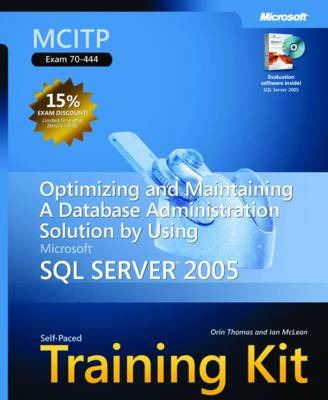
MCITP self-paced training Kit (Exam 70-444) : Optimizing and maintaining a database administration solution microsoft SQL server 2005
Designed to help you make the most of your study time. Maximize your performance on the exam by learning to: * Monitor and troubleshoot queries, databases, and servers * Help defend against injection attacks, denial of service attacks, worms, and viruses * Manage security strategies and perform audits * Detect and resolve data conflicts * Diagnose faults and recover from database failures and disasters * Optimize database availability with failover clustering, database mirroring, log shipping, and replication * Customize a maintenance strategy and automate routine tasks * Build, debug, and deploy SQL Server Integration Services packages PRACTICE TESTS Assess your skills with practice tests on CD. You can work through hundreds of questions using multiple testing modes to meet your specific learning needs. You get detailed explanations for right and wrong answers-including a customized learning path that describes how and where to focus your studies. Your training kit includes: Details inside. * Official self-paced study guide. * Practice tests with multiple, customizable testing options and a learning plan based on your results. *400+ practice and review questions. * Case scenarios, practice exercises, and best practices. *180-day evaluation version of Microsoft SQL Server 2005 Enterprise Edition. * Fully searchable eBook of this guide.

Mathematical Tools for Data Mining : Set Theory, Partial Orders, Combinatorics
Mathematics is presented in a thorough and rigorous manner offering a detailed explanation of each topic, with applications to data mining such as frequent item sets, clustering, decision trees also being discussed. More than 400 exercises are included and they form an integral part of the material. Some of the exercises are in reality supplemental material and their solutions are included. The reader is assumed to have a knowledge of elementary analysis.

Introduction to Machine Learning with Applications in Information Security
Provides a classroom-tested introduction to a wide variety of machine learning and deep learning algorithms and techniques, reinforced via realistic applications. The book is accessible and doesn't prove theorems, or dwell on mathematical theory. The goal is to present topics at an intuitive level, with just enough detail to clarify the underlying concepts. The book covers core classic machine learning topics in depth, including Hidden Markov Models (HMM), Support Vector Machines (SVM), and clustering. Additional machine learning topics include k-Nearest Neighbor (k-NN), boosting, Random Forests, and Linear Discriminant Analysis (LDA). The fundamental deep learning topics of backpropagation, Convolutional Neural Networks (CNN), Multilayer Perceptrons (MLP), and Recurrent Neural Networks (RNN) are covered in depth. A broad range of advanced deep learning architectures are also presented, including Long Short-Term Memory (LSTM), Generative Adversarial Networks (GAN), Extreme Learning Machines (ELM), Residual Networks (ResNet), Deep Belief Networks (DBN), Bidirectional Encoder Representations from Transformers (BERT), and Word2Vec.
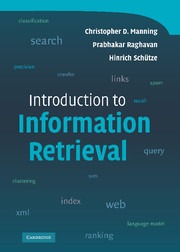
Introduction to information retrieval
Teaches classical and web information retrieval, including web search and the related areas of text classification and text clustering from basic concepts. It gives an up-to-date treatment of all aspects of the design and implementation of systems for gathering, indexing, and searching documents; methods for evaluating systems; and an introduction to the use of machine learning methods on text collections. All the important ideas are explained using examples and figures, making it perfect for introductory courses in information retrieval for advanced undergraduates and graduate students in computer science.

Interactive TV : A shared experience ; 5th European Conference, EuroITV 2007, Amsterdam, the Netherlands, May 24-25, 2007, Proceedings
This book constitutes the refereed proceedings of the 5th European Conference on Interactive Television, EuroITV 2007, held in Amsterdam, The Netherlands, May 2007. The papers are organized in topical sections on social TV systems, user studies, the future of TV, social TV evaluation, personalization, and mobile TV.

Interactive and dynamic graphics for data analysis : With R and Ggobi
This richly illustrated book describes the use of interactive and dynamic graphics as part of multidimensional data analysis. Chapters include clustering, supervised classification, and working with missing values. A variety of plots and interaction methods are used in each analysis, often starting with brushing linked low-dimensional views and working up to manual manipulation of tours of several variables. The role of graphical methods is shown at each step of the analysis, not only in the early exploratory phase, but in the later stages, too, when comparing and evaluating models.

Intelligent Data Mining : Techniques and Applications
Intelligent Data Mining - Techniques and Applications is an organized edited collection of contributed chapters covering basic knowledge for intelligent systems and data mining, applications in economic and management, industrial engineering and other related industrial applications. The main objective of this book is to gather a number of peer-reviewed high quality contributions in the relevant topic areas.
