



Page 1
Page 1

How to photograph the moon and planets with your Digital camera
Using just a regular digital camera along with an amateur astronomical telescope, anyone can produce spectacular photographs of the Moon, as well as surprisingly good images of major planets.Purpose-made astronomical CCD cameras are still very expensive, but technology has now progressed so that digital cameras – the kind you use for everyday photos – are more than capable of being used for astronomy. Tony Buick has written this illustrated step-by-step manual for anyone who has a telescope (of any size) and a digital camera. Look inside at the beautiful color images he has produced – you could do the same.

Electronic Imaging in Astronomy : Detectors and Instrumentation
The second edition of Electronic Imaging in Astronomy: Detectors and Instrumentation describes the remarkable developments that have taken place in astronomical detectors and instrumentation in recent years – from the invention of the charge-coupled device (CCD) in 1970 to the current era of very large telescopes, such as the Keck 10-meter telescopes in Hawaii with their laser guide-star adaptive optics which rival the image quality of the Hubble Space Telescope. Authored by one of the world’s foremost experts on the design and development of electronic imaging systems for astronomy, this book has been written on several levels to appeal to a broad readership. Mathematical expositions are designed to encourage a wider audience, especially among the growing community of amateur astronomers with small telescopes with CCD cameras.

Digital astrophotography : The state of the Art
This book is the successor to David Ratledge’s much-acclaimed The Art and Science of CCD Astronomy.CCD cameras and their associated technologies have continued to make great strides since the original book was first published almost eight years ago, particularly in the universal availability of color cameras and in the dramatically lower cost of equipment.Digital Astrophotography: The State of the Art provides examples of the latest and best images, and describes how to get the best out of this extraordinary technology.
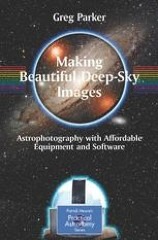
Making Beautiful Deep-Sky Images : Astrophotography with Affordable Equipment and Software
Professor Greg Parker's astronomical photographs are widely known for their excellence, and a selection of them has recently been shown as a public exhibition in the UK. In Making Beautiful Deep-Sky Images, he provides a detailed account of how spectacular deep-sky images can be taken by amateur astronomers using CCD cameras, and how they can subsequently be processed and enhanced in the "electronic darkroom" for maximum beauty and impact. Quite simply, this is a "how to do it" book for people who want to make stunning astronomical pictures.

L'astrofilo moderno = The modern amateur astronomer
In less than two decades, amateur astronomy has changed its face. The reason, of course, is technological progress. Cheap but high-quality telescopes, computer-controlled "go-to" mounts, autoguiders, CCD cameras, video cameras and (as always) computers and the Internet are just some of the elements that revolutionized 21st century astronomy. Not only have they made amateur astronomy more "friendly" and fun, but they have also greatly expanded the potential of the amateur astronomer. Martin Mobberley first tackles the basic issues and then analyzes in depth what tools are available on the market. From here he starts to review the revolutionary possibilities that open up for amateur astronomers, from imaging, to spectroscopy, to photometry, to the surveillance of Near-Earth objects - comets and asteroids that can come dangerously close to the Earth.

CCD Image Sensors in Deep-Ultraviolet : Degradation Behavior and Damage Mechanisms
As the deep-ultraviolet (DUV) laser technology continues to mature, an increasing number of industrial and manufacturing applications are emerging. For example, the new generation of semiconductor inspection systems is being pushed to image at increasingly shorter DUV wavelengths to facilitate inspection of deep sub-micron features in integrated circuits. DUV-sensitive charge-coupled device (CCD) cameras are in demand for these applications. Although CCD cameras that are responsive at DUV wavelengths are now available, their long-term stability is still a major concern. This book describes the degradation mechanisms and long-term performance of CCDs in the DUV, along with new results of device performance at these wavelengths.

A Practical Guide to Lightcurve Photometry and Analysis
A Practical Guide to Lightcurve Photometry and Analysis provides, for those with access to even a modest telescope and CCD camera, all the information needed to take part in the scientific study of asteroids and variable stars.A Practical Guide to Lightcurve Photometry and Analysis contains all the material needed for readers to understand the theory, and avoid the practical pitfalls of lightcurve photometry. Detailed examples are given for obtaining data, and of course for the exciting and rewarding task of analyzing the data to determine the physical properties of the object.
