



Page 9
Page 9

Reasoning Web ; 3rd International Summer School 2007, Dresden, Germany, September 3-7, 2007, Tutorial Lectures
This book contains a collection of thoroughly revised tutorial papers based on lectures given by leading researchers at the Second International Summer School on the Reasoning Web in Dresden, Germany, September 2007.

Real-Time Object Uniform Design Methodology with UML
The competitiveness of organizations facing globalization, information and communication technologies relies on strategic issues such as reuse of knowledge from past experiences to make higher quality decisions, deployment of innovative, fast methodological approaches for solving problems and building systems. Real-life systems are often multidisciplinary; their development commands a uniform way of object modeling in order to close the loop of various interactions crossing multiple domains.

Rapid Prototyping of Digital Systems : SOPC ed.
RAPID PROTOTYPING OF DIGITAL SYSTEMS provides an exciting and challenging environment for rapidly adapting System-on-a-Programmable Chip (SOPC) technology to existing designs or integrating the new design methods into a laboratory component for digital logic, computer and embedded-design curriculums. New to this edition is an introduction to embedded operating systems for SOPC designs. Featuring four accelerated tutorials on the Quartus II and Nios II design environments, this edition progresses from introductory programmable logic to full-scale SOPC design seamlessly integrating hardware implementation, software development, operating system support, state-of-the-art I/O, and IP cores.

Rapid Integration of Software Engineering Techniques ; Vol. 3943 ; Second International Workshop, RISE 2005, Heraklion, Crete, Greece, September 8-9, 2005, Revised Selected Papers
This book constitutes the thoroughly refereed postproceedings of the Second International Workshop on Rapid Integration of Software Engineering Techniques, RISE 2005, held in Heraklion, Crete, Greece in September 2005. The 19 revised full papers presented together with the abstract of a keynote paper went through two rounds of reviewing and improvement and were selected from 43 initial submissions. Among the topics addressed are modelling safety case evolution, practical approaches in model mapping, context-aware service composition, techniques for representing product line core assets for automation, formal development of reactive fault-tolerant systems, stepwise feature introduction in practice, programming languages, aspects and contracts.

Rapid Integration of Software Engineering Techniques ; Vol. 3475 : 1st International Workshop, RISE 2004, Luxembourg-Kirchberg, Luxembourg, November 26, 2004, Revised Selected Papers
This paper reports on the experiences of integrating several Software Engineering techniques by the Rapid Prototyping group of Siemens Corporate Research. This experience was gained during our recent project that involved developing a web-based, workflow-driven information system. The techniques integrated for this project included agile and iterative processes, user centered design, requirements discovery and maturation, and test-driven development. These techniques were integrated and supported by a proprietary process entitled “Siemens Rapid Prototyping” (S-RaP), a software architecture, and project management techniques. This paper will detail the specific characteristics of S-RaP, the software architecture, and the project management techniques that supported the integration of the above listed software engineering techniques. We will also report on our experience with their effectiveness and our thoughts on future enhancements in all three areas

Rapid integration of software engineering techniques ; 3rd International Workshop, RISE 2006, Geneva, Switzerland, September 13-15, 2006. Revised Selected Papers
RISE 2006 constituted an international forum for researchers and practitioners interested in the advancement and rapid application of novel, integrated, or pratical software engineering approaches, being part of a methodological framework, that apply to the development of either new or evolving applications and s- tems.

Radical business model transformation : How leading organizations have successfully adapted to disruption
This book offers practical advice on how to understand the fit of an existing business model and reconstruct it with a forward-thinking approach. New illustrative case studies of global organizations which have boldly transformed offer examples for change, including SAP, Netflix and Daimler. Business transformation is presented as a leadership challenge and methods to realize and implement opportunities for innovation company-wide are discussed in detail.

Quantum Computation and Quantum Communication : Theory and Experiments
The field of quantum computing has experienced rapid development and many different experimental and theoretical groups have emerged worldwide.This book presents the key elements of quantum computation and communication theories and their implementation in an easy-to-read manner for readers coming from physics, mathematics and computer science backgrounds. Integrating both theoretical aspects and experimental verifications of developing quantum computers, the author explains why particular mathematical methods, physical models and realistic implementations might provide critical steps towards achieving the final goal - constructing quantum computers and quantum networks. The book serves as an excellent introduction for new researchers and also provides a useful review for specialists in the field.

Quality of Software Architectures. Models and Architectures ; 4th International Conference on the Quality of Software-Architectures, QoSA 2008, Karlsruhe, Germany, October 14-17, 2008. Proceedings
This book is organized in topical sections on architectural design and architectural decisions, tracing architectural decisions, architecture evaluation, architecture evolution, architecting process and architectural knowledge.

Pseudomonas syringae Pathovars and Related Pathogens : Identification, Epidemiology and Genomics
This book reports on recent advances on: (1) new methods and approaches for specific and sensitive detection and identification of Pseudomonas syringae and Ralstonia solanacearum; (2) ecology and epidemiology bases of Pseudomonas syringae that enable the development of management strategies; (3) pathogenesis and determinant of pathogenicity, and in particular, mechanisms involved in virulence and virulence gene expression; (4) evolution and diversity of the pseudomonads through multilocus sequence typing (MLST) analysis; (5) determination of pathogens associated with new and emerging diseases; (6) effect of global warming on increase and emergence of new bacterial diseases."

Protocolli di studio in TC spirale multistrato : Vol.1 : Addome = Study protocols in multilayer spiral CT
Multilayer spiral CT (TCMS) is a pivotal method in abdominal diagnostics, able to offer an often decisive contribution to the clinical status of the patient. However, an accurate diagnosis cannot be separated from a rigorous examination technique, which is constantly evolving in parallel with the development of the equipment. Through the presentation of cases concerning the main abdominal pathologies, the volume represents for the general radiologist and for the resident a streamlined guide able to support them in the decisions regarding the optimization of study protocols in relation to the clinical question.

Promote management and implementation = إدارة وتنفيذ البرومت
The prompt management and execution project aims to revolutionize the handling and optimization of prompts in various applications. This project involves developing a system that efficiently manages different versions of prompts, executes them seamlessly, and performs automatic prompt optimization. By leveraging advanced algorithms, the system ensures that prompts are not only managed effectively but are also optimized for better performance and user engagement. This study focuses on the creation of a robust framework that facilitates the entire lifecycle of prompt management, from version control to execution. Key features include automated version tracking, real-time execution, and continuous optimization based on user interactions and feedback. The system's ability to dynamically adjust and enhance prompts ensures that users receive the most relevant and effective prompts tailored to their needs.

Projectpilot = نظام تحسين إدارة المشاريع الأكاديمية
The Projectpilot system stands as a transformative solution aimed at revolutionizing project management within the College of Information Technology. In response to prevailing challenges including manual processes, coordination inefficiencies, and communication gaps, this integrated platform offers a comprehensive suite of features designed to streamline project workflows and enhance collaboration. At its core, ProjectPilot facilitates seamless project proposal management, empowering students to submit proposals and administrators to evaluate and respond efficiently. The system's Group Formation capability simplifies team assembly, fostering collaboration among students with shared project interests. Additionally, Supervisor Matching enables students to connect with appropriate faculty mentors, ensuring guidance throughout the project lifecycle. ProjectPilot integrates robust project management tools to facilitate task allocation, progress tracking, and communication among team members. The system's Similarity Checking feature promotes originality by comparing project proposals to previous works. A dedicated Blog Section provides a platform for knowledge sharing and updates.

Progress in WWW Research and Development ; 10th Asia-Pacific Web Conference, APWeb 2008, Shenyang, China, April 26-28, 2008. Proceedings
This book is organized in topical sections on data mining and knowledge discovery, wireless, sensor networks and grid, XML and query processing and optimization, privacy and security, information extraction, presentation and retrieval, P2P, agent systems, ontology, semantic Web and Web applications, data streams, time series analysis and data mining, Web mining and Web search, as well as workflow and middleware.

Programming Multi-Agent Systems ; Vol. 3346 : 2nd International Workshop ProMAS 2004, New York, NY, July 20, 2004, Selected Revised and Invited Papers
Focusses on a principled way to combine the two dominant paradigms for building multiagent team plans, namely the “belief-desire-intention” (BDI) approach and distributed POMDPs. In this hybrid BDI-POMDP approach, BDI team plans are exploited to improve distributed POMDP tractability and distributed POMDP-based analysis improves BDI team plan performance. Concretely, we focus on role allocation, a fundamental problem in BDI teams – which agents to allocate to the different roles in the team. The hybrid BDI-POMDP approach provides three key contributions. First, unlike prior work in multiagent role allocation, we describe a role allocation technique that takes into account future uncertainties in the domain. The second contribution is a novel decomposition technique, which exploits the structure in the BDI team plans to significantly prune the search space of combinatorially many role allocations. Our third key contribution is a significantly faster policy evaluation algorithm suited for our BDI-POMDP hybrid approach. Finally, we also present experimental results from two domains: mission rehearsal simulation and RoboCupRescue disaster rescue simulation. In the RoboCupRescue domain, we show that the role allocation technique presented in this paper is capable of performing at human expert levels by comparing with the allocations chosen by humans in the actual RoboCupRescue simulation environment.
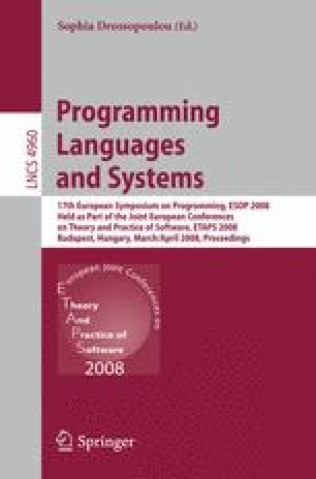
Programming Languages and Systems ; 17th European Symposium on Programming, ESOP 2008, Held as Part of the Joint European Conferences on Theory and Practice of Software, ETAPS 2008, Budapest, Hungary, March 29-April 6, 2008. Proceedings
This book presented together with the abstract of one invited talk and two tool presentations were carefully reviewed and selected from 104 submissions and address fundamental issues in the specification, analysis, and implementation of programming languages and sytems. The papers are organized in topical sections on static analysis, security, concurrency and program verification.

Programming Languages : An Active Learning Approach
This interactive textbook is intended to be used in and outside of class. Each chapter follows a pattern of presenting a topic followed by a practice exercise or exercises that encourage students to try what they have just read. This textbook is best-suited for students with a 2-3 course introduction to imperative programming.

Pro WPF in C# 2008 : Windows Presentation Foundation with .NET 3.5
The Microsoft Windows Presentation Foundation provides the foundation for building applications and high–quality user experiences in Windows Vista. WPF blends application user interface, documents, and media content to provide richer control, design, and development of the visual aspects of Windows programs. Author Matthew MacDonald shows you how WPF really works. His no–nonsense, practical advice will get you building high–quality WPF applications quickly and easily. MacDonald will take you through a thorough investigation of the more advanced aspects of WPF, and its relation to other elements of the WinFX stack and the .NET Framework 3.5, to complete your understanding of WPF and C# 2008.

Pro Web 2.0 Mashups : Remixing Data and Web Services
Teaches you how to forge those latent connections—to make the Web your own—by remixing information to create your own mashups. A mashup, in the words of the Wikipedia, is a web site or web application “that seamlessly combines content from more than one source 1 into an integrated experience. ” Learning how to draw content from the Web together into new integrated interfaces and applications, whether for yourself or for other others, is the central concern of this book.

Pro Visual C++/CLI and the .NET 2.0 Platform
This book explains how to write .NET 2.0 applications and services. It provides you with a clean slate, erasing the need for developing the COM, DCOM, COM+, or ActiveX components that used to be a necessity. Instead, you'll learn how to write .NET applications using C++/CLI. This book is based on its highly successful predecessor, and bridges the gap between classic C++ and C++/CLI. Furthermore, this edition is based on the newest version of Visual Studio .NET (2005) and .NET 2.0. All topic areas include specific code examples. By the end of the book, you will be proficient in developing .NET applications and services for both the Windows desktop and the Web.
