



Page 84
Page 84

Genetics and Genomics of Soybean
The book covers recent progress on genome research in soybeans, including the genetic map with classical, RFLP, SSR and SNP markers; genomic and cDNA libraries, functional genomics platforms (e.g., cDNA, Affymetrix and oligonucleotide based DNA microarrays); physical maps, and the efforts to fully sequence the genome. Given the pending release of the soybean genome sequence, through the efforts of the Department of Energy’s Joint Genome Institute, this book will stand as a critical source of information on soybean.

Genetic Systems Programming : Theory and Experiences
This book is devoted to reporting innovative and significant progress about the contribution of genetic programming in systems programming. The contributions of this book clearly demonstrate that genetic programming is very effective in solving hard and yet-open problems in systems programming. Followed by an introductory chapter, in the remaining contributed chapters, the reader can easily learn about systems where genetic programming can be applied successfully. These include but are not limited to, information security systems, compilers, data mining systems, stock market prediction systems, robots and automatic programming.

Genetic Programming Theory and Practice V
Genetic Programming Theory and Practice V was developed from the fifth workshop at the University of Michigan’s Center for the Study of Complex Systems to facilitate the exchange of ideas and information related to the rapidly advancing field of Genetic Programming (GP). Contributions from the foremost international researchers and practitioners in the GP arena examine the similarities and differences between theoretical and empirical results on real-world problems. The text explores the synergy between theory and practice, producing a comprehensive view of the state of the art in GP application.

Genetic Programming Theory and Practice IV
Genetic Programming Theory and Practice IV was developed from the fourth workshop at the University of Michigan’s Center for the Study of Complex Systems to facilitate the exchange of ideas and information related to the rapidly advancing field of Genetic Programming (GP). Contributions from the foremost international researchers and practitioners in the GP arena examine the similarities and differences between theoretical and empirical results on real-world problems.

Genetic Programming Theory and Practice III
Genetic Programming Theory and Practice III explores the emerging interaction between theory and practice in the cutting-edge, machine learning method of Genetic Programming (GP). This contributed volume was developed from the third workshop at the University of Michigan’s Center for the Study of Complex Systems to facilitate the exchange of ideas and information related to this rapidly advancing field. The text provides a cohesive view of the issues facing both practitioners and theoreticians and examines the synergy between GP theory and application.
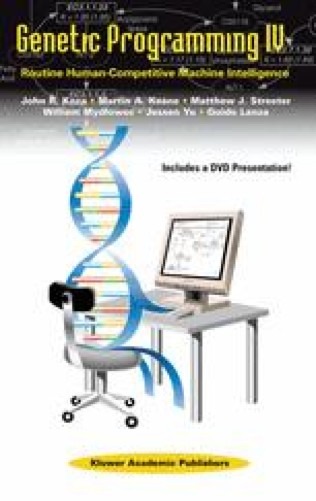
Genetic programming IV : Routine human-competitive machine intelligence
Genetic Programming IV: Routine Human-Competitive Machine Intelligence presents the application of GP to a wide variety of problems involving automated synthesis of controllers, circuits, antennas, genetic networks, and metabolic pathways. The book describes fifteen instances where GP has created an entity that either infringes or duplicates the functionality of a previously patented 20th-century invention, six instances where it has done the same with respect to post-2000 patented inventions, two instances where GP has created a patentable new invention, and thirteen other human-competitive results. The book additionally establishes: GP now delivers routine human-competitive machine intelligence GP is an automated invention machine GP can create general solutions to problems in the form of parameterized topologies GP has delivered qualitatively more substantial results in synchrony with the relentless iteration of Moore's Law
Genetic Programming ; 11th European Conference, EuroGP 2008, Naples, Italy, March 26-28, 2008. Proceedings
The 11th European Conference on Genetic Programming, EuroGP 2008, took place in Naples, Italy from 26 to 28 March in the University of Naples Congress Centre with spectacular views over the Gulf of Naples. This volume contains the papers for the 21 oral presentations and 10 posters that were presented during this time. A diverse array of topics were covered refecting the current state of research in the ?eld of Genetic Programming, including the latest work on representations, theory, operators and analysis, evolvable hardware, agents and numerous applications. A rigorous, double-blind peer review process was employed, with each s- mission reviewed by at least three members of the international Program C- mittee.

Genetic programming : Theory and practice II
This volume explores the emerging interaction between theory and practice in the cutting-edge, machine learning method of Genetic Programming (GP). The contributions developed from a second workshop at the University of Michigan's Center for the Study of Complex Systems where leading international genetic programming theorists from major universities and active practitioners from leading industries and businesses met to examine how GP theory informs practice and how GP practice impacts GP theory. Chapters include such topics as financial trading rules, industrial statistical model building, population sizing, the roles of structure in problem solving by computer, stock picking, automated design of industrial-strength analog circuits, topological synthesis of robust systems, algorithmic chemistry, supply chain reordering policies, post docking filtering, an evolved antenna for a NASA mission and incident detection on highways.

Genetic Engineering of Mesenchymal Stem Cells
MSC (mesenchymal stem cells) have been reported to initiate revascularization after injury, to facilitate engraftment of blood-forming stem cells, and to reduce the incidence of graft-vs. host disease through their immune-suppressive qualities. Finally, bone marrow-derived MSC have been reported to home to areas of solid tumor revascularization, and thus may be used as delivery vehicles to target ablative agents into dividing tumor cells. Recently the characteristics of human MSC from adipose (fat) tissue have also been identified. The possibility of repairing tissues, speeding stem cell engraftment, and targeting solid tumors for specific killing, using MSC easily harvested from bone marrow, or better yet, from unwanted fat tissue, holds broad appeal, and is an intriguing possibility that could have dramatic effect on health care. This book has information on how to isolate, grow, and characterize MSC from marrow and fat, and gives important insight into how these cells may be used for gene delivery and cellular therapies in the future. Updates on emerging clinical trials are given.

Genetic Democracy : Philosophical Perspectives
GENETIC DEMOCRACY involves an in-depth analysis of the ethical, social and philosophical issues related to modern genetic research and gene technology. The aim of the book is to introduce systematic research on the social and ethical impacts of the use and development of genetically modified organisms (GMOs) as well as the acquisition, use and storage of human genetic information (HGI). The book contributes into enhancing public discussion and reaching fair and democratic decision-making practices in GMO and HGI use and development both on local and global level.

Genetic basis of oral health conditions
This book explains the genetic basis of a wide range of dental disorders, including dental caries, periodontitis, congenital anomalies, malocclusions, orofacial pain, dental implant failure, and cancer. The information provided in this book will assist in the delivery of effective personalized dental care through optimization of preventive strategies.

Generator remote controlling using internet connection
The traditional technique of monitoring the electricity generated through regular checks on the alternator variables: oil, temperature, voltage and current on a daily basis. Therefore, maintaining a normal performance cycle requires hard work and is often imprecise. The idea is to create an application that monitors wireless generators using the popular smartphone Android operating system. Implemented sensors deliver analog signals that provide real-time data on the status of the generator. This data is converted and programmed through the Node MCU microcontroller, which reads the results from the sensors and then converts into a signal, which is transmitted to the android phone, through a router. Thus live feedback of the generator status is ensured. In addition, this project provides a control button that can actually turn this generator on and off. This project is the first step towards bringing systems and control together as it revolutionizes the ideology of monitoring and displaying real-time data that can be implemented in different fields according to different needs. These fields include electricity, mechanics, and communications.

Generative and transformational techniques in software engineering II : International Summer School, GTTSE 2007, Braga, Portugal, July 2-7, 2007. Revised Papers
This tutorial book presents an augmented selection of the material presented at the International Summer School on Generative and Transformational Techniques in Software Engineering, GTTSE 2007, held in Braga, Portugal, in July 2007.The 7 tutorial lectures presented together with 5 short tutorials and 4 contributions to the participants workshop were carefully selected during multiple rounds of reviewing and improvement. The tutorials given by renowned representatives of complementary approaches and problem domains combine foundations, methods, examples, and tool support.

Generative and transformational techniques in software engineering ; International Summer School, GTTSE 2005, Braga, Portugal, July 4-8, 2005. Revised Papers
This tutorial book presents an augmented selection of material presented at the International Summer School on Generative and Transformational Techniques in Software Engineering, GTTSE 2005. The book comprises 7 tutorial lectures presented together with 8 technology presentations and 6 contributions to the participants workshop.

Generalized Curvatures
The central object of this book is the measure of geometric quantities describing N a subset of the Euclidean space (E ,), endowed with its standard scalar product. Let us state precisely what we mean by a geometric quantity. Consider a subset N S of points of the N-dimensional Euclidean space E , endowed with its standard N scalar product. LetG be the group of rigid motions of E . We say that a 0 quantity Q(S) associated toS is geometric with respect toG if the corresponding 0 quantity Q[g(S)] associated to g(S) equals Q(S), for all g?G . For instance, the 0 diameter ofS and the area of the convex hull ofS are quantities geometric with respect toG . But the distance from the origin O to the closest point ofS is not, 0 since it is not invariant under translations ofS. It is important to point out that the property of being geometric depends on the chosen group. For instance, ifG is the 1 N group of projective transformations of E , then the property ofS being a circle is geometric forG but not forG , while the property of being a conic or a straight 0 1 line is geometric for bothG andG . This point of view may be generalized to any 0 1 subsetS of any vector space E endowed with a groupG acting on it.

General ultrasound in the critically ill
General ultrasound in the critically ill describes a bedside tool destined for use by the intensivist and any physician involved in emergencies. It specifically deals with findings of immediate clinical relevance throughout the body. New emergency applications of ultrasound in the abdomen, the vessels, the head and the heart are considered. The major topic, the lung, is extensively discussed. Interventional ultrasound forms part of nearly every chapter. Flow charts simplify daily concerns: acute dyspnea, shock, unexplained fever, etc. The strong points and pitfalls of ultrasound are reviewed. Technical notes are mingled with general considerations. Benefiting from the extensive experience of an intensivist intimately familiar with ultrasound, this book accurately answers most daily problems arising in the critically ill. it offers not only an exhaustive atlas but also a permanent aid to the therapeutic decision. All in all, General ultrasound in the critically ill provides a key for practicing a kind of visual medicine. Since 1990 Daniel Lichtenstein has been an intensivist in a medical ICU which already occupied a pioneering place in echocardiography. He has from the beginning devoted his efforts to the development of general ultrasound. He regularly publishes studies on lung ultrasound, his main topic, in the international literature.

General Theory of Information Transfer and Combinatorics
This book constitutes the thoroughly refereed research papers contributed to a research project on the `General Theory of Information Transfer and Combinatorics' that was hosted from 2001-2004 at the Center for Interdisciplinary Research (ZIF) of Bielefeld University and also papers of several incorporated meetings thereof. The 63 revised full papers presented were carefully reviewed and selected for inclusion in the book. The papers are organized in topical sections on probabilistic models, cryptology, pseudo random sequences, quantum models, statistics, probability theory, information measures, error concepts, performance criteria, search, sorting, ordering, planning, language evolution, pattern discovery, reconstructions, network coding, combinatorial models, and a problem section.

General Relativity
This book offers an alternative to other textbooks on the subject, providing a more specific discussion of numerous general relativistic effects for readers who have knowledge of classical mechanics and electrodynamics, including special relativity. Coverage includes gravitational lensing, signal retardation in the gravitational field of the Sun, the Reissner-Nordström solution, selected spin effects, the resonance transformation of an electromagnetic wave into a gravitational one, and the entropy and temperature of black holes. The book includes numerous problems at various levels of difficulty, making it ideal also for independent study by a broad readership of advanced students and researchers.

General Principles of Tumor Immunotherapy : Basic and Clinical Applications of Tumor Immunology
Brings together the world’s leading authorities on tumor immunology. This book describes the basic immunology principles that form the foundation of understanding how the immune system recognizes and rejects tumor cells. The role of the innate and adaptive immune responses is discussed and the implications of these responses for the design of clinical strategies to combat cancer are illustrated through both experimental clinical trials and review of current standard of care therapeutic agents. This information will be invaluable to both students of immunology and cancer research and practicing physicians who have patients with cancer. The book provides a comprehensive overview of the field, demonstrates how advances in basic immunology can and are being applied to cancer, and describes the current status of approved immunotherapy regimens.

General Concepts in Integrated Pest and Disease Management
The first volume of the Integrated Management of Plant Pests and Diseases book series presents general concepts on integrated pest and disease management, organized in three sections. Section one (modeling, management, environment) includes chapters on infection models, resurgence and replacement. The second section (emerging technologies) includes remote sensing and information technology. In the third section (molecular aspects) the management of insect-borne viruses with transmission interference.
