



Page 83
Page 83

Geometric Algebra for Computer Graphics
The first five chapters review the algebras of real numbers, complex numbers, vectors, and quaternions and their associated axioms, together with the geometric conventions employed in analytical geometry. As well as putting geometric algebra into its historical context, John Vince provides chapters on Grassmann’s outer product and Clifford’s geometric product, followed by the application of geometric algebra to reflections, rotations, lines, planes and their intersection. The conformal model is also covered, where a 5D Minkowski space provides an unusual platform for unifying the transforms associated with 3D Euclidean space.

Geomatics Solutions for Disaster Management
Natural and anthropogenic disasters have caused a large number of victims and significant social and economic losses in the last few years. There is no doubt that the risk prevention and disaster management sector needs drastic measures and improvements in order to decrease damage and save lives of inhabitants. Effective utilization of satellite positioning, remote sensing, and GIS in disaster monitoring and management requires research and development in numerous areas: data collection, access and delivery, information extraction and analysis, management and their integration with other data sources (airborne and terrestrial imagery, GIS data, etc.), data standardization, organizational and legal aspects of sharing of remote sensing information. This book provides researchers and practitioners with a good overview of what is being developed in this topical area.

Geological Storage of Highly Radioactive Waste : Current Concepts and Plans for Radioactive Waste Disposal
The book describes and assesses current concepts for long-term disposal of highly radioactive waste. Different types of rock are discussed and assessed with respect to practical difficulties in construction of a repository, and the efficiency in isolating radioactive waste. Safety matters are most important and are treated in the respective chapters and in a final, conclusive chapter. Cost issues and related quality matters are discussed for the case of constructing a virgin repository and repositories in the form of converted abandoned mines.

Geological atlas of Africa : With notes on stratigraphy, tectonics, economic geology, geohazards, geosites and geoscientific education of each country
Here is the new edition of the first attempt to summarize the geology of Africa by presenting it in an atlas and to synthesize the stratigraphy, tectonics, economic geology, geohazards and geosites of each country and territory of the continent. Furthermore, the digitized geological maps are correlated and harmonized according to the current stratigraphic timetable. The atlas aims to contribute to capacity building in African Earth Sciences and to aid the initiation of research and enable the achievement of economic opportunities by providing a database of basic geological background information.
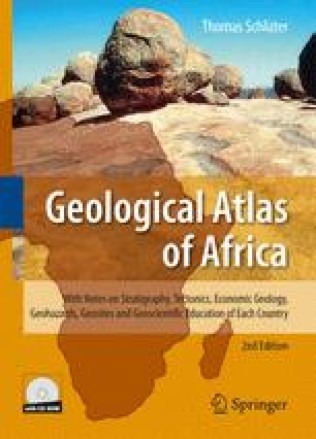
Geological atlas of Africa : With notes on stratigraphy, tectonics, economic geology, geohazards, geosites and geoscientific education of each country
T is atlas is intended primarily for anybody who is in-some background for the arrangement of how the terested in basic geology of Africa. Its originality lies atlas was done. T e second chapter is devoted to the in the fact that the regional geology of each African history of geological mapping in Africa, necessary nation or territory is reviewed country-wise by maps for a fuller appreciation of why this work in Africa is and text, a view normally not presented in textbooks worth doing. Chapter 3 provides an executive s- of regional geology. It is my belief, that there has long mary on the stratigraphy and tectonics of Africa as a been a need in universities and geological surveys, whole, i. e. in the context of no political boundaries.
Geo-information for Disaster Management
Geo-information technology offers an opportunity to support disaster management: industrial accidents, road collisions, complex emergencies, earthquakes, fires, floods and similar catastrophes (for example the recent huge disaster with the Tsunami in South-East Asia on 26 December 2004). Access to needed information, facilitation of the interoperability of emergency services, and provision of high-quality care to the public are a number of the key requirements. The book provides a broad overview of the (geo-information) technology, software, systems needed, used and to be developed for disaster management. The book provokes a wide discussion on systems and requirements for use of geo-information under time and stress constraints and unfamiliar situations, environments and circumstances.

Geographic Uncertainty in Environmental Security
Proceedings of the NATO Advanced Research Workshop on Fuzziness and Uncertainty in GIS for Environmental Security and Protection.was held in Kyiv, Ukraine, June 28-July 1, 2006 The papers based upon the presentations at this meeting are included in this book. They were all quite good, some focusing on the use of fuzzy sets in geography, others focusing on explicit environmental concerns in Ukraine.

Geographic Information Science ; 5th International Conference, GIScience 2008, Park City, UT, USA, September 23-26, 2008. Proceedings
This book constitutes the refereed proceedings of the 5th International Conference on Geographic Information Secience, GIScience 2008, held in Park City, UT, USA, in September 2008.The 24 revised full papers presented were carefully reviewed and selected from 77 submissions. Among the traditional topics addressed are spatial relations, geographic dynamics, and spatial data types. A significant number of papers deal with navigation networks, location-based services, and spatial information query and retrieval. Geo-sensors, mobile computing, and Web mapping rank among the important new directions.
Geographic Information Science ; 4th International Conference, GIScience 2006, Münster, Germany, September 20-23, 2006, Proceedings
The GIScience conference series (www. giscience. org) was created as a forum for all researchers who are interested in advancing research in the fundam- tal aspects of geographic information science.The conferences focus on emerging topics and basic research ?ndings across all s- tors of geographic information science. After three highly successful conferences in the United States, this year’s GIScience conference was held in Europe for the ?rst time. The GIScience conferences have been a meeting point for researchers coming from various disciplines, including cognitive science, computer science, engine- ing, geography,information science, mathematics, philosophy, psychology,social science, and statistics. The advancement of geographic information science - quiressuchinterdisciplinarybreadth,andthisisalsowhatmakestheconferences so exciting. In order to account for the di?erent needs of the involved scienti?c disciplines with regard to publishing their research results.

Geographic information metadata for spatial data infrastructures : Resources, interoperability and information retrieval
Metadata play a fundamental role in both DLs and SDIs. Commonly defined as "structured data about data" or "data which describe attributes of a resource" or, more simply, "information about data", it is an essential requirement for locating and evaluating available data. Therefore, this book focuses on the study of different metadata aspects, which contribute to a more efficient use of DLs and SDIs. The three main issues addressed are: the management of nested collections of resources, the interoperability between metadata schemas, and the integration of information retrieval techniques to the discovery services of geographic data catalogs (contributing in this way to avoid metadata content heterogeneity).

Geographic Hypermedia : Concepts and Systems
This book introduces a new paradigm, Geographic Hypermedia, which emerges from the convergence of Geographic Information Science and - permedia technology. Both GI Science and hypermedia have been rapidly evolving fields. The initial idea of Geographic Hypermedia was born in 2004 when the editors had been invited to organize a workshop in conju- tion with the ‘Hypertext’ conference organized annually by the Special - terest Group of the Association for Computing Machinery. The purpose of the workshop was to examine how hypermedia concepts and tools may be applied in geographical domains. The workshop was eventually held in conjunction with the Maps and the Internet Commission of the International Cartographic Association at the annual meeting of the Association of American Geographers in Denver, Colorado, in April 2005. The Denver workshop was a successful event, bringing together mul- disciplinary researchers and professionals in the area of Geographic - permedia.

Geodynamics of the Lithosphere : An Introduction
This second edition of the important introductory text for earth scientists has been thoroughly revised and extended. It contains chapters on heat flow, sedimentary basin modeling, the mechanics of continental deformation, PT path modeling, geomorphology, mass transfer and more.

Geodetic Deformation Monitoring : From Geophysical to Engineering Roles ; IAG Symposium Jaén, Spain, March 7-19,2005
Geodesy is the science dealing with the determination of the position of points in space, the shape and gravity field of the Earth and with their time variations. A consequence is that geodesists feel as a permanent subject of research, the detection, analysis and interpretation of spatial deformation as well as gravity field variation. This book collects 36 selected papers from the International Symposium on Geodetic Deformation Monitoring held in Jaén (Spain) from 17th to 19th March 2005. The main topics covered in the symposium were: mathematical and statistical models for crustal deformation analysis, deformation monitoring from GPS and InSAR data: analysis and geophysical interpretation, geodetic monitoring of movements in civil engineering, integration of spatial and terrestrial techniques in deformation studies, geodynamical applications of gravimetric observations and present-day geodetic instrumentation for deformation monitoring. This volume is a good overview of theoretical matters, models and results.

Geodetic and geophysical observations in Antarctica : An overview in the IPY perspective
This book is a collection of papers on various aspects of the scientific investigation and observation techniques of the polar regions at both temporary and permanent observatories. Most papers focus on regional models based on data acquired in polar regions. Geodetic satellite positions systems (GNSS: GPS, GLONASS, GALILEO) will also be discussed as well as other space techniques (DORIS, VLBI). Gravimetry, absolute gravimetry, and tidal gravimetry are also discussed, as well as seismology and meteorology.

Genomics-assisted crop improvement ; Vol.1 : Genomics approaches and platforms
Genomics research has great potential to revolutionize the discipline of plant breeding. This two-volume set provides a critical assessment of genomics tools and approaches for crop breeding. Volume 1, entitled "Genomics Approaches and Platforms", illustrates state-of-the-art genomics approaches and platforms presently available for crop improvement.

Genomics of Tropical Crop Plants
Genomics of Tropical Crop Plants summarizes recent progress on genomic research, including the development of molecular markers, genomic and cDNA libraries, expressed sequence tags (ESTs), genetic and physical maps, gene expression profiles, and whole genome sequences for 20 tropical crop plants. It offers background information about the evolutionary origin and environments of tropical crop species, international programs that are addressing the needs of tropical agriculture, and the potential for new technologies to increase the productivity and value of tropical crops. This book provides new dimensions to growing information concerning temperate crops and their morphology, physiology, and parallel evolution in diverse plant lineages.

Genomics of Disease
Genomics of Disease is the 24th volume in the Stadler Genetics Symposium series published by Springer, which has, over many years, served as a comprehensive collection of current trends and hot topics in the field of genetics. The current volume summarizes recent progress in our attempts to characterize the genomics of plant and animal diseases. Authoritative analytical reviews are specialized to be attractive to professional researchers, teachers, and students, while also being appealing to a wider audience of scientists in related disciplines. Genomics of Disease offers essential reference material for any scientist or teacher working in the fields of plant and animal diseases. Coverage of key areas of both animal and plant disease is a unique feature of this volume and one that allows direct comparisons between the systems. All academics, scientists, and industry professionals that desire to take advantage of the most up-to-date information on the continuously emerging and expanding field of the genomics of plant and animal diseases will find it an invaluable resource.

Genome Exploitation : Data Mining the Genome
Data Mining the Genomes, is the 23rd volume of the Stadler Symposia series published by Springer, which have served over many years as a comprehensive collection of current trends and emerging hot topics in the field of genetics. Data Mining the Genomes summarizes the progress in bioinformatics and computational biology in data mining the vast amount of exciting information emerging from studies of plant and animal genomes, with authoritative analytical reviews specialized enough to be attractive to professional researchers, yet also appealing to the wider audience of scientists in related disciplines.

Genetics of Adaptation
What is the genetic basis of adaptive evolution? In this volume, a new generation of biologists have taken up this challenge. Using advances in both molecular genetic and statistical techniques, evolutionary geneticists have made considerable progress in this emerging field. In this volume, a diversity of examples from plant and animal studies provides valuable information for those interested in the genetics and evolution of complex traits.

Genetics and regulation of nitrogen fixation in free-Living bacteria
This book is the second volume of a seven-volume series, which covers all fields of research related to nitrogen fixation - from basic studies through applied aspects to environmental impacts. Volume II provides a comprehensive and detailed source of information concerning the genetics and regulation of biological nitrogen fixation in free-living prokaryotes.
