



Page 8
Page 8

Mechanics : From Newton's Laws to Deterministic Chaos
This updated and revised fourth edition covers all topics in mechanics from elementary Newtonian mechanics, canonical and rigid body mechanics to relativistic mechanics and nonlinear dynamics. In particular, symmetries and invariance principles, geometrical structures and continuum mechanics play an important role. This book will enable the reader to develop general principles from which equations of motions may be derived, to understand the importance of symmetries as a basis for quantum mechanics and to get practice in using theoretical tools and concepts that are essential for all branches of physics. The book contains numerous problems with complete solutions, and some practical examples.This will be appreciated in particular by students using the text to accompnay lectures on mechanics. The book ends with some historical remarks on important pioneers in mechanics.

Mechanical Sytems, Classical Models ; Vol. I : Particle Mechanics
The guideline of the present book is precisely the mathematical model of mechanics. A special accent is put on the solving methodology as well as on the mathematical tools used; vectors, tensors and notions of field theory. Continuous and discontinuous phenomena, various mechanical magnitudes are presented in a unitary form by means of the theory of distributions.

Measuring Professional Competence for the Teaching of Mathematical Modelling : A Test Instrument
This book presents a structural model and an associated test instrument designed to provide a detailed analysis of professional competences for teaching mathematical modelling. The conceptualisation is based on the COACTIV model, which describes aspects, areas and facets of professional competences of teachers. The manual provides an overview of the essential teaching skills in application-related contexts and offers the tools needed to capture these aspects. It discusses the objectives and application areas of the instrument, as well as the development of the test. In addition, it describes the implementation and evaluates the quality and results of the structural equation analysis of the model.

Measurement Uncertainty : An Approach via the Mathematical Theory of Evidence
This text is the first to make full use of the mathematical theory of evidence to express the uncertainty in measurements. It gives an overview of the current standard, then pinpoints and constructively resolves its limitations through its unique approach. The text presents various tools for evaluating uncertainty, beginning with the probabilistic approach and concluding with the expression of uncertainty using random-fuzzy variables. The exposition is driven by numerous examples. The book is designed for immediate use and application in research and laboratory work.
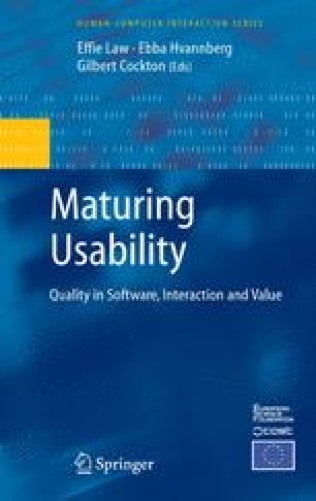
Maturing Usability : Quality in Software, Interaction and Value
Divided into three parts, ‘Quality in Software’ looks at how using development tools can enhance usability of a system, and how methods and models can be integrated into the development process to produce effective user interfaces. ‘Quality in Interaction’ addresses theoretical frameworks on the nature of interactions; techniques and metrics for evaluation interaction quality; and the transfer of concepts and methods from research to practice. Finally, ‘Quality in Value’ assesses the impact that a system has in the real world, focusing on increasing the value of usability practice for software development and on increasing value for the users.

Mathematics of Surfaces XII ; 12th IMA International Conference, Sheffield, UK, September 4-6, 2007, Proceedings
This book constitutes the refereed proceedings of the 12th IMA International Conference on the Mathematics of Surfaces, held in Sheffield, UK in September 2007. The papers cover a range of ideas from underlying theoretical tools to industrial uses of surfaces.

Mathematics of Large Eddy Simulation of Turbulent Flows
Large eddy simulation (LES) is a method of scientific computation seeking to predict the dynamics of organized structures in turbulent flows by approximating local, spatial averages of the flow. This book focuses on the mathematical foundations of LES and its models and provides a connection between the powerful tools of applied mathematics, partial differential equations and LES. Thus, it is concerned with fundamental aspects not treated so deeply in the other books in the field, aspects such as well-posedness of the models, their energy balance and the connection to the Leray theory of weak solutions of the Navier-Stokes equations.

Mathematics of Financial Markets
This book presents the mathematics that underpins pricing models for derivative securities, such as options, futures and swaps, in modern financial markets. The idealized continuous-time models built upon the famous Black-Scholes theory require sophisticated mathematical tools drawn from modern stochastic calculus. However, many of the underlying ideas can be explained more simply within a discrete-time framework. This is developed extensively in this substantially revised second edition to motivate the technically more demanding continuous-time theory, which includes a detailed analysis of the Black-Scholes model and its generalizations, American put options, term structure models and consumption-investment problems. The mathematics of martingales and stochastic calculus is developed where it is needed.

Mathematics and Technology
Mathematics and Technology presents technological applications of mathematics making use of elegant mathematical concepts. The selected subjects consist of: public key cryptography, error correcting codes, the global positioning system (GPS) and cartography, image compression using fractals and the JPEG format, digital recording, robot movement, DNA computing, Google's PageRank algorithm, savings and loans, gamma ray surgery and random number generators. The authors highlight how mathematical modeling, together with the power of mathematical tools, have been crucial for innovation in technology. The exposition is clear, straightforward, motivated by excellent examples, and user-friendly. Numerous exercises at the end of every chapter reinforce the material. An engaging quality is the various historical notes accompanying the mathematical development.

Mathematical Tools for Data Mining : Set Theory, Partial Orders, Combinatorics
Mathematics is presented in a thorough and rigorous manner offering a detailed explanation of each topic, with applications to data mining such as frequent item sets, clustering, decision trees also being discussed. More than 400 exercises are included and they form an integral part of the material. Some of the exercises are in reality supplemental material and their solutions are included. The reader is assumed to have a knowledge of elementary analysis.

Mathematical Software - ICMS 2006 ; 2nd International Congress on Mathematical Software, Castro Urdiales, Spain, September 1-3, 2006, Proceedings
This volume contains the outstanding collection of invited papers and refereed papers selected for the Second International Congress on Mathematical Software, ICMS 2006, held in Castro Urdiales, Spain, September 1-3, 2006. This congress was devoted to all aspects of mathematical software, whose appearance is — in our opinion — one of the most important events in mathematics. Mathematical software systems are used to construct examples, to prove theorems, and to find new mathematical phenomena. Conversely, mathematical research often motivates developments of new algorithms and new systems. Beyond mathematics, mathematical software systems are becoming indispensable tools in many branches of science and technology.

Mathematical Problems in Image Processing : Partial Differential Equations and the Calculus of Variations
The goals of this book are to present a variety of image analysis applications, the precise mathematics involved and how to discretize them. Thus, this book is intended for two audiences. The first is the mathematical community by showing the contribution of mathematics to this domain. It is also the occasion to highlight some unsolved theoretical questions. The second is the computer vision community by presenting a clear, self-contained and global overview of the mathematics involved in image processing problems. This work will serve as a useful source of reference and inspiration for fellow researchers in Applied Mathematics and Computer Vision, as well as being a basis for advanced courses within these fields.

IoT and AI Technologies for Sustainable Living : A Practical Handbook
Brings together all the latest methodologies, tools and techniques related to the Internet of Things and Artificial Intelligence in a single volume to build insight into their use in sustainable living. The areas of application include agriculture, smart farming, healthcare, bioinformatics, self-diagnosis systems, body sensor networks, multimedia mining, and multimedia in forensics and security. Provides a comprehensive discussion of modeling and implementation in water resource optimization, recognizing pest patterns, traffic scheduling, web mining, cyber security and cyber forensics. It will help develop an understanding of the need for AI and IoT to have a sustainable era of human living. The tools covered include genetic algorithms, cloud computing, water resource management, web mining, machine learning, block chaining, learning algorithms, sentimental analysis and Natural Language Processing (NLP).

Ionospheric multi-spacecraft analysis tools : Approaches for deriving ionospheric parameters
This book provides a comprehensive toolbox of analysis techniques for ionospheric multi-satellite missions. The immediate need for this volume was motivated by the ongoing ESA Swarm satellite mission, but the tools that are described are general and can be used for any future ionospheric multi-satellite mission with comparable instrumentation.

Investment Banking : Valuation, LBOs, M&A, and IPOs
This book fulfills an important need as a valuable training material and reliable handbook for finance professionals in these markets. This book also provides essential tools for professionals at corporations, including members of business development, M&A, finance, and treasury departments. These specialists are responsible for corporate finance, valuation, and transaction-related deliverables on a daily basis. They also work with investment bankers on various M&A transactions (including leveraged buyouts (LBOs) and related financings), as well as IPOs, restructurings, and other capital markets transactions.

Investment Appraisal : Methods and Models
Investment decisions are of vital importance to all companies. Getting these decisions right is crucial but, due to a complex and dynamic business environment, this remains a challenging management task. Effective appraisal methods are valuable tools in supporting investment decision-making. As organisations continue to seek a competitive edge, it is increasingly important that management accountants and strategic decision-makers have a sound knowledge of these tools. This book presents a range of investment appraisal methods and models, some of which are not widely known, or at least not well covered in other books. Each approach is thoroughly described, evaluated and illustrated using examples, with its assumptions and limitations analysed in terms of their implications for investment decision-making practice.

Investigating Spoken English : A Practical Guide to Phonetics and Phonology Using Praat
Combining coverage of the key concepts and tools within phonetics and phonology with a systematic introduction to Praat, this textbook provides a lively and engaging 'way in' to the discipline. The author first covers the fundamentals of the articulatory and acoustic aspects of speech and introduces Praat as the main tool for examining and visualising speech. Next, the unit of analysis is gradually expanded (from syllables to words to turns and dialogues) and excerpts of real dialogues exemplify the core concepts for discovering how speech works.

Introduzione alla medicina molecolare = Introduction to molecular medicine
An indispensable guide for understanding a young science with rapid and promising developments. Now in its third completely revised edition, it presents in a concise yet comprehensive way the scientific and technological principles of this discipline and provides, in widely accessible language, the basic conceptual tools for understanding the human genome, gene expression and regulation, the various aspects of genetic engineering that allow for the manipulation of DNA, and human cloning.

Introduction to wine laboratory practices and procedures
winemaking was a romanticized notion of putting grape juice into a barrel and allowing time to perform its magic as you sat on the veranda watching the sunset on a Tuscan landscape. For some small wineries, this notion might still ring true, but for the majority of wineries commercially producing quality wines, the reality of winemaking is far more complex. The persistent evolution of the wine industry demands continual advan- ments in technology and education to sustain and promote quality winem- ing. The sciences of viticulture, enology, and wine chemistry are becoming more intricate and sophisticated each year. Wine laboratories have become an integral part of the winemaking process, necessitating a knowledgeable staff possessing a multitude of skills. Science incorporates the tools that new-age winemakers are utilizing to produce some of the best wines ever made in this multibillion dollar trade. A novice to enology and wine chemistry can find these subjects daunting and intimidating. Whether you are a home winemaker, a new winemaker, an enology student, or a beginning-to-intermediate laboratory technician, p- ting all the pieces together can take time.

Introduction to Variance Estimation
The book provides instruction on the methods that are vital to data-driven decision making in business, government, and academe. It will appeal to survey statisticians and other scientists engaged in the planning and conduct of survey research, and to those analyzing survey data and charged with extracting compelling information from such data. It will appeal to graduate students and university faculty who are focused on the development of new theory and methods and on the evaluation of alternative methods. Software developers concerned with creating the computer tools necessary to enable sound decision-making will find it essential.
