



Page 8
Page 8

Location- and Context-Awareness ; Vol. 3987 ; 2nd International Workshop, LoCA 2006, Dublin, Ireland, May 10-11, 2006, Proceedings
Contain the papers presented at the 2 International Workshop on Location- and Context-Awareness in May of 2006. As computing moves increasingly into the everyday world, the importance of location and context knowledge grows. The range of contexts encountered while sitting at a desk working on a computer is very limited compared to the large variety of situations experienced away from the desktop. For computing to be relevant and useful in these situations, the computers must have knowledge of the user’s activity, resources, state of mind, and goals, i.e., the user’s context, of which location is an important indicator. This workshop was intended to present research aimed at sensing, inferring, and using location and context data in ways that help the user.

Location- and Context-Awareness ; Vol. 3479 ; First International Workshop, LoCA 2005, Oberpfaffenhofen, Germany, May 12-13, 2005, Proceedings
The workshop was organized by the Institute of Communications and Navigation of the German Aerospace Center (DLR) in Oberpfa?enhofen, and the Mobile and Distributed Systems Group of the University of Munich. During the workshop, novel positioning algorithms and location sensing techniques were discussed, comprising not only enhancements of singular systems, like positioning in GSM or WLAN, but also hybrid technologies, such as the integration of global satellite systems with inertial positioning. Furthermore, improvements in sensor technology, as well as the integration and fusion of sensors, were addressed both on a theoretical and on an implementation level. Personal and confidential data, such as location data of users, have p- found implications for personal information privacy. Thus privacy protection, privacy-oriented location-aware systems, and how privacy aspects the feasibility and usefulness of systems were also addressed in the workshop.

Location- and context-awareness ; 3rd International Symposium, LoCA 2007, Oberpfaffenhofen, Germany, September 20-21, 2007, Proceedings
These proceedings contain the papers presented at the 3rd International S- posium on Location- and Context-Awareness in September of 2007. Computing has become mobile, wireless, and portable. The rangeof contexts encountered while sitting at a desk working on a computer is very limited c- pared to the large variety of situations experienced away from the desktop.
Legal Programming : Designing Legally Compliant RFID and Software Agent Architectures for Retail Processes and Beyond
LEGAL PROGRAMMING: Designing Legally Compliant RFID and Software Agent Architectures for Retail Processes and Beyond provides a process-oriented discussion of the legal concerns presented by agent-based technologies, processes and programming. It offers a general outline of the potential legal difficulties that could arise in relation to them, focusing on the programming of negotiation and contracting processes in a privacy, consumer and commercial context. The authors will elucidate how it is possible to create form of legal framework and design methodology for transaction agents, applicable in any environment and not just in a specific proprietary framework, that provides the right level of compliance and trust. Key elements considered include the design and programming of legally compliant methods, the determination of rights in respect of objects and variables, and ontologies and programming frameworks for agent interactions. Examples are used to illustrate the points made and provide a practical perspective.

Law, surveillance and the humanities
Explores key issues such as the use and legitimacy of surveillance to address a global health crisis, the role of surveillance in the experience of indigenous peoples in post-colonial societies, how surveillance interacts with gender, race, ethnicity, and social class, and the interaction between technology, surveillance, and changing attitudes to expression. how philosophy and sociology can help to correct biases and law and politics can offer new approaches to the legitimacy, use and implications of surveillance.
ISSE/SECURE 2007 securing electronic business processes : Highlights of the information security solutions Europe/SECURE 2007 Conference
Presents the most interesting talks given at ISSE/SECURE 2007 - the forum for the interdisciplinary discussion of how to adequately secure electronic business processes. Adequate information security is one of the basic requirements of all electronic business processes. It is crucial for effective solutions that the possibilities offered by security technology can be integrated with the commercial requirements of the applications.
ISSE 2006 — Securing Electronic Busines Processes : Highlights of the Information Security Solutions Europe 2006 Conference
Presents the most interesting talks given at ISSE 2006 - the forum for the interdisciplinary discussion of how to adequately secure electronic business processes. The topics include: Smart Token and e-ID-Card Developments and their Application - Secure Computing and how it will change the way we trust computers - Risk Management and how to quantify security threats - Awareness raising, Data Protection and how we secure corporate information. Adequate information security is one of the basic requirements of all electronic business processes. It is crucial for effective solutions that the possibilities offered by security technology can be integrated with the commercial requirements of the applications. The reader may expect state-of-the-art: best papers of the Conference ISSE 2006.

Communities and Technologies 2005 ; Proceedings of the Second Communities and Technologies Conference, Milano 2005
This book includes 23 papers dealing with the impact of modern information and communication technologies that support a wide variety of communities: local communities, virtual communities, and communities of practice, such as knowledge communities and scientific communities. The volume is the result of the second multidisciplinary "Communities and Technologies Conference", a major event in this emerging research field. The various chapters discuss how communities are affected by technologies, and how understanding of the way that communities function can be used in improving information systems design. This state of the art overview will be of interest to computer and information scientists, social scientists and practitioners alike.

Communications and Multimedia Security ; Vol. 3677 ; 9th IFIP TC-6 TC-11 International Conference, CMS 2005, Salzburg, Austria, September 19-21, 2005, Proceedings
This book constitutes the refereed proceedings of the 9th IFIP Ti6 Ti11 International Conference on Communications and Multimedia Security, CMS 2005, held in Salzburg, Austria in September 2005. The 28 revised full papers and 13 two-page abstracts presented together with 4 invited papers were carefully reviewed and selected from 143 submissions. The papers are organized in topical sections on applied cryptography, DRM and e-commerce, media encryption, multimedia security, privacy, biometrics and access control, network security, mobile security, and XML security.

Communications and Multimedia Security ; Vol. 175 ; 8th IFIP TC-6 TC-11 Conference on Communications and Multimedia Security, Sept. 15-18, 2004, Windermere, The Lake District, United Kingdom
Communications and Multimedia Security is an essential reference for both academic and professional researchers in the fields of Communications and Multimedia Security. This state-of-the-art volume presents the proceedings of the Eighth Annual IFIP TC-6 TC-11 Conference on Communications and Multimedia Security, September 2004, in Windermere, UK. The papers presented here represent the very latest developments in security research from leading people in the field. The papers explore a wide variety of subjects including privacy protection and trust negotiation, mobile security, applied cryptography, and security of communication protocols. Of special interest are several papers which addressed security in the Microsoft .Net architecture, and the threats that builders of web service applications need to be aware of. The papers were a result of research sponsored by Microsoft at five European University research centers. This collection will be important not only for multimedia security experts and researchers, but also for all teachers and administrators interested in communications security.

Canadian Semantic Web
This book covers a variety of well known topics of interest to practitioners in industry and research scientists. The range of topics includes languages, tools and methodologies for the semantic Web, semantic Web-based ontology management and engineering, semantic Web services, practical applications of the semantic Web techniques, artificial intelligence methods and tools for the semantic Web, software agents on the semantic Web, visualization and modeling of the semantic Web. The goal of this book is to provide a state-of-the-art review of the research as well as to introduce topics of interest to experts.
Blockchain : Empowering Secure Data Sharing
The book explains the security architecture model and the practice of building data sharing from the blockchain infrastructure, allowing readers to understand the importance of data sharing security based on the blockchain framework, as well as the threats to security and privacy. Further, by presenting specific data sharing case studies, it offers insights into solving data security sharing problems in more practical fields. The book is intended for readers with a basic understanding of the blockchain infrastructure, consensus mechanisms, smart contracts, secure multiparty computing, homomorphic encryption and image retrieval technologies.

Biosurveillance and biosecurity ; International Workshop, BioSecure 2008, Raleigh, NC, USA, December 2, 2008. Proceedings
This book constitutes the refereed proceedings of the International Workshop on Biosurveillance and Biosecurity, BioSecure 2008, held in Raleigh, NC, USA, in December 2008.

Biometric systems : Technology, design and performance evaluation
The use of computers to recognize humans from physical and behavioral traits dates back to the digital computer evolution of the 1960s. But even after decades of research and hundreds of major deployments, the field of biometrics remains fresh and exciting as new technologies are developed andoldtechnologiesareimprovedandfieldedinnewapplications.Wor- wide over the past few years,there has been a marked increase in both g- ernment and private sector interest in large-scale biometric deployments for accelerating human–machine processes, efficiently delivering human services, fighting identity fraud and even combating terrorism. The p- pose of this book is to explore the current state of the art in biometrics- tems and it is the system aspect that we have wished to emphasize. By their nature, biometric technologies sit at the exact boundary of the human–machineinterface.Butlikealltechnologies,bythemselvestheycan provide no value until deployed in a system with support hardware, n- work connections, computers, policies and procedures, all tuned together to work withpeople to improve some real business process within a social structure.
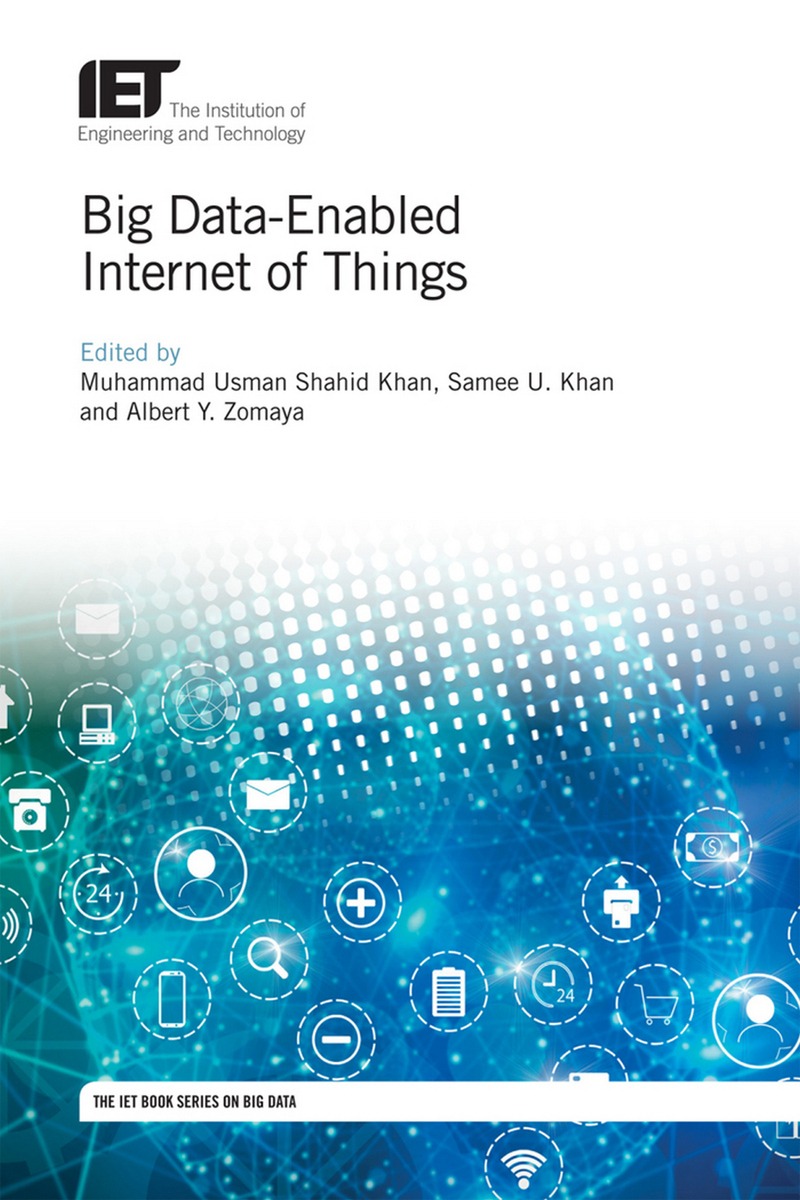
Big data-enabled internet of things
Covers analytical techniques for handling the huge amount of data generated by the Internet of Things, from architectures and platforms to security and privacy issues, applications, and challenges as well as future directions. The fields of Big Data and the Internet of Things (IoT) have seen tremendous advances, developments, and growth in recent years. The IoT is the inter-networking of connected smart devices, buildings, vehicles and other items which are embedded with electronics, software, sensors and actuators, and network connectivity that enable these objects to collect and exchange data. The IoT produces a lot of data. Big data describes very large and complex data sets that traditional data processing application software is inadequate to deal with, and the use of analytical methods to extract value from data. This edited book covers analytical techniques for handling the huge amount of data generated by the Internet of Things, from architectures and platforms to security and privacy issues, applications, and challenges as well as future directions.
Big Data in Context : Legal, Social and Technological Insights
Sheds new light on a selection of big data scenarios from an interdisciplinary perspective. It features legal, sociological and economic approaches to fundamental big data topics such as privacy, data quality and the ECJ’s Safe Harbor decision on the one hand, and practical applications such as smart cars, wearables and web tracking on the other. Addressing the interests of researchers and practitioners alike, it provides a comprehensive overview of and introduction to the emerging challenges regarding big data.All contributions are based on papers submitted in connection with ABIDA (Assessing Big Data), an interdisciplinary research project exploring the societal aspects of big data and funded by the German Federal Ministry of Education and Research.
Big Data and Global Trade Law
Explores the relevance of global trade law for data, big data and cross-border data flows. Contributing authors from different disciplines including law, economics and political science analyze developments at the World Trade Organization and in preferential trade venues by asking what future-oriented models for data governance are available and viable in the area of trade law and policy. The collection paints the broad picture of the interaction between digital technologies and trade regulation as well as provides in-depth analyses of critical to the data-driven economy issues, such as privacy and AI, and different countries' perspectives.

Autonomic and Trusted Computing ; 4th International Conference, ATC 2007, Hong Kong, China, July 11-13, 2007, Proceedings
To cope with the growing and ubiquitous complexity, autonomic computing (AC) focuses on se- manageable computing and communication systems that exhibit self-awareness, self-configuration, self-optimization, self-healing, self-protection and other self-x operations to the maximum extenteven without human interventionor guidance. Organiccomputing(OC)additionally emphasizes natural-analogueconceptslike self-organization and controlled emergence. Any autonomic ororganic system must be trus tworthy to avoid the risk of l- ing control and to retain confidence that the system will not fail. Trust and/or distrust relationships on the Internet and in pervasive infrastructures are key factors to enable dynamic interaction and cooperation of various users, systems and services. Trusted/trustworthy computing (TC) aims at making computing and communication systems as well as services available, predictable, traceable, controllable, assessable, sustainable, dependable, persist-able, security/privacy protect-able, etc.

Automotive software - connected services in mobile networks ; 1st Automotive software workshop, ASWSD 2004, San Diego, CA, USA, January 10-12, 2004, Revised Selected Papers
Software development for the automotive domain is currently subject to a silent revolution. On the one hand, software has become the enabling technology for almost all safety-critical and comfort functions o?ered to the customer. A total of 90 % of all innovations in automotive systems are directly or indirectly - abled by software. the following list highlights three of the corresponding challenges: First, the dependencies between safety-critical and comfort functions are rapidly increasing;a simple example is the interplay of airbag controland power seat control in the case of an accident. Careful analysis and design of these dependencies are necessary to yield correct software solutions. Second, advances in wired and wireless networking infrastructures enable - terconnection between cars and backend service providers .
Artificial intelligence-based Internet of things systems
Discusses the evolution of future generation technologies through Internet of Things (IoT) in the scope of Artificial Intelligence (AI). The main focus of this volume is to bring all the related technologies in a single platform, so that undergraduate and postgraduate students, researchers, academicians, and industry people can easily understand the AI algorithms, machine learning algorithms, and learning analytics in IoT-enabled technologies. This book uses data and network engineering and intelligent decision support system-by-design principles to design a reliable AI-enabled IoT ecosystem and to implement cyber-physical pervasive infrastructure solutions. This book brings together some of the top IoT-enabled AI experts throughout the world who contribute their knowledge regarding different IoT-based technology aspects. Addresses the complete functional framework workflow in AI-enabled IoT ecosystem; Presents intelligent object identification and object discovery through the IoT ecosystem and its implications to the real world ;Explores security and privacy issues and trustworthy machine learning related to data-intensive technologies in AI-based IoT ecosystems.
