



Page 8
Page 8

Computational Fluid Dynamics for Engineers
This book introduces a wide range of Computational Fluid Dynamics (CFD) methods used in the aerospace industry to solve engineering problems. Its format is arranged so that students and practicing engineers can understand the fundamental principles used in CFD, with sample computer programs for the solution of model problems. The emphasis is on two-dimensional equations in order to present the material in a modest sized book. Source codes for selected problems are given so that the reader can understand how those methods are implemented in FORTRAN and C languages, while exercises provide more hands-on experience.

Combinatorics of Coxeter Groups
Coxeter groups are of central importance in several areas of algebra, geometry, and combinatorics. This clear and rigorous exposition focuses on the combinatorial aspects of Coxeter groups, such as reduced expressions, partial order of group elements, enumeration, associated graphs and combinatorial cell complexes, and connections with combinatorial representation theory. While Coxeter groups have already been exposited from algebraic and geometric perspectives, this text is the first one to focus mainly on the combinatorial aspects of Coxeter groups. The first part of the book provides a self-contained introduction to combinatorial Coxeter group theory. The emphasis here is on the combinatorics of reduced decompositions, Bruhat order, weak order, and some aspects of root systems. The second part deals with more advanced topics, such as Kazhdan-Lusztig polynomials and representations, enumeration, and combinatorial descriptions of the classical finite and affine Weyl groups. A wide variety of exercises, ranging from easy to quite difficult are also included.

Combinatorial Optimization : Theory and Algorithms
Puts special emphasis on theoretical results and algorithms with provably good performance, in contrast to heuristics. It has arisen as the basis of several courses on combinatorial optimization and more special topics at graduate level. Since the complete book contains enough material for at least four semesters (4 hours a week), one usually selects material in a suitable way. The book contains complete but concise proofs, also for many deep results, some of which did not appear in a book before. Many very recent topics are covered as well, and many references are provided. Thus this book represents the state of the art of combinatorial optimization. This third edition contains a new chapter on facility location problems, an area which has been extremely active in the past few years. Furthermore there are several new sections and further material on various topics. New exercises and updates in the bibliography were added.

Combinatorial Commutative Algebra
Combinatorial commutative algebra is an active area of research with thriving connections to other fields of pure and applied mathematics. This book provides a self-contained introduction to the subject, with an emphasis on combinatorial techniques for multigraded polynomial rings, semigroup algebras, and determinantal rings. The eighteen chapters cover a broad spectrum of topics, ranging from homological invariants of monomial ideals and their polyhedral resolutions, to hands-on tools for studying algebraic varieties with group actions, such as toric varieties, flag varieties, quiver loci, and Hilbert schemes. Over 100 figures, 250 exercises, and pointers to the literature make this book appealing to both graduate students and researchers.
Cognitive engineering : A distributed approach to machine intelligence
Cognitive Engineering: A Distributed Approach to Machine Intelligence explores the design issues of intelligent engineering systems. Beginning with the foundations of psychological modeling of the human mind, the main emphasis is given to parallel and distributed realization of intelligent models for application in reasoning, learning, planning and multi-agent co-ordination problems. The last two chapters provide case studies on human-mood detection and control, and behavioral co-operation of mobile robots. This is the first comprehensive text of its kind, bridging the gap between Cognitive Science and Cognitive Systems Engineering. Each chapter includes plenty of numerical examples and exercises with sufficient hints, so that the reader can solve the exercises on their own. Computer simulations are also included in most chapters to give a clear idea about the application of the algorithms undertaken in the book. In addition, mathematical analysis on convergence and stability of the neuro-fuzzy models will enable the reader to pursue their research career in cognitive engineering.

Coercion and the State
A signal feature of legal and political institutions is that they exercise coercive power. The essays in this volume examine institutional coercion with the aim of trying to understand its nature, justification and limits. Included are essays that take a fresh look at perennial questions – what, if anything, can legitimate state exercises of coercive force? What is coercion in politics and law? – and essays that take a first or nearly first look at newer questions – may the state coercively hold certain terrorists indefinitely? Leading scholars from philosophy, political science and law examine these and related questions shedding new light on an apparently inescapable feature of political and legal life: Coercion.

Coding for Data and Computer Communications
In a unique, single volume, this highly versatile text/reference introduces readers to the importance of channel coding (error-correcting codes), secure coding (cryptography), and source coding (data compression). It is organized in three main parts and uses clear, nonmathematical explanations to develop the concepts, principles, and techniques in each area of coding. Requiring only a general familiarity with computer methods, the book deals with all aspects of coding and its relevance to fast, secure, and reliable data transmission and storage. Features & Benefits: Presents comprehensive coverage of areas of coding often found in separate books, and stresses data coding’s relevance in today’s world / Provides a wealth of examples and exercises (with solutions) to help readers easily grasp the material / Incorporates an extensive chapter on data hiding, a sparsely documented topic of increasing importance in the community / Includes an author-supplied website with supplementary material / Possesses a detailed bibliography and helpful glossary, index, and appendixes (including projects for self-study).

Matematica si parte! : Nozioni di base ed esercizi per il primo anno di Ingegneria = Mathematics, let's go! : Basics and exercises for the first year of Engineering
This manual has been created to allow future engineering students to successfully face their studies. Some basic concepts in mathematics are presented, generally already learned before entering the University. It has been found that not all students have a complete mastery of this set of fundamental notions: therefore this manual provides useful support, in the form of both exercises and theoretical notions. The future student will be able to choose the chapters that interest him most, in order to verify his ability to solve problems such as "Review problems", using his own reasoning skills and knowledge.
Mastering Scientific And Medical Writing
Intended for scientific and medical professionals and students who wish to improve their scientific writing skills. This book contains exercises that invite the reader to practice important aspects of scientific writing.

Martingales and financial mathematics in discrete time
This book is entirely devoted to discrete time and provides a detailed introduction to the construction of the rigorous mathematical tools required for the evaluation of options in financial markets. Both theoretical and practical aspects are explored through multiple examples and exercises, for which complete solutions are provided. Particular attention is paid to the Cox, Ross and Rubinstein model in discrete time.
Market-Conform Valuation of Options
we will investigate the 'market-conform' pricing of newly issued contingent claims. A contingent claim is a derivative whose value at any settlement date is determined by the value of one or more other underlying assets, e. g. , forwards, futures, plain-vanilla or exotic options with European or American-style exercise features. Market-conform pricing means that prices of existing actively traded securities are taken as given, and then the set of equivalent martingale measures that are consistent with the initial prices of the traded securities is derived using no-arbitrage arguments.

Make Your Own Map : Career Success Strategy for Women
This book shows you how to repurpose those methods for yourself, even if you're not in the corporate world. Packed with strategic tools and practical exercises, this book will help you: Assess and define your career goals / Make a plan / Implement your plan to find the work that fits your needs, your skills, and your direction.
Maîtriser laléatoire : Exercices résolus de probabilités et statistique = Mastering Randomness : Solved Exercises in Probability and Statistics
Consists of 245 solved exercises that cover all the basic concepts of probability and statistics. The work is structured in nine chapters, each containing a brief introduction, bibliographic references to more specialized works, as well as a series of exercises and their detailed solutions. Ranked in increasing order of difficulty, these will allow the reader to appreciate the extent of his progress. This book can be used as a supplement to any theory manual on statistics and probability. Due to the great diversity of the examples offered, it will suit a diverse readership: students of economics, psychology, social sciences, mathematics, physics, chemistry, medicine or biology.

Machine learning refined : Foundations, algorithms, and applications
Providing a unique approach to machine learning, this text contains fresh and intuitive, yet rigorous, descriptions of all fundamental concepts necessary to conduct research, build products, tinker, and play. By prioritizing geometric intuition, algorithmic thinking, and practical real world applications in disciplines including computer vision, natural language processing, economics, neuroscience, recommender systems, physics, and biology, this text provides readers with both a lucid understanding of foundational material as well as the practical tools needed to solve real-world problems. With in-depth Python and MATLAB/OCTAVE-based computational exercises and a complete treatment of cutting edge numerical optimization techniques, this is an essential resource for students and an ideal reference for researchers and practitioners working in machine learning, computer science, electrical engineering, signal processing, and numerical optimization
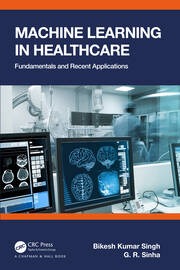
Machine learning in healthcare : Fundamentals and recent applications
Discusses how to build various ML algorithms and how they can be applied to improve healthcare systems. Healthcare applications of AI are innumerable: medical data analysis, early detection and diagnosis of disease, providing objective-based evidence to reduce human errors, curtailing inter- and intra-observer errors, risk identification and interventions for healthcare management, real-time health monitoring, assisting clinicians and patients for selecting appropriate medications, and evaluating drug responses. Extensive demonstrations and discussion on the various principles of machine learning and its application in healthcare is provided, along with solved examples and exercises.
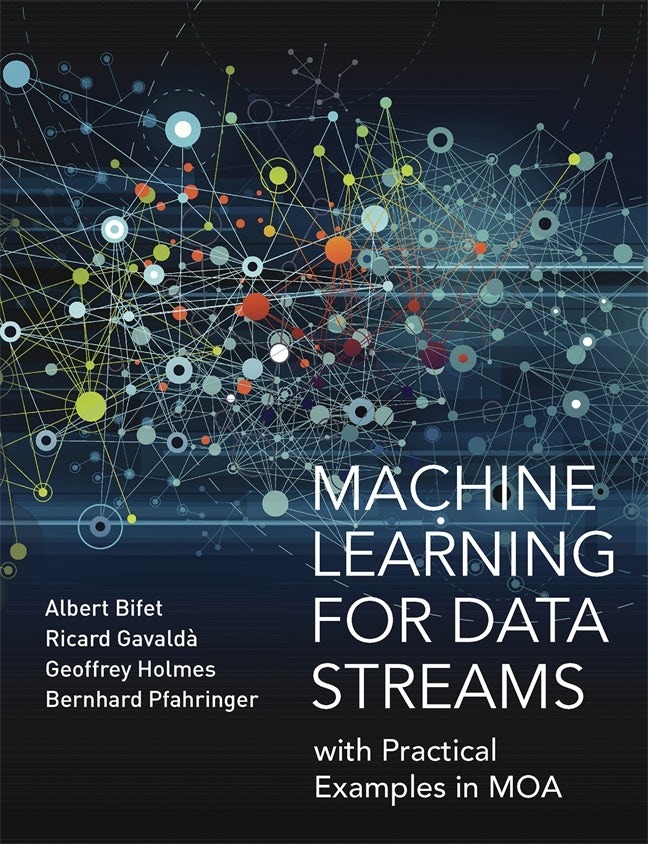
Machine learning for data streams : With practical examples in MOA
The book first offers a brief introduction to the topic, covering big data mining, basic methodologies for mining data streams, and a simple example of MOA. More detailed discussions follow, with chapters on sketching techniques, change, classification, ensemble methods, regression, clustering, and frequent pattern mining. Most of these chapters include exercises, an MOA-based lab session, or both. Finally, the book discusses the MOA software, covering the MOA graphical user interface, the command line, use of its API, and the development of new methods within MOA.
LRFD Bridge Design : Fundamentals and Applications
Examines and explains material from the 9th edition of the AASHTO LRFD Bridge Design Specifications, including deck and parapet design, load calculations, limit states and load combinations, concrete and steel I-girder design, bearing design, and more. With increased focus on earthquake resiliency, two separate chapters– one on conventional seismic design and the other on seismic isolation applied to bridges– will fully address this vital topic. The primary focus is on steel and concrete I-girder bridges, with regard to both superstructure and substructure design. / Includes several worked examples for a project bridge as well as actual bridges designed by the author / Examines seismic design concepts and design details for bridges / Presents the latest material based on the 9th edition of the LRFD Bridge Design Specifications / Covers fatigue, strength, service, and extreme event limit states / Includes numerous solved problems and exercises at the end of each chapter to illustrate the concepts presented
Logic Programming with Prolog
Logic Programming is the name given to a distinctive style of programming, very different from that of conventional programming languages such as C++ and Java. By far the most widely used Logic Programming language is Prolog. Prolog is a good choice for developing complex applications, especially in the field of Artificial Intelligence. This book does not assume that the reader is an experienced programmer or has a background in Mathematics, Logic or Artificial Intelligence. It starts from scratch and aims to arrive at the point where quite powerful programs can be written in the language. It is intended both as a textbook for an introductory course and as a self-study book. On completion the reader will know enough to use Prolog in their own research or practical projects. Each chapter has self-assessment exercises so that the reader may check their own progress. A glossary of the technical terms used completes the book.
Logic for Computer Scientists
This book introduces the notions and methods of formal logic from a computer science standpoint, covering propositional logic, predicate logic, and foundations of logic programming. It presents applications and themes of computer science research such as resolution, automated deduction, and logic programming in a rigorous but readable way.The style and scope of the work, rounded out by the inclusion of exercises, make this an excellent textbook for an advanced undergraduate course in logic for computer scientists.
Linear Differential Equations and Group Theory from Riemann to Poincaré
A study of how a particular vision of the unity of mathematics, often called geometric function theory, was created in the 19th century. The central focus is on the convergence of three mathematical topics: the hypergeometric and related linear differential equations, group theory, and on-Euclidean geometry. The text for this second edition has been greatly expanded and revised, and the existing appendices enriched with historical accounts of the Riemann–Hilbert problem, the uniformization theorem, Picard–Vessiot theory, and the hypergeometric equation in higher dimensions. The exercises have been retained, making it possible to use the book as a companion to mathematics courses at the graduate level.
