



Page 7
Page 7

Integral Methods in Science and Engineering : Techniques and Applications
The physical world is studied by means of mathematical models, which consist of differential, integral, and integro-differential equations accompanied by a large assortment of initial and boundary conditions. In certain circumstances, such models yield exact analytic solutions. When they do not, they are solved numerically by means of various approximation schemes. Whether analytic or numerical, these solutions share a common feature: they are constructed by means of the powerful tool of integration—the focus of this self-contained book. This work illustrates the application of integral methods to diverse problems in mathematics, physics, biology, and engineering. The thirty two chapters of the book, written by scientists with established credentials in their fields, contain state-of-the-art information on current research in a variety of important practical disciplines.

Integral Foam Molding of Light Metals : Technology, Foam Physics and Foam Simulation
This book shows in three parts the technology, the fundamentals and the simulation models for the Integral Foam Molding of Light Metals Part I: “Technology” shows for the first time that foaming of metals is possible by applying molding techniques very similar to polymer integral foam molding. Part II: “Physics” is devoted to the physics of foaming with special emphasis on the very short time scale which is characteristic for integral foam molding. Part III: “Numerical Simulation” presents a new lattice Boltzmann approach for the treatment of free surfaces is developed and applied on foam evolution problems. For the first time, the numerical simulation of foam evolution starting from nucleation until decay is accessible.

Integral closure : Rees algebras, multiplicities, algorithms
Integral Closure gives an account of theoretical and algorithmic developments on the integral closure of algebraic structures. These are shared concerns in commutative algebra, algebraic geometry, number theory and the computational aspects of these fields. The overall goal is to determine and analyze the equations of the assemblages of the set of solutions that arise under various processes and algorithms. It gives a comprehensive treatment of Rees algebras and multiplicity theory - while pointing to applications in many other problem areas. Its main goal is to provide complexity estimates by tracking numerically invariants of the structures that may occur.

Integral bridges : a fundamental approach to the time–temperature loading problem
In recent years, integral bridges have become increasingly popular in the UK. The Highways Agency standard now requires, where possible, that all new bridges with a length of less than sixty metres should be of integral form. In addition, it has been found that, due especially to the problems and costs associated with failed expansion joints, integral bridges are not only cost effective but also have a longer lifespan. Integral Bridges was commissioned by the Highways Agency to produce guidance for bridge designers by addressing the thermally induced soil/structure interaction problem created by environmental changes of temperature and the associated cyclical displacements imposed on the granular backfill to the bridge abutments. It develops a better theoretical understanding of the cyclic performance, in particular the strain racheting in the backfill soil when in contact with a stiff structure. It also identifies the governing soil parameters and examines their influence in the interaction problem, develops numerical modelling procedures to predict interactive soil behaviour, and identifies and quantifies the controlling features of bridge structures relevant to the interaction problem.

Integer programming and combinatorial optimization ; 13th International Conference, IPCO 2008 Bertinoro, Italy, May 26-28, 2008 Proceedings
The volume contains the papers selected for presentation at IPCO 2008, the 13th International Conference on Integer Programming and Combinatorial - timization that was held in Bertinoro (Italy), May 26–28, 2008. The IPCO series of conferences, sponsored by the Mathematical Progr- ming Society, highlights recent developments in theory, computation, and app- cation of integer programming and combinatorial optimization. The frst conf- ence took place in 1990; starting from IPCO 1995, the proceedings are published in the Lecture Notes in Computer Science series. The 12 previous IPCO conferences were held in Waterloo (Canada) 1990.

Instability in Models Connected with Fluid Flows II
Instability in Models Connected with Fluid Flows II presents chapters from world renowned specialists. The stability of mathematical models simulating physical processes is discussed in topics on control theory, first order linear and nonlinear equations, water waves, free boundary problems, large time asymptotics of solutions, stochastic equations, Euler equations, Navier-Stokes equations, and other PDEs of fluid mechanics. Fields covered include: the free surface Euler (or water-wave) equations, the Cauchy problem for transport equations, irreducible Chapman--Enskog projections and Navier-Stokes approximations, randomly forced PDEs, stability of equilibrium figures of uniformly rotating viscous incompressible liquid, Navier-Stokes equations in cylindrical domains, Navier-Stokes-Poisson flows in a vacuum.

Information Processing with Evolutionary Algorithms : From Industrial Applications to Academic Speculations
The last decade of the 20th century has witnessed a surge of interest in num- ical, computation-intensive approaches to information processing. The lines that draw the boundaries among statistics, optimization, arti cial intelligence and information processing are disappearing, and it is not uncommon to nd well-founded and sophisticated mathematical approaches in application - mains traditionally associated with ad-hoc programming. Heuristics has - come a branch of optimization and statistics. Clustering is applied to analyze soft data and to provide fast indexing in the World Wide Web. Non-trivial matrix algebra is at the heart of the last advances in computer vision. The breakthrough impulse was, apparently, due to the rise of the interest in arti cial neural networks, after its rediscovery in the late 1980s. Disguised as ANN, numerical and statistical methods made an appearance in the - formation processing scene, and others followed. A key component in many intelligent computational processing is the search for an optimal value of some function. Sometimes, this function is not evident and it must be made explicit in order to formulate the problem as an optimization problem. The search - ten takes place in high-dimensional spaces that can be either discrete, or c- tinuous or mixed. The shape of the high-dimensional surface that corresponds to the optimized function is usually very complex. Evolutionary algorithms are increasingly being applied to information processing applications that require any kind of optimization.

Infinite matrices and their finite sections : An introduction to the limit operator method
In this book we are concerned with the study of a certain class of infinite matrices and two important properties of them: their Fredholmness and the stability of the approximation by their finite truncations. Let us take these two properties as a starting point for the big picture that shall be presented in what follows. Stability Fredholmness We think of our infinite matrices as bounded linear operators on a Banach space E of two-sided infinite sequences.The class of operators we are interested in consists of those bounded and linear operatorson E which can be approximated in the operator norm by b and matrices. We refer to them as band-dominated operators. Of course, these considerations 2 are not limited to the space E = . We will widen the selection of the underlying space E in three directions: p

Implementing Models in Quantitative Finance : Methods and Cases
This book puts numerical methods into action for the purpose of solving concrete problems arising in quantitative finance. Part one develops a comprehensive toolkit including Monte Carlo simulation, numerical schemes for partial differential equations, stochastic optimization in discrete time, copula functions, transform-based methods and quadrature techniques. The content originates from class notes written for courses on numerical methods for finance and exotic derivative pricing held by the authors at Bocconi University since the year 2000. Part two proposes eighteen self-contained cases covering model simulation, derivative valuation, dynamic hedging, portfolio selection, risk management, statistical estimation and model calibration. It encompasses a wide variety of problems arising in markets for equity, interest rates, credit risk, energy and exotic derivatives.

Hyperbolic Problems : Theory, Numerics, Applications ; Proceedings of the Eleventh International Conference on Hyperbolic Problems held in Ecole Normale Supérieure, Lyon, July 17-21, 2006
This volume contains papers that were presented at HYP2006, the eleventh international Conference on Hyperbolic Problems: Theory, Numerics and Applications held at the Ecole Normale Supérieure de Lyon, France, July 17-21, 2006. This biennial series of conferences has become one of the most important international events in Applied Mathematics. As computers became more and more powerful, the interplay between theory, modelling, and numerical algorithms gained considerable impact, and the scope of HYP conferences expanded accordingly. The field is currently in interaction with a variety of scientific domains, including fluid dynamics, physics, electromagnetism, chemistry, biology, road and network traffic, and engineering. Many of these papers present new effective numerical methods and their application in various contexts.

Hot cracking phenomena in welds
The first chapter provides an overview of the various hot cracking phenomena. Different mechanisms of solidification cracking proposed in the past decades are summarized and new insight is particularly given into the mechanism of ductility dip cracking. The effects of different alloying elements on the hot cracking resistance of various materials are shown in the second chapter and, as a special metallurgical effect, the initiation of stress corrosion cracking at hot cracks has been highlighted. The third chapter outlines how numerical analyses and other modelling techniques can be utilized to describe hot cracking phenomena and how such results might contribute to the explanation of the mechanisms. Various hot cracking test procedures are presented in the final chapter with a special emphasis on standardization. For the engineering and natural scientists in research and development the book provides both, new insight and a comprehensive overview of hot cracking phenomena in welds. The contributions additionally give numerous individual solutions and helpful advice for international welding engineers to avoid hot cracking in practice. Furthermore, it represents a very helpful tool for upper level metallurgical and mechanical engineering students.

High resolution numerical modelling of the atmosphere and ocean
This book includes 15 individual papers that highlight the emerging research in atmospheric and oceanic science that has been made possible by exploiting newly available computational resources. Results from regional atmospheric, global atmospheric, global ocean, and global coupled ocean-atmosphere models are discussed in the various contributions.

High Performance Tensegrity-Inspired Metamaterials and Structures
New metamaterials, smart materials and structures, and adaptive systems with adjustable behaviour or which use high performance or 'extremal' materials can be applied to bigger structural systems, such as cellular tensegrity lattices with extremal mechanical properties. Numerical analyses justify tensegrities and discrete and continuum models offer two main approaches to the analysis of tensegrity-based mechanical metamaterials and lattices. Two examples of 2D and 3D tensegrity modules and lattices, and potential applications in civil engineering are presented.

High performance computing on vector systems 2007 ; Conference proceedings
The following book presents contributions from the 6th TERAFLOP Workshop which was hosted by Tohoku University in Sendai, Japan in Autumn 2006 and the 7th Workshop in Stuttgart which was held in spring 2007 in Stuttgart. Focus is layed on current applications and future requirements, as well as developments of next generation hardware architectures and installations. The papers presented in this book lay out the wide range of fields in which sustained performance can be achieved if engineering knowledge, numerical mathematics and computer science skills are brought together. With the advent of hybrid systems, the Teraflop workbench project will continue the support of leading edge computations for future applications.
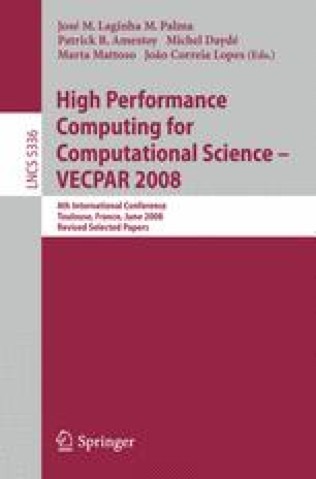
High performance computing for computational science - VECPAR 2008 ; 8th International Conference, Toulouse, France, June 24-27, 2008. Revised Selected Papers
This book constitutes the thoroughly refereed post-conference proceedings of the 8th International Conference on High Performance Computing for Computational Science, VECPAR 2008, held in Toulouse, France, in June 2008.The 51 revised full papers presented together with the abstract of a surveying and look-ahead talk were carefully reviewed and selected from 73 submissions. The papers are organized in topical sections on parallel and distributed computing, cluster and grid computing, problem solving environment and data centric, numerical methods, linear algebra, computing in geosciences and biosciences, imaging and graphics.

High performance computing for computational science - VECPAR 2006 ; 7th International Conference, Rio de Janeiro, Brazil, June 10-13, 2006, Revised Selected and Invited Papers
This book constitutes the thoroughly refereed post-proceedings of the 7th International Conference on High Performance Computing for Computational Science, VECPAR 2006, held in Rio de Janeiro, Brazil, in June 2006.

High Energy Polarized Proton Beams : A Modern View
This monograph begins with a review of the basic equations of spin motion in particle accelerators. It then reviews how polarized protons can be accelerated to several tens of GeV using as examples the preaccelerators of HERA, a 6.3 km long cyclic accelerator at DESY / Hamburg. Such techniques have already been used at the AGS of BNL / New York, to accelerate polarized protons to 25 GeV. But for acceleration to energies of several hundred GeV as in RHIC, TEVATRON, HERA, LHC, or a VLHC, new problems can occur which can lead to a significantly diminished beam polarization. For these high energies, it is necessary to look in more detail at the spin motion, and for that the invariant spin field has proved to be a useful tool. This is already widely used for the description of high-energy electron beams that become polarized by the emission of spin-flip synchrotron radiation. It is shown that this field gives rise to an adiabatic invariant of spin-orbit motion and that it defines the maximum time average polarization available to a particle physics experiment.

Hierarchical Matrices : A Means to Efficiently Solve Elliptic Boundary Value Problems
Hierarchical matrices are an efficient framework for large-scale fully populated matrices arising, e.g., from the finite element discretization of solution operators of elliptic boundary value problems. In addition to storing such matrices, approximations of the usual matrix operations can be computed with logarithmic-linear complexity, which can be exploited to setup approximate preconditioners in an efficient and convenient way. Besides the algorithmic aspects of hierarchical matrices, the main aim of this book is to present their theoretical background. The book contains the existing approximation theory for elliptic problems including partial differential operators with nonsmooth coefficients.

Hemodynamical Flows : Modeling, Analysis and Simulation
This book surveys research results on the physical and mathematical modeling, as well as the numerical simulation of complex fluid and structural mechanical processes occurring in the human blood circulation system. Topics treated include continuum mechanical description; choice of suitable liquid and wall models; mathematical analysis of coupled models; numerical methods for flow simulation; parameter identification and model calibration; fluid-solid interaction; mathematical analysis of piping systems; particle transport in channels and pipes; artificial boundary conditions, and many more.

Handbook of ocean wave energy
This book offers a concise, practice-oriented reference-guide to the field of ocean wave energy. The ten chapters highlight the key rules of thumb, address all the main technical engineering aspects and describe in detail all the key aspects to be considered in the techno-economic assessment of wave energy converters. Written in an easy-to-understand style, the book answers questions relevant to readers of different backgrounds, from developers, private and public investors, to students and researchers. It is thereby a valuable resource for both newcomers and experienced practitioners in the wave energy sector.
