



Page 61
Page 61

Privacy Preserving Data Mining
Data mining has emerged as a significant technology for gaining knowledge from vast quantities of data. However, concerns are growing that use of this technology can violate individual privacy. These concerns have led to a backlash against the technology, for example, a "Data-Mining Moratorium Act" introduced in the U.S. Senate that would have banned all data-mining programs (including research and development) by the U.S. Department of Defense. Privacy Preserving Data Mining provides a comprehensive overview of available approaches, techniques and open problems in privacy preserving data mining. This book demonstrates how these approaches can achieve data mining, while operating within legal and commercial restrictions that forbid release of data. Furthermore, this research crystallizes much of the underlying foundation, and inspires further research in the area.

Privacy in Statistical Databases; CENEX-SDC Project International Conference, PSD 2006, Rome, Italy, December 13-15, 2006, Proceedings
Privacy in statistical databases is a discipline whose purpose is to provide - lutions to the con?ict between the increasing social, political and economical demand of accurate information, and the legal and ethical obligation to protect the privacy of the individuals and enterprises to which statistical data refer. - yond law and ethics, there are also practical reasons for statistical agencies and data collectors to invest in this topic: if individual and corporate respondents feel their privacyguaranteed,they arelikelyto providemoreaccurateresponses.

Privacy in Statistical Databases ; UNESCO Chair in Data Privacy International Conference, PSD 2008, Istanbul, Turkey, September 24-26, 2008. Proceedings
Constitutes the refereed proceedings of the International Conference on Privacy in Statistical Databases, PSD 2008, held in September 2008 in Istanbul, Turkey, under the sponsorship of the UNESCO chair in Data Privacy.The 27 revised full papers presented were carefully reviewed and selected from 37 submissions. The papers are organized in topical sections on tabular data protection; microdata protection; online databases and remote access; privacy-preserving data mining and private information retrieval; and legal issues.

Privacy Enhancing Technologies ; Vol. 4258 ; 6th International Workshop, PET 2006, Cambridge, UK, June 28-30, 2006, Revised Selected Papers
The papers in this volume represent the proceedings of The 6th Workshop on Privacy Enhancing Technologies, PET 2006, was heldat Robinson College, Cambridge (UK), on June 28–30, 2006. The workshopreceived 91 full paper submissions out ofwhich 24 were selected for presentation

Privacy Enhancing Technologies ; Vol. 3856 ; 5th International Workshop, PET 2005, Cavtat, Croatia, May 30 - June 1, 2005, Revised Selected Papers
The papers in this volume represent the proceedings of the 5th International Workshop, PET 2005, Cavtat, Croatia, May 30-June 1, 2005, Revised Selected Papers on Privacy-Enhancing Technologies , which is now established asa yearly event. The workshop received 74 full paper submissions out of which 17papers were ultimately selected to be presented.

Privacy Enhancing Technologies ; Vol. 3424 : 4th International Workshop, PET 2004, Toronto, Canada, May 26-28, 2004, Revised Selected Papers
Traditional methods for evaluating the amount of anonymity afforded by various Mix configurations have depended on either measuring the size of the set of possible senders of a particular message (the anonymity set size), or by measuring the entropy associated with the probability distribution of the messages possible senders. This paper explores further an alternative way of assessing the anonymity of a Mix system by considering the capacity of a covert channel from a sender behind the Mix to an observer of the Mix’s output. Initial work considered a simple model [4], with an observer (Eve) restricted to counting the number of messages leaving a Mix configured as a firewall guarding an enclave with one malicious sender (Alice) and some other naive senders (Cluelessi’s). Here, we consider the case where Eve can distinguish between multiple destinations, and the senders can select to which destination their message (if any) is sent each clock tick.

Privacy Enhancing Technologies ; 8th International Symposium, PETS 2008 Leuven, Belgium, July 23-25, 2008 Proceedings
Constitutes the thoroughly refereed post-proceedings of the 8th International Symposium on Privacy Enhancing Technologies, PET 2008, held in Leuven, Belgium, in July 2008 in conjunction with WOTE 2008, the IAVoSS Workshop on Trustworthy Elections.The 13 revised full papers presented were carefully selected from 48 submissions during two rounds of reviewing and improvement. The papers - both from academia and industry - cover design and realization of privacy services for the internet and other communication networks and present novel research on all theoretical and practical aspects of privacy technologies, as well as experimental studies of fielded systems.

Privacy Enhancing Technologies ; 7th International Symposium, PET 2007 Ottawa, Canada, June 20-22, 2007 Revised Selected Papers
This book constitutes the thoroughly refereed post-proceedings of the 7th International Symposium on Privacy Enhancing Technologies, PET 2007, held in Ottawa, Canada, in June 2007. The papers cover design and realization of privacy services for the internet and other communication networks and present novel research on all theoretical and practical aspects of privacy technologies, as well as experimental studies of fielded systems.

Privacy and Technologies of Identity : A Cross-Disciplinary Conversation
Privacy and Technologies of Identity: A Cross-Disciplinary Conversation provides an overview of ways in which technological changes raise privacy concerns. It then addresses four major areas of technology: RFID and location tracking technology; biometric technology, data mining; and issues with anonymity and authentication of identity. Many of the chapters are written with the non-specialist in mind, seeking to educate a diverse audience on the "basics" of the technology and the law and to point out the promise and perils of each technology for privacy. The material in this book provides an interface between legal and policy approaches to privacy and technologies that either threaten or enhance privacy.

Privacy and Data Protection in Software Services
The aim of the book is to create a bridge between two ‘lands’ that are usually kept separate: technical tools and legal rules should be bound together for moulding a special ‘toolbox’ to solve present and future issues. The volume is intended to contribute to this ‘toolbox’ in the area of software services, while addressing how to make legal studies work closely with engineers’ and computer scientists’ fields of expertise, who are increasingly involved in tangled choices on daily programming and software development. In this respect, law has not lost its importance and its own categories in the digital world, but as well as any social science needs to experience a new realistic approach amid technological development and individuals’ fundamental rights and freedoms.

Principles, Systems and Applications of IP Telecommunications. Services and Security for Next Generation Networks ; 2nd International Conference, IPTComm 2008, Heidelberg, Germany, July 1-2, 2008. Revised Selected Papers
This book constitutes the thoroughly refereed proceedings of the 10th International Workshop on Principles, Systems and Applications of IP Telecommunications, held in Heidelberg, Germany, in July 2008.The 16 full papers presented were carefully reviewed and selected from a total of 56 submissions. Topics covered include recent advances in the domains of convergent networks, VoIP security, and multimedia service environments for next generation networks.

Principles of the Spin Model Checker
Principles of Spin is an introductory book for students and practicing software engineers who wish to learn Promela and Spin. The presentation starts with the verification of sequential programs and proceeds in gradual stages to the verification of concurrent and then distributed programs. Complete programs are used to demonstrate each construct and concept, and the source code of these programs, together with that of longer case studies, are available on the companion website.The book describes free software that the author has developed: jSpin—an integrated development environment for Spin, SpinSpider.

Principles of statistics for engineers and scientists
Emphasizes statistical methods and how they can be applied to problems in science and engineering. The book contains many examples that feature real, contemporary data sets, both to motivate students and to show connections to industry and scientific research. Because statistical analyses are done on computers, the book contains exercises and examples that involve interpreting, as well as generating, computer output.

Principles of Security and Trust ; 8th International Conference, POST 2019, Held as Part of the European Joint Conferences on Theory and Practice of Software, ETAPS 2019, Prague, Czech Republic, April 6–11, 2019, Proceedings
This book presented in this volume were carefully reviewed and selected from 27 submissions. They deal with theoretical and foundational aspects of security and trust, including on new theoretical results, practical applications of existing foundational ideas, and innovative approaches stimulated by pressing practical problems.

Principles of Security and Trust ; 7th International Conference, POST 2018, Held as Part of the European Joint Conferences on Theory and Practice of Software, ETAPS 2018, Thessaloniki, Greece, April 14-20, 2018, Proceedings
Contains the papers presented at POST 2018, the 7th Conference on Principles of Security and Trust, held April 16–17, 2018, in Thessaloniki, Greece, as part of ETAPS. Principles of Security and Trust is a broad forum related to all theo-retical and foundational aspects of security and trust.

Principles of Protocol Design
Introduces the reader to the principles used in the construction of a large range of modern data communication protocols. The approach we take is rather a formal one, primarily based on descriptions of protocols in the notation of CSP. This not only enables us to describe protocols in a concise manner, but also to reason about many of their interesting properties and formally to prove certain aspects of their correctness with respect to appropriate speci?cations. Only after considering the main principles do we go on to consider actual protocols where these principles are exploited.

Principles of Mobile Communication
Features new content on 4G cellular systems, 5G cellular outlook, bandpass signals and systems, and polarization, among many other topics, in addition to a new chapters on channel assignment techniques. Along with coverage of fundamentals and basic principles sufficient for novice students, the volume includes finer details that satisfy the requirements of graduate students aiming to conduct in-depth research. The book begins with a survey of the field, introducing issues relevant to wireless communications. The book moves on to cover relevant discrete subjects, from radio propagation, to error probability performance, and cellular radio resource management. An appendix provides a tutorial on probability and random processes.
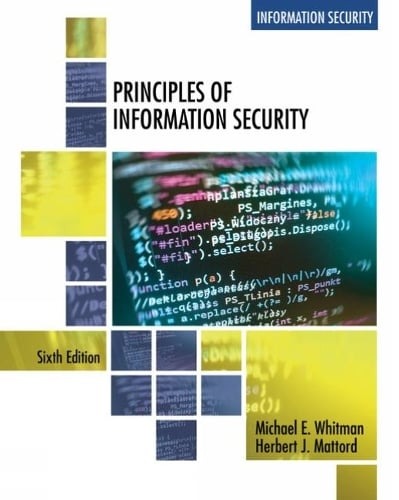
Principles of information security
Emphasizes all aspects of information security, rather than just a technical control perspective. You receive a broad overview of the entire field of information security and related elements with the detail to ensure understanding. You review terms used in the field and a history of the discipline as you learn how to manage an information security program. Current and relevant, this edition highlights the latest practices with fresh examples that explore the impact of emerging technologies, such as the Internet of Things, Cloud Computing, and DevOps. Updates address technical security controls, emerging legislative issues, digital forensics, and ethical issues in IS security, making this the ideal IS resource for business decision makers

Principles of hyperplasticity : An approach to plasticity theory based on thermodynamic principles
Principles of Hyperplasticity is concerned with the theoretical modelling of the behaviour of solids which undergo nonlinear and irreversible deformation. The approach to plasticity theory developed here is firmly rooted in thermodynamics, so that the models developed are guaranteed to obey the First and Second Laws. Major emphasis is placed on the use of potentials, and the derivation of constitutive models for irreversible behaviour entirely from two scalar potentials is shown. It is to accentuate this feature that the authors use the term "hyperplasticity", by analogy with the use of "hyperelasticity" in elasticity theory.

Principles of Distributed Systems ; Vol. 4305 ; 10th International Conference, OPODIS 2006, Bordeaux, France, December 12-15, 2006, Proceedings
This book constitutes the refereed proceedings of the 10th International Conference on Principles of Distributed Systems, OPODIS 2006, held at Bordeaux, France, in December 2006.
